While Kimberley Process Certification Scheme figures for 2015 showed that Russia is by far the world's largest diamond producer and Botswana in second place, they also show that Canada continues to consolidate its position as the world's third-largest producer by value. And as world diamond production drops, Canadian firms are competing to make up the shortfall. In production terms, Canada is actually fourth, but it is behind the Republic of Congo (RoC) which had production of more than 16 million carats worth just $132.5 million compared with Canada's 11.667 million carats worth $1.68 billion. Most of the RoC's output is of diamonds that are used for industrial use.
Canada's leading position is all the more surprising given that diamond-rich areas weren't discovered in the country until the early 1990s. Before that time, diamond mining and production in Canada had hardly existed. Canada owes its number three ranking up to now to just one region of the country: the Northwest Territories, and Lac de Gras in particular, the location of three large diamond-producing mines, and soon a fourth when a joint venture between De Beers Canada and Mountain Province Diamonds takes off.
Of the three Lac de Gras mines, Dominion Diamond Corporation’s majority-held Ekati has about five years left of life expectancy, although development of the Jay deposit could potentially add another 11 years. Ekati was the first major discovery and has so far produced in excess of 40 million carats.
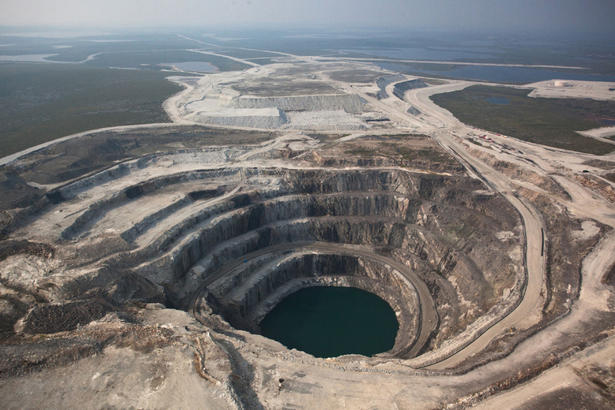
Ekati Diamond Mine
Meanwhile, Diavik, a 60/40 Rio Tinto-Dominion joint venture, could last to 2023 with the addition of a fourth pipe. The mine is currently undergoing a transitional shift from open pit to underground mining, and the life span of the mine is expected to be 16 to 22 years from its opening in 2003.
De Beers last year closed down its Snap Lake mine which had been posited as lasting to 2028. Some analysts said it had never been profitable and questioned why De Beer sank so much money into it in the first place. Snap Lake was De Beers' first mine outside of Africa. It was also unique for being Canada’s first completely underground mine. De Beers spent nearly $900 million with local contractors and suppliers building the mine.
A fourth Lac de Gras operation, destined to become “the world’s largest and richest new diamond mine,” remains on track for production to commence in the second half of this year. Mountain Province Diamonds and joint venture partner De Beers expect Gahcho Kué to produce an annual average 4.5 million carats over a dozen years. De Beers Canada owns 51 percent of the venture, with Mountain Province owning the rest.
Then there is Kennady Diamonds Inc. which controls 100 percent of the Kennady North diamond project located in the Northwest Territories. Kennady North is immediately to the north and west of the Gahcho Kué mine. Kennady Diamonds aims to identify a resource along the Kelvin-Faraday kimberlite corridor of between 12 and 15 million tonnes at a grade of between 2 and 2.5 carats per tonne and also to identify new kimberlites outside of the corridor. The Kelvin-Faraday corridor is a target for further exploration. The tonnage estimate is based on the drilling completed to date. The potential quantity is conceptual in nature as there has been insufficient drilling to define a mineral resource and it is uncertain if further exploration will result in the target being delineated as a mineral resource.
Meanwhile, Arctic Star Exploration has announced plans to explore its 54,000-hectare T-Rex property in Lac de Gras. Previous exploration has found over a dozen kimberlites, most of them diamondiferous, the company says.
Further afield, Ontario’s only diamond mine, De Beers’ Victor operation, faces depletion in 2018. The company hopes to postpone this by developing the Tango kimberlite, a smaller, lower-grade deposit seven kilometers northwest. Victor is an open pit mine and is currently producing 600,000 carats per year of rough diamond stones.
Meanwhile, in Quebec, Stornoway Diamond has operations scheduled to begin at its Renard operation late this year and commercial production slated for the second quarter of 2017. The diamond mine would be the first and only such diamond project in the province. Although potential resource expansion continues, the company estimates Renard will supply 1.6 million carats annually for 11 years, providing about 2 percent of global supply.
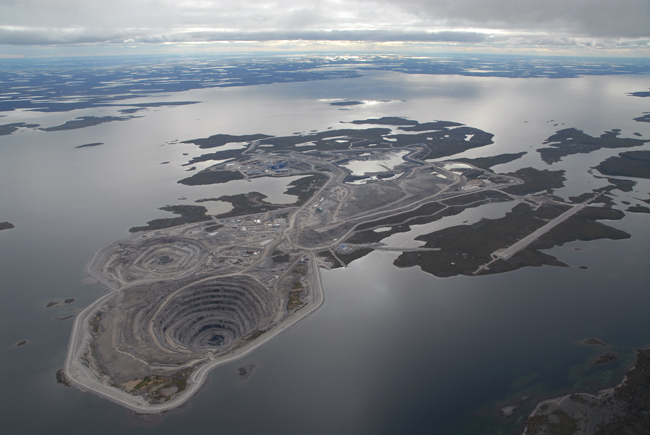
Diavik Diamond Mine
In other diamond mining developments, Zimtu Capital announced last year that exploration had begun on the Munn Lake project in the Northwest Territories held by the company and a partner, thus becoming the area's most recent entry. The 14,000-hectare area has not yet undergone modern exploration despite about $5.7 million of work being carried between 1996 and 2007 that found two diamondiferous kimberlites. Zimtu now has a crew sampling kimberlites to validate previous sampling and provide additional insight into the diamondiferous potential of each area, the company said.
Meanwhile, Canterra Minerals, with an area of more than 97,000 hectares of Lac de Gras, reported in June that it has identified several areas that “warrant further detailed exploration, including drilling,” along with other areas that could undergo till sampling and geophysics.
And in 2015, Margaret Lake Diamonds announced an agreement to acquire the remaining 40 percent interest in the Margaret Lake property, giving the company sole ownership. The company anticipates a winter drill program to test targets identified by last year’s airborne gravity survey. The 19,716-hectare property lies contiguous to the north and west of Kennady Diamonds’ Kennady North project, the region’s most advanced project other than the Gahcho Kué mine-to-be, which Kennady surrounds on three sides.
The Canadian diamond industry has placed a great deal of emphasis on its diamonds not having any association with conflict diamonds from Africa. Indeed, Canada was careful to become one of the main supporters of the Kimberley Process. All diamonds mined and cut in the Northwest Territories are laser inscribed with a unique identification number so that retailers can assure they are conflict-free stones. In addition, all Canadian diamond mines are overseen by the Canada Mining Regulations for the Northwest Territories. This program ensures the preservation of surrounding land and aquatic habitats.
The future for the Canadian diamond mining industry? Clearly, it will likely remain the third-largest producer for years to come. Although mining conditions are exceptionally difficult and explorations costs very high, many explorers are said to feel more comfortable working in a country with a strong democracy and rule of law than in some other states where those two elements are more talked about than put into practice.
By our Israel correspondent Abraham Dayan
