The Moscow Kremlin Museums hosted an exhibition displaying a unique collection of the Art Deco era - women's clothing from the Kyoto Costume Institute, adornments dating back to 1910-1930 produced by famous jewelry houses Cartier and Van Cleef & Arpels, as well as original sketches and photographs from the archives.
The era of Art Deco is a bright cultural phenomenon of the 20th century combining the features of the European classic design and modernism, Asian cultures and ancient civilizations, folk traditions and technical progress, which has kept its uniqueness and relevance of being a truly golden age in the history of fashion, the last great European style.
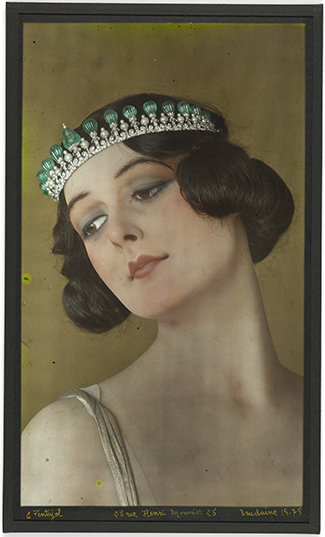 The exhibition named “Elegance and Splendour of Art Deco. The Kyoto Costume Institute, Jewelry Houses Cartier and Van Cleef & Arpels” includes 119 items of clothing, 60 jewelry pieces and 20 original sketches and photographs. The Kyoto Costume Institute, which granted a collection of clothes, is one of the four best fashion museums in the world. These exhibits have never left Japan and have been specially restored for this project featuring evening, cocktail and dance dresses and coats, as well as accessories related to the era familiar to a wide audience from such film adaptations as "The Great Gatsby" and TV series "Downton Abbey."
The Japanese are well-known aesthetes, and in their Kyoto they gathered a rare collection of feminine dresses and accessories from European houses of haute couture and famous designers, such as Chanel, Poiret, Lanven, Fortuny and others.
Elegant ladies' dresses are presented in a single ensemble with luxurious jewelry from the jewelry houses of Cartier and Van Cleef & Arpels – many samples made in the early Art Deco style, as well as extravagant adornments of a later period.
Jewelry exhibitions in the Moscow Kremlin Museums are rare, but always to the point, and as usual, not just demonstrating status and prestige, but also presenting a high aesthetic value.
One can see there a vivid image of the Art Deco era, which is the diadem-bandeau (a jeweled hair bandage) by Cartier graced with pearls and diamonds of the old cut, harmoniously complementing the black dress of valuable charmeuse introduced by Coco Chanel into fashion.
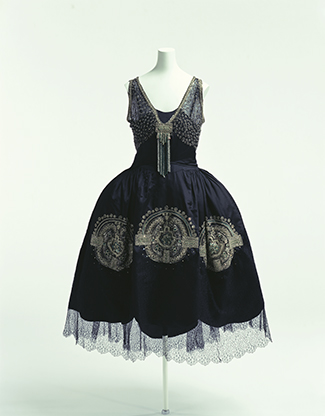 "Now it seems that there is nothing more natural than to exhibit dresses and jewelry together. Meanwhile, a hundred years ago, such an approach could be viewed as almost revolutionary by organizers," Elena Gagarina, Director of the Moscow Kremlin Museums said.
"Art Deco became a revolution. It was freedom itself, a flight of fancy, but at the same time this style was the evidence of emerging interest towards folk costumes and ancient traditions,” Naoko Tsutsui, Associate Curator of the Kyoto Costume Institute said.
"The finest dresses are only seemingly so vulnerable,” Larisa Peshekhonova, the curator of the exhibition said. “These weightless fabrics would not crinkle under the weight of huge, like the shield of Achilles, 40-centimeter wide brooches set with diamonds and emeralds."
Larisa Peshekhonova, a renowned art historian and keeper of the jewelry art collection of the 20th-21st centuries at the Moscow Kremlin Museums, looks enthusiastic as she tells about the era of Art Deco and the exhibition featuring this period:
"Art Deco is closely related to our time. This is an extremely modern style, which has not lost its relevance and charm. Its influence can be seen in many contemporary design works. New technologies and the invention of new forms played a huge role in the development of this style. It was then that cooperation of artists from different fields of decorative art began to take its shape. Louis Cartier was the first jeweler to show jewelry pieces produced by his house along with clothes made by famous fashion designers in the Elegance Pavilion with the support of Jeanne Lanvin. Before that, the world of fine jewelry was closed and followed its own narrow, respectable and rather conservative path, and 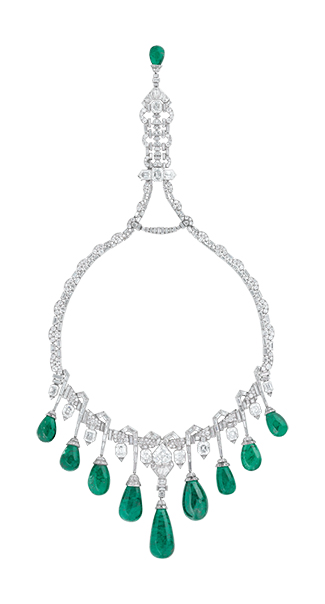 only in the era of Art Deco jewelers began to "keep up with the times." That period gave birth to common stylistic devices and decorative motifs inspired by the famous Russian Seasons in clothing and jewelry. Many of the ideas set forth by Louis Cartier came out from Diaghilev’s Russian Ballets and costumes by Leon Bakst. In the early twentieth century the Jewelry House of Cartier started to use unusual combinations of contrasting stones - green and blue, purple and bright green - and put together gems and non-precious stones, such as ruby and onyx or diamond and coral. Later, in the 1920s, Cartier’s innovations turned to be extremely popular. At that time, Cartier created a clip, which could be functionally and smartly used with any elements of the garment, fixing underwear under an evening dress, decorating a hat or using it as a clasp for bags. Popularity was won by clips shaped as a diamond jewelry piece - they were used to decorate one’s face and hair, and sometimes several of such clips were attached at the edge of the hair on one’s forehead or temple or even eyebrows. Many jewelry companies - including Van Cleef & Arpels - began to use this new kind of adornment."
The sphere of fine jewelry has always been conservative and experiments were risky - but the famous Louis Cartier allowed himself many things in jewelry and did a lot for its subsequent development.
Whereas the Cartier Company was founded in 1847, Van Cleef & Arpels is much younger: they opened their boutique on the Place Vendôme only in 1906. Van Cleef & Arpels had a large number of celebrities among their regular customers, including Florence Jay Gould, the daughter-in-law of a railroad magnate and socialite, whose literary salon was frequented by Scott and Zelda Fitzgerald, Cocteau and Dali. In 1920-1930, Van Cleef & Arpels produced many jewelry pieces in the modernist style.
Visitors to Elegance and Splendour of Art Deco are greatly attracted by the items that belonged to celebrities. Thus, one of the exhibits displays a handbag of Jacqueline Kennedy Onassis graced with a fastener in the form of a coral cylinder and diamond "roses" and emeralds made by Cartier in 1930.
The magnificent collaret belonging to Egyptian princess Faiz looks typical of Art Deco – it is decorated with ten Colombian pear-shaped emeralds in suspensions weighing 165 carats and diamonds of the most unusual shapes.
One of Cartier’s cigarette cases dating back to 1924 was bought by Hugh Grosvenor, the second Duke of Westminster, who gave it Coco Chanel as a gift.
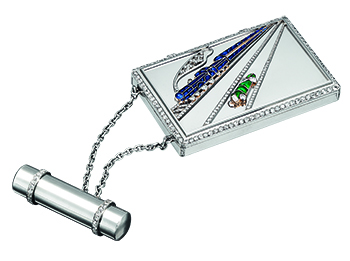 The "Blue Train" powder case with emeralds, sapphires and diamonds ordered from Van Cleef & Arpels for the wife of famous car racer Woolf Barnato is a reminder of one wager, which he won. The multimillionaire and heir to the gold and diamond mines in Africa, who became the head of the Bentley Group in 1931, Barnato, driving his green Bentley, was four minutes ahead of the Blue Train, which ferried between Cannes and Paris. A blue sapphire train and a green emerald car on the platinum powder case are rushing in the same direction. This charming story is typical of the Art Deco era, which saw the rise of cars and cinema, airplane flights, the age of jazz and Charleston, free cut, short hair, bright make-up and thin cigarettes held in luxurious long mouthpieces.
There is an item in this exposition belonging to the Moscow Kremlin Museums. It is small, but unique - a brooch called "Double Curl" dating back to 1930 and donated by Cartier after the Kremlin Exhibition in 2007.
Galina Semyonova for Rough&Polished
