Apart from Botswana, Russia, Angola, Namibia, Canada and South Africa, which in addition to diamond mining are developing diamond manufacturing, the pool of the world’s major diamond producing countries may as well include Australia and the Democratic Republic of the Congo. These 8 countries account for about 95% of global diamond production (Table. 1).
Table 1
Production, import and export of diamonds by major diamond producing countries in 2014-2015
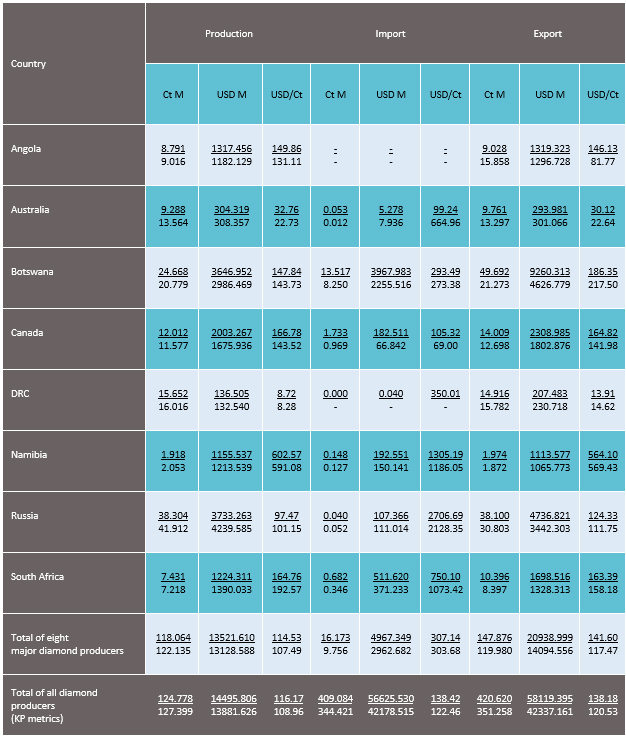
The numerator carries metrics for 2014, while the denominator carries metrics for 2015.
The table is compiled by the author based on the Annual Global Summary: 2014, 2015 Production, Imports, Exports and KPC Counts.
Analysis of the data above shows that the major diamond producing countries are mostly exporting rough diamonds and this brings their participation in the diamond trade to an end. The exception is Botswana, which is engaged in large-scale diamond re-export operations involving neighboring poor African countries through the diamond exchange in Gaborone. It should also be noted that diamond manufacturing companies based in this country, which is pursuing the beneficiation policy, process small amounts of rough as compared with the world’s traditional diamond cutting centers, such as India and Israel.
If we consider the diamond export and diamond import operations by country based on the Kimberley Process metrics, it is also possible to single out 8 major diamond trading countries (Tab. 2).
Table 2
Major diamond importing and diamond exporting countries in 2012-2015
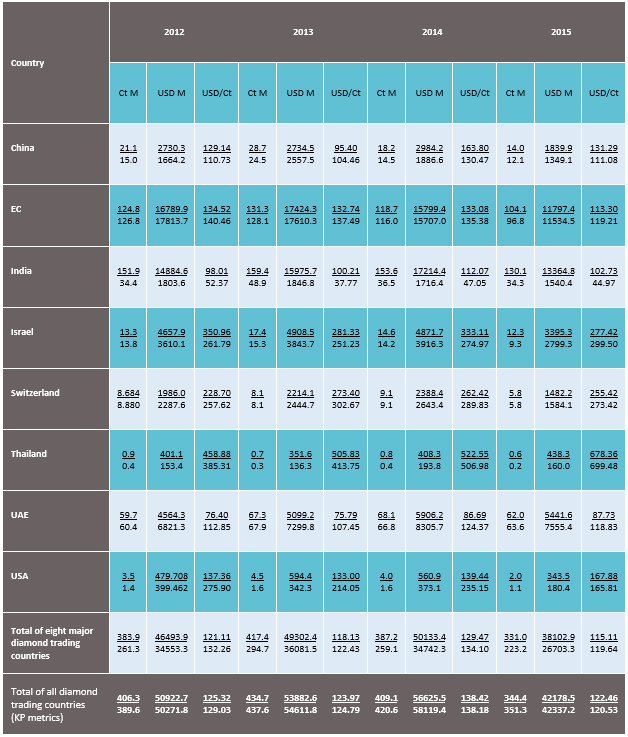
The numerator carries import amounts, while the denominator carries export amounts.
The table is compiled by the author based on the Annual Global Summary: 2012, 2013, 2014, 2015 Production, Imports, Exports and KPC Counts.
Analysis of the above data shows that more than 90% of global rough imports and two-thirds of global rough exports both by value and volume go through major diamond trading countries. These countries have an advanced jewelry industry and are processing rough diamonds into polished goods then sold around the world as diamond jewelry, the latter winning final value for rough it is made of.
The total global diamond imports and exports are more than three times higher by volume as the global rough diamond production and more than 3.5 times higher by value. This suggests that rough diamonds before they are cut into polished diamonds make at least 3 trips through intermediary countries, which receive additional income from the resale of diamonds. Among them, the United Arab Emirates is particularly noteworthy, for this country turned into one of the global diamond trading hubs in a matter of a decade using its favorable geographical location.
Yuri Danilov, Director of “Expert” Information and Analysis Center at Ammosov North-Eastern Federal University
