Looking at the same glass, the optimist views it as half full and the pessimist as half empty. This saying always comes to my mind whenever I read Bain’s annual forecasts for the diamond market.
"For the next three years, the supply of rough diamonds is expected to maintain a tight balance with demand. We expect demand for rough diamonds to recover from the recent downturn and return to a long-term growth trajectory of about 2 % to 5 % per year on average, relying on strong fundamentals in the US and the continued growth of the middle class in China and India," Bain predicts.
The forecast for global rough diamond production is not questioned - it is based on production targets of mining companies, which are usually set for decades and not subject to major corrections.
However, it is a much more baffling affair when it comes to predicting demand. Demand for steel, for example, is calculated proceeding from global targets for construction and machinery production. It is possible to figure out demand for gold with a certain degree of accuracy: at least half of this metal is used not for jewelry, but as an investment asset or a means of saving money. Demand for platinum group metals can be estimated even more precisely: half of these metals are used in the industry, cleaning, for example, exhaust gases in your car. But how to predict demand for diamonds, which are not suitable for anything other than jewelry? Buying a diamond always involves emotions, be it a finally matured decision to connect one’s life with another person or a sudden whim to buy a new piece of jewelry for one’s collection. How to predict emotions and measure them in money, if the coffee grounds and tarot cards are not yet officially recognized forecasting tools?
In the absence of other tools, Bain links demand forecasts to fundamental macroeconomic indicators. Simply put, it states: "If the economy is totally growing, so it may be obvious that demand for diamonds will grow as well."
In essence, the entire optimism of our industry is based on this forecast of Bain (at least because there is simply no other so extensive analytics to be found in the industry). Bain predicts that if diamond demand will continue to grow at such a pace (2-5% per year), it will start outstripping supply significantly around 2019. This means that rough prices will go up due to shortage of rough diamonds, all this to the delight of diamond business stakeholders.
The glass is simultaneously half full and half empty. It is empty only because Bain predicted rough shortage to happen as early as 2017 just a few years ago. But even without picking at dates, the major question remains open: How true is the assertion that overall economic growth will bring about higher diamond demand and the more so higher diamond prices? I see two problems that greatly prejudice this concept.
Problem No. 1 – Consumer basket structure
So, the forecast for higher diamond demand is based on the expectation of a growing GDP in the United States and an increase in the middle-class population in China and India. In other words, we all expect that people in these countries will gradually get rich and only thanks to this they will start buying more jewelry, which means that jewelers will need more rough diamonds.
Per various estimates, the official average salary in the U.S. is about $ 50,000-60,000 a year. But of course, this figure is obtained by deriving an arithmetic average of the salary received by a top manager of a bank and the wages received by a dishwasher at a roadside cafe. According to official statistics provided by the U.S. Census Bureau, in reality 70% of the U.S. population earn less than $ 50,000 a year, while 43% of workers earn less than $ 25,000 a year.
Imagine, for example, a manager with an annual paycheck of $ 50,000. He or she spends about $ 20,000 a year to pay mortgage and utility bills (per the Bureau of Labor Statistics), about $ 10,000 for commuting, and another $ 6,000 for a variety of insurance policies. This manager is left about $ 14,000 a year for all the other pleasures of life - including food, clothing, and repayment of debt on credit cards held by 60% of Americans.
Imagine also that the three-percent GDP growth in the U.S. means an equal three-percent increase in the salary of our manager. Imagine even a miracle happen that spared the country from inflation. Then the manager will have additional $ 1,500 a year.
Taking into account everything that has been described above, try to give an honest answer to the question: Do you believe that the consumer will definitely spend these additional fifteen hundred on a diamond? That he or she will choose, for example, to buy a larger stone instead of prepaying part of the mortgage or repairing his/her car?
I remind you that we are talking about the United States, the country ranking within the top ten in any income or living standard ratings. If we consider India and China in the same vein, the results, I believe, will be much more sorrowful.
Let us assume that the consumer will still decide to buy a jewelry piece. But what exactly? In the same survey of 2016, Bain offers very interesting data on the amounts that consumers are willing to spend on diamond jewelry.
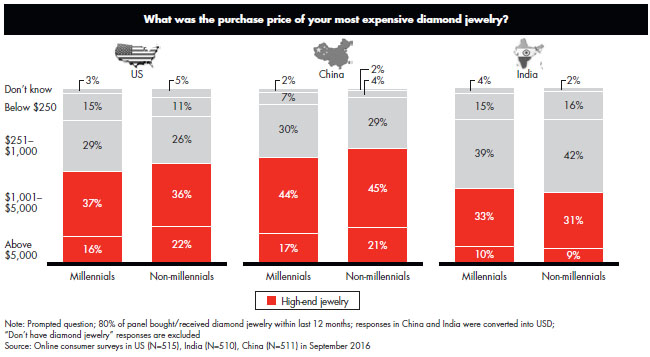
It follows from this table that about half of the buyers surveyed are not willing to buy jewelry worth more than $ 1,000. Another 40% are willing to pay for a purchase up to $ 5,000, but here we should again remember the arithmetic mean rule - in reality, $ 2,500 is the sum mentioned as a common measure of value for an engagement ring. That said, it should be noted that Millennials just turning into full-fledged consumers are willing to spend on jewelry much less than the older generation.
The demand pattern built around the growth of GDP and disposable income alone is based on matter-of-fact figures and does not take into account the psychology of consumer behavior. It is possible that the average consumer would indeed become a bit richer due to the growth of GDP. But the question is, in what way exactly and how much he or she will spend the extra money.
Problem No. 2 - Problem of choice
The modern market offers a zillion of options to the consumer to spend his or her salary on. Even if he or she will wish to buy a piece of jewelry, there will be several alternatives. Some time ago, growth in demand for diamonds inevitably meant some growth in diamond consumption. But today, in 2017 these statements are not identical.
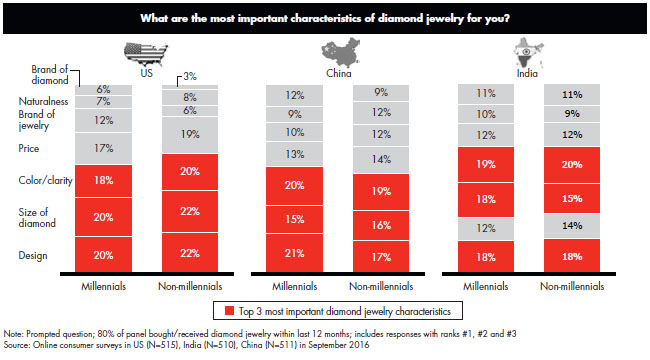
This is the most important slide of all the time Bain has been providing its reports. It seems that the company’s analysts just missed how important it is - judging by the fact that they devoted it only a few lines in their review. The design, size, quality and price are the most important criteria for the buyer when choosing a stone. And only after that, being put on the sixth (!) place in terms of importance, there comes the stone’s naturalness and its origin. The buyers literally vote with their eyes and purse, actually saying that if a jewelry piece looks beautiful and is acceptable, it is not so important where the diamond in it comes from and if it is natural at all. Yes, while being polled (especially if it is a TV interview), many people say that, of course, they would like to have a natural stone mined in compliance with ethical standards. But generally, there is no inscription on a synthetic stone that it is artificial. You can buy it and tell everyone it is natural – there will hardly be any relatives or friends to guess it is not. Or you can openly admit that you bought a synthetic diamond thereby protecting the environment - it is perhaps a good chance to win respect.
Think about it: even if the market in 2019 will really face diamond scarcity, it does not guarantee a bright future for diamonds. The growing cost value of rough diamonds, inevitable due to inflation and sophisticated production technologies, may lead to a situation where natural rough will gradually be replaced by synthetics. People’s well-being is growing slowly, and they are not willing to spend much money on jewelry needlessly. And in these circumstances, it is not so important for consumers if it is a natural stone or not in case it is beautiful and has a reasonable price. To buy a good stone, customers have no need any longer to force themselves to cross the psychological threshold of $ 1,000 for a diamond ring, as they can buy a synthetic stone, which in this case will be larger and better than natural for the same money.
Synthetics is beneficial not only to consumers, but also to the most numerous segment of the market - diamond cutters and jewelers. These artificial stones are cut exactly along the same technique and on the same equipment as natural diamonds, but they are half as expensive. Right now, diamond manufacturers, squeezed between the high cost of rough and unwillingness of buyers to pay too much for polished diamonds, operate at almost a zero rate of return. Just imagine, what a good margin they can have working with artificial stones.
Currently, the diamond business is facing two major tasks: to make consumers once again willing to buy diamonds in general and besides willing to buy natural diamonds in particular. The Diamond Producers Association is wasting time denying counteraction against synthetics and focusing on generic marketing only.
However, and this is a great misfortune, it has been common practice in our market to avoid calling a spade a spade. We are afraid to confront, we resort to politically correct wording and skulk behind "moderately optimistic forecasts", which gives us more pleasure to read than to face criticism. Our "moderate optimism" is successfully fighting with common sense. We have so often repeated that an early scarcity of rough will give a second wind to the market that did not even think of developing a "plan B." We have so long claimed that synthetic goods have a separate niche, not threatening our market, that now it seems we fail to see the obvious things, even if they are chalked in black and white on the slide depicting the results of the population survey.
It is high time for diamond market stakeholders to stop finding consolation in optimistic predictions about demand growth and finally go over to shaping it on their own. Demand, unlike analytical articles, cannot be born out of nowhere just at one’s sole will and pleasure. To create it, the industry will need long and expensive efforts. But such efforts are a must, otherwise it will take just several years to make the glass irrevocably empty, to an extent forbidding even the most inveterate optimist to say the opposite.
Elena Levina for Rough&Polished
