The founder of the Russian mining science, mineralogy and chemistry, Mikhail Lomonosov, in his treatise "The First Foundations of Metallurgy or Ore Mining" (1763) predicted the possibility of discovering diamonds in Russia's "midnight lands," having stated this in his book “On the Layers of the Earth”: “... In the north ... we cannot doubt that diamonds could have happened there ... and they can be found.” His prophecy came true in the 1980s, when the first primary diamond deposit on the Winter Coast of the Onega Peninsular was discovered and named after Mikhail Lomonosov.
In archival materials, there are references to the discovery of a diamond in the 18th century on the Severnaya Dvina River near the village of Orletsy.
In the 1950s, single crystals of diamond and its satellite minerals were found during a geological survey in the channel sediments of Mezen Pizhma, near the village of Nenoksa (1967-69), in the four first explosion pipes in the European part of Russia composed of alkaline-ultrabasic rocks related to kimberlites. The same type of pipes was found on the Kola Peninsula in the Kandalaksha Bay area.
The garnets discovered in 1974 on the Winter Bank of the Onega Peninsular in the channel sediments and beach sands of the White Sea were diagnosed as pyropes in 1975, the genetic satellites of diamonds. A peculiar kind of rocks identified as kimberlites were discovered in 1975 on the Mela River.
The Pomorskaya kimberlite pipe, the first in this area, was uncovered in 1980. In the 1980s, there were discovered new diamond pipes in the vicinity of Pomorskaya - Lomonosovskaya, Arkhangelskaya, Karpinskaya, Snegurochka, Pionerskaya and others.
The Arkhangelsk Diamond Province (ADP), Europe's first diamondiferous province of primary diamond deposits, is located on the northern outskirts of the European part of Russia. It is confined to the north-west of the Russian Plate (part of the Mezen Syneclise) and the Baltic Shield (the Tersky Shore of the Kola Peninsula) of the East European Craton (EEC). The unifying sign of the vast majority of ADP magmatic bodies is their occurrence in the form of explosion pipes with a sharply subordinate development of sills and dikes. Currently, there have been identified two diamond deposits, one named after Mikhail Lomonosov and the other after Vladimir Grib. The ADP includes a variety of volcanic manifestations developed along the coast of the White Sea: on the Winter and Summer Coasts of the Onega Peninsula an on the Tersky Coast of the Kola Peninsula. The manifestations of volcanism are confined to narrow linear uplifts and deflections of the northwestern strike in the ancient Archean-Early Proterozoic (more ancient than 1650 million years) granite-gneiss crystalline basement of the Russian Plate.
The kimberlite rocks of the ADP deposits are characterized by uneven distribution of diamonds in both horizontal and vertical sections. In general, the existing pipes belong to bodies with large diamonds, they have a geological structure that is classical for light-eroded kimberlite pipes - with clearly distinguished crater and vent parts. The thick (up to 120 m) crater part is composed of subhorizontal layers and bundles of various volcaniclastic, volcanocrystalline and simple sedimentary rocks - from quartz clay sandstones and breccia sedimentary rocks to tuffites and tuffs of kimberlites, their lower part containing thin injections of kimberlites.
A junior exploration company in Russia is a commercial entity. This is usually a small company, which is characterized by the following features: control of the company is carried out by one or more individuals; the company conducts geological exploration works (GEW) on one or several promising areas of the subsoil; it does not have real estate and does not generate income from other spheres of activity (including mining); the main goal of the company is to achieve a sharp increase in the market value of the allocated subsoil plot by increasing its prospects or discovering a deposit and then selling the plot with maximum benefit.
In our opinion, the specifics of geological exploration for diamonds and its difference from other fields of business can be summarized in the following way: geological exploration is a capital-intensive field of business and has a purely cost-intensive nature; in addition, it is characterized by the exclusivity of each diamond deposit, as well as by the poor exploration maturity of a particular area.
On the other hand, the discovery of a new deposit during exploration permits not only to compensate for all the costs incurred, but also to obtain profits inconceivable in other industries. Mar-West Resources, the company that discovered the San Martin deposit in Honduras in 1996, increased its capitalization by a factor of about 80, from CAD 554,460 to CAD 42.4 million (polymetals). In the case of commercial diamond-bearing assets this is hundreds of thousands of percent!
The success or failure of geological exploration largely depends on the intuition, qualifications and experience of the geologist who fulfilled the forecast, chose the site, and then planned and carried out exploration. Geological exploration, and especially its search stage, is the only field of business in which the intuition, creativity and ability to “penetrate the depths of the earth with reason, bringing things and deeds to sunshine” so strongly affect the financial performance of a company.
In Russia, there have not been created conditions for the formation of a small geological exploration business involving junior companies, similar to those operating in Canada and Australia. Russian junior companies cannot emerge under the current subsoil legislation in principle, for this is hampered by both the lack of protectionist measures in relation to prospecting and exploration and the absence of special markets for venture (risk) capital in the financial system of Russia.
Therefore, right now the term “Russian junior company” does not reflect the western characteristics of juniors. In Russia, such a system has not yet been created, so you cannot count on the arrival of private investment in this particular business area before a fundamental change in legislation.
The main problems in the management of the mineral reserve fund in Russia, which affect the activities of junior companies, are the following:
- Absence of measures of state support in the field of taxation of geological exploration;
- Complex and long procedure for obtaining and transferring the rights for using subsoil;
- Complete lack of opportunity to attract venture capital to risky projects.
In Russia, the very notion of venture capital has emerged quite recently, and the legislative framework governing its turnover is completely absent, so there is no corresponding market. The prospects for even a developed project are not large: the per capita GDP is very far from the possibility of attracting the Russian population to invest money in high-risk projects. There is no capital market for small private investors and it is not expected in the foreseeable future.
OOO Proex Service was established in 2008, and its main economic activities included scientific research and development in the field of natural and technical sciences, activities in creating and using databases, and the provision of consulting services. We have long sought to obtain licenses for the exploration and evaluation of diamond deposits on an application basis. In 2015, we obtained 5 search and evaluation licenses in the Arkhangelsk Region.
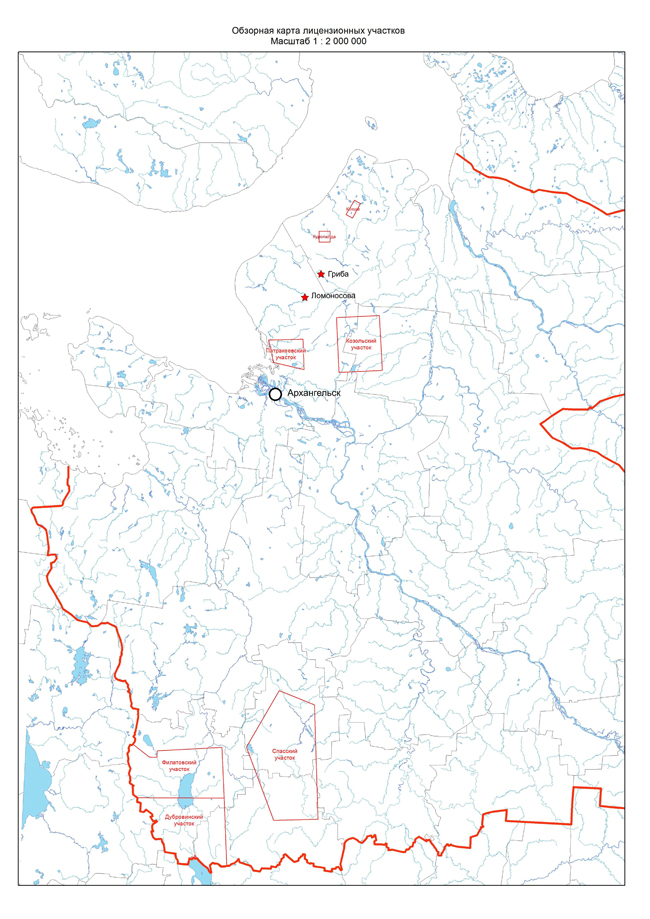
License areas of OOO Proex Service
The union of top-grade and highly professional geologists, geochemists and programmers is now more than 20 years. We did not commercialize our developments, this area was an integral, non-negotiable part of our daily geological work. And we still treat it like this: this is our "workhorse," which is a delight for all geologists, geophysicists, who managed to see it. It was created for our tasks, which included a complex processing of geological and geophysical data: a database, a cartographic information processing unit, a unit for processing primary geological information, a geophysical data processing unit, a remote sensing data processing unit, and a simulation module with the possibility of rapid modification and scaling. The software complex has the Certificate of Rospatent (Russia’s Federal Service for Intellectual Property). For more than 15 years of its use and modernization, we now perfectly imagine what particular tasks it can solve for other geological applications (ore and non-ore prospecting and evaluation). This is an exceptional software product for diamond prospecting and evaluation work.
Proex Service deals exclusively with diamond exploration. Its CEO Vladimir Shchukin, who has the Ph. D. degree in Geology and Mineralogy and is the main generating and driving force of our company, has a work record of more than 40 years in this field, while the average work record of the main "creative group" is 20 to 30 years. Vladimir Shchukin added his Canadian work experience to the search projects in the Arkhangelsk Region. Therefore, our knowledge of this region in the field of diamond geology is very complete. Our enthusiasm and constant search for new approaches and ideas, multiplied by experience, give good results. The kimberlite pipes, discovered at the end of 2016-2017, are the first for the last 10 years of work on all diamond exploration projects in the Arkhangelsk Region. And it is noteworthy that diamonds here are also sought for by ALROSA, Arkhangelskgeoldobycha, and other companies...
A few words about the explosion pipes in Finland... There have already been discovered more than 30 of them. As always, they have to be assessed to identify if they belong to kimberlite, kimberlite diamondiferous, commercial kimberlite diamondiferous pipes, etc.
With regard to manifestations of Precambrian kimberlites, the Eastern European platform is not an exception among the ancient cratons: the Neoproterozoic manifestations of kimberlite magmatism on the EEC are represented by the fields of Kaavi-Kuopio and Kuusamo and Lentiira-Kuhmo in Eastern Finland. They are among the kimberlite manifestations of the vast area on the passive edge of the Iapetus Ocean, which opened during the disintegration of the Rodinia supercontinent. Within the Russian part of the EEC, kimberlites of this age are not identified. However, manifestations of ultrabasic lamprophyres (tuffs, tuffites, thin sheets and veins) associated with the Late Vendian deposits are known in the Arkhangelsk Diamond Province on the Winter Coast of the Onega Peninsular and on the South-East Coast of the White Sea. These lamprophyres may represent the eastern extension of the extensive Neoproterozoic province of alkaline and alkaline-ultrabasic magmatism, which also covers the north of Canada and Scandinavia (A. A. Nosova, V. A. Kononova, 2009).
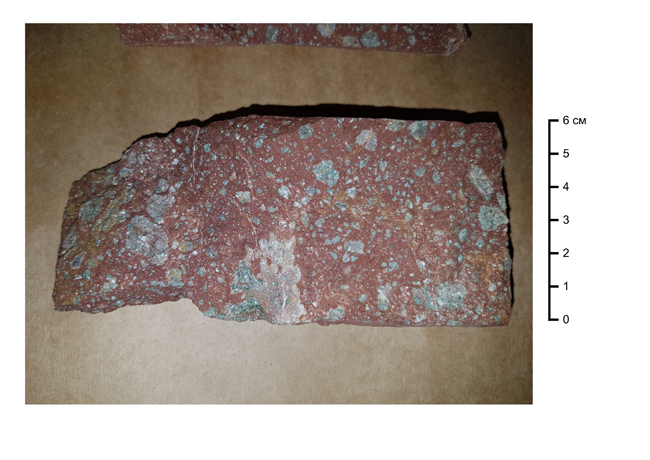
Crater facie sample from KL01 Pipe
Proex Service was able to timely receive 7 licenses (covering 15,500 sq. km) under the application principle (now it is reserved only for those areas where geologic exploration for this type of minerals was not performed). We are sure that the southern areas have a good resource potential, as there have been discovered diamond accompanying minerals with good technical characteristics and indicators received by ICP-methods, which make it possible to state that their primary sources are not the known kimberlite fields. We conducted aerogeophysical studies, ground-based magnetography to outline the magnetic perspective anomalies for drilling. The south of the Arkhangelsk Region is favorable in the natural and climatic respect, the area is sparsely populated, and there are no environmental or territorial claims of the indigenous population, and good logistics of the territory is also noted. The two new licenses to the north of the Grib Pipe is a completely new material for processing the previously made high-quality remote and geophysical surveys.
The kimberlite pipes we have discovered are of the classical type, typical for this region, with a thick tuffaceous stratum (the development of the Grib Pipe from 2014 to 2016 yielded 10 million carats of diamonds extracted from its crater part), and they differ from the pipes in Finland, Norway and Sweden. The latter are characterized by a deep erosion cut, which reveals mainly the basal parts of the kimberlite structures. The Phanerozoic kimberlites of the Arkhangelsk Diamondiferous Province are characterized by an erosion cut revealing mainly diatreme and often crater facies (A. A. Nosova, V. A. Kononova, 2009).
A very unusual and established fact for our kimberlites is that they contain a large number of iron-manganese-titanium-silicate spherules. It is known from literary sources that such spherules are present in the kimberlites of the Yakut diamond-bearing province and are often found in the Catoca pipe (Angola). At the moment, it is possible to consider the availability of such spherules in sediments as a search sign of diamond content (Yatsenko, 2011).
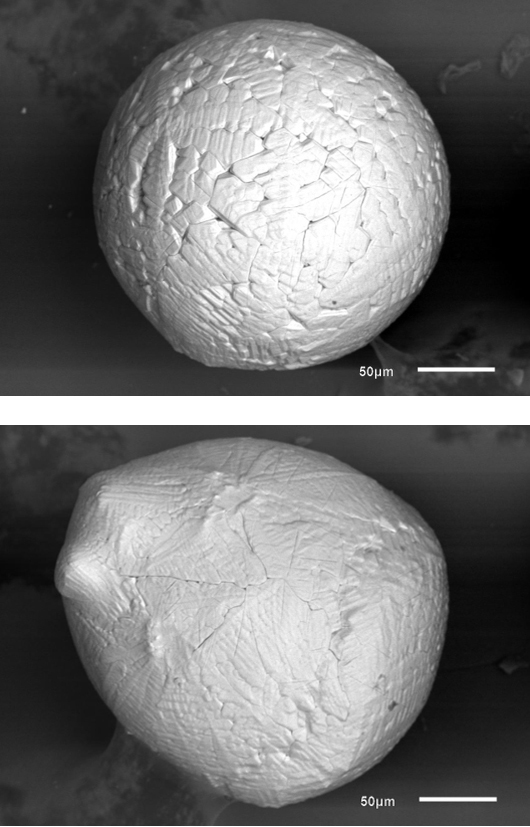
Spherules
The team of like-minded geologists has covered a long way – they started from regional works, outlined promising areas for exploration and evaluation, conducted expensive aerial magnetic survey for most of the licenses, performed a large volume of work on ground-based grading of local magnetic anomalies, produced a large number of high-quality modern analytical analyses, tried out new methods of electrical survey, computer simulation, and are verifying their findings by drilling operations. The result was not long in coming: the company has added seven kimberlite pipes to its assets.
Prospects for an investor, who put his money in an exploration project and received a result in the form of a diamond-bearing pipe based on assessment materials, are quite tangible: a multiple increase in the capitalization of his stake.
By Irina Gogol, Deputy Director for Development of Proex Service, Geochemist, MBA
