The countries that are leading in the global diamond production, cutting&polishing and trading are widely viewed as the world diamond centres. Diamond mining countries, cutting&polishing centres and rough and polished diamond trade hubs are among them.
Beneficiary countries
Besides the pool of the BRANCS countries - Botswana, Russia, Angola, Namibia, Canada and South Africa - where a cutting&polishing industry is developing in addition to the rough diamond production, Australia and the Democratic Republic of Congo could be added to the top diamond mining countries in terms of the diamond production. These top 8 countries account for 95 per cent of the global diamond production (Table 1).
Table 1
Top miners’ diamond production, imports and exports in 2015-2016
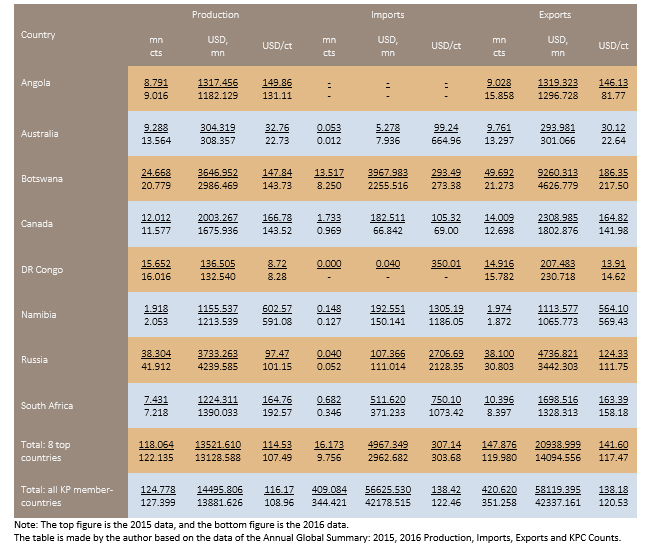
The analysis of the above data shows that the leading diamond mining countries mainly export rough diamonds and this is the only way they participate in the diamond trade. Russia and Botswana are the exceptions as they also sell their rough diamonds via diamond exchanges set up in their countries. That said, Botswana sells the goods in more significant quantity due to the re-export of the rough diamonds produced in the neighbouring African countries via the Gaborone diamond exchange.
It should be noted that the volume of diamonds cut and polished in the beneficiary countries by their own cutting operations is not as significant as that in India and Israel that are traditional diamond cutting centres.
Importers – exporters
If you take a look at the rough diamond export-import operations in the countries according to the Kimberley Process data, you can see 8 top countries selling rough diamonds practically without mining rough diamonds (Table 2).
Table 2
Top diamond importers – exporters in 2013-2016
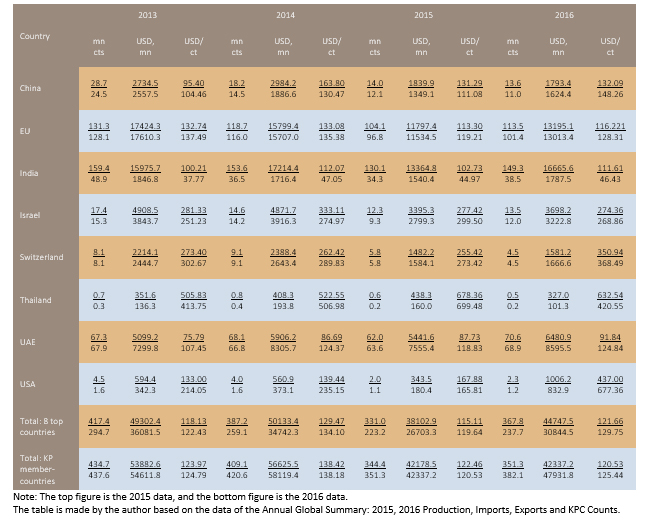
Normally, about 90% of the global imports and two thirds of the global exports both by value and by volume go through the top diamond trading countries. Taking into account that a jewellery industry is also developed in these countries it can be said that the diamonds are cut and polished there, used as studs in the jewellery items and then sold all over the world as jewellery getting the final value of diamond goods.
The total global imports and exports are more than three times as high as the global production volume and over 3.5 times higher by value. This suggests that the roughs prior to being cut and polished make at least three trips through the mediatory countries that get additional profits reselling the rough diamonds.
Special mention should be made of the United Arab Emirates among them, which used their beneficial geographic position and were able to turn into a world trade hub for rough diamonds within a decade. The UAE’s rough diamond trade surplus is about US$2 billion.
Yuri Danilov, Director of “Expert” Information and Analysis Center at Ammosov North-Eastern Federal University
