Gem Diamonds had a good start to the year as it recovered four “high quality” diamonds over 100 carats last January from its 70 percent-owned Letšeng mine, in Lesotho.
The mine was well-known for the production of large, top colour, exceptional white diamonds, making it the highest dollar per carat kimberlite diamond mine in the world.
The company first reported on 8 January that it had unearthed two “high quality” diamonds from Letšeng.
The 117 carat and 110 carat stones were classified as D colour Type IIa.
Gem Diamonds also announced on 15 January the recovery of an “exceptional” 910 carat diamond, which was believed to be the fifth largest gem quality diamond ever recovered.
The 910 carat diamond was also the largest to be mined at Letšeng to date.
Company chief executive Clifford Elphick said this “highlights the unsurpassed quality” of the Letšeng mine.
It didn’t take long before Gem Diamonds announced yet another big find.
The company said on 22 January that it had found an “exceptional quality” 149 carat, D colour Type IIa diamond, with “excellent shape”.
Since Gem Diamonds acquired Letšeng in 2006, the mine was said to have produced some of the world’s most remarkable diamonds, including the 603 carat Lesotho Promise.
But, the recovery of the 910 carat stone last month did not cause much noise as was the case with Lucara Diamond’s Lesedi La Rona in Botswana or the so-called Peace Diamond in Sierra Leone.
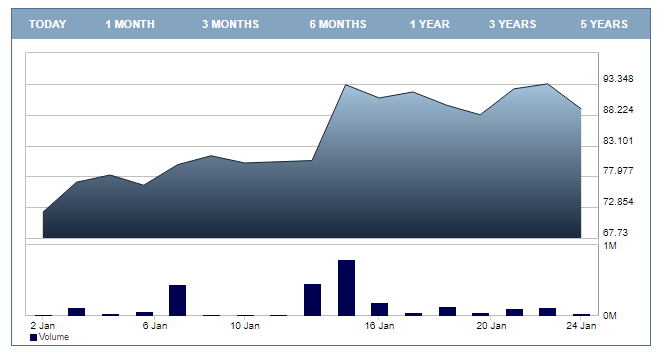
Source: London Stock Exchange
Gem Diamonds’ share started trading at a price of 84.00 pence each on the day it announced the recovery of the 910 carat stone and closed at 93.20 pence each, an increase of about 13 percent.
Although this was a positive response from investors, the gains didn’t last long as its share price closed the following day slightly lower at 91.00 pence each.
After a marginal gain on 17 January it further dropped to close the day at 88.20 pence each on 19 January.
The share was trading at a price of 90.00 pence each at the time of writing this article.
Single production asset
I asked Paul Zimnisky, an industry analyst, why it appeared there was lack of enthusiasm over Gem Diamonds’ stock following the recovery of the big stones, of which one was regarded as the world’s fifth largest gem quality diamond ever.
He said: “Listed in London, Gem Diamonds is perhaps the longest running publicly-traded pure-play diamond miner around, but in most cases long-term investors have lost money in the stock (at least over the last decade), so I think a lot of investors have finally given up.”
Zimnisky also said that on top of this, it was a single production-asset company with production only coming from Letšeng, a mine with economics highly dependent on the recovery on very-large, special diamonds.
Gem Diamonds mothballed its Ghaghoo project in Botswana in February 2017 due to “prevailing market conditions”, leaving it with Letšeng as its only production asset.
It reported on 17 August 2017 that it had received an offer to acquire 100 percent of the Ghaghoo asset and was being considered by the board.
However, it said on 12 December 2017 that discussions had not resulted in agreement between parties and the offer had been withdrawn.
Gem Diamonds further said it was presently in discussions with other parties interested in acquiring the Botswana asset.
Zimnsky also said that the company had a history of breaking a lot of large stones during recovery.
“The recent recoveries, including the 5th largest gem-quality diamond ever found, could be a sign that this problem is finally being ameliorated,” he said.
“If they can maintain a consistent supply of exceptional diamonds like we have seen in recent weeks, I think you will see investors return.”
Mathew Nyaungwa, Editor in Chief of the African Bureau, Rough&Polished
