Liang Weizhang (Лян Вэйчжан), Guangzhou Diamond Exchange
Guangzhou Diamond Exchange recently analysed the newly released official trade data, it shows that commodities under the HS Codes of Chapter 71 contribute more than 31% of the total imports from Hong Kong S.A.R. to Mainland China in 2018, achieving over US$2.6 billion in value. This is according to the monthly statistical data published by the General Administration of Customs, P.R. China.
According to the Explanatory Notes of the Harmonized Commodity Description and Coding System, Chapter 71 includes natural or cultured pearls, precious or semiprecious stones, precious metals, metals clad with precious metal, and articles thereof, imitation jewellery and coin. Generally, we take the data under this Chapter for jewellery trade. However, most of the imports from Hong Kong S.A.R. to Mainland China under this sector attributes to the gold trade, but not diamonds and gems as mentioned by some other observations.
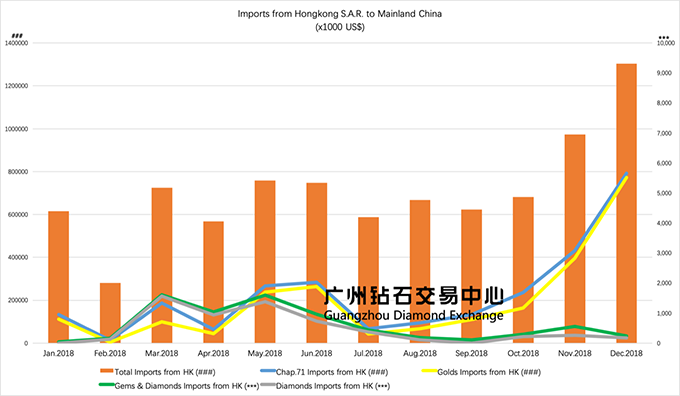
Fig.1 Imports from Hong Kong S.A.R. to Mainland China in 2018
Gold dwarfed diamonds and gems in jewellery imports. (Fig.1) The total imports from Hong Kong S.A.R. to Mainland China experienced a seasonal decrease in February (US$281 million), as it stumbled monthly by around US$568 million to US$758 million from March to October but reached US$973 million in November and made a sprint to even US$1.3 billion in December (see orange columns). In this year-end dash, jewellery products (Chapter 71 of HS Codes, see blue line) led the run and contributed almost two-thirds of the total imports this month. Amongst the commodities under this chapter, gold shares the biggest portion, more than US$2.3 billion (see yellow line) or 86% of the total jewellery imports. Being contrary to the common expectation, diamonds and gems play a very limited role in imports, only US$7 million this year (see green line for gemstones, grey line for diamonds).
In 2013, designated banks and companies were granted licenses to import gold from the overseas market. Since then, Hong Kong S.A.R. became one of the major sources of gold imports into Mainland China, and gold has been playing a very big share in the cake of imports to the mainland under Chapter 71. In 2018, Hong Kong S.A.R. is the seventh-most important import-trading source for Mainland China in the jewellery trade, following Switzerland, South Africa, Australia, Canada, the US, Singapore, Japan and Belgium. Obviously, Switzerland, South Africa, Australia, Canada and the US also export gold to the mainland with a rather big portion in their trade of commodities with China in Chapter 71. (Fig.2)
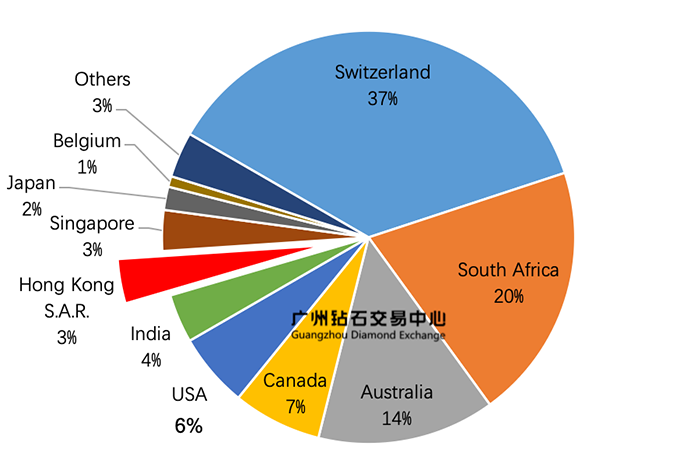
Fig.2 Top 10 Import Sources for Mainland China in Jewellery Trade
Gem imports are too far to feed the Mainland Chinese market. Two of the major trading modes in Mainland China are Ordinary Trade and Manufacturing Trade. In Ordinary Trade, commodities for import/export shall clear their tariff and VAT before entering or leaving the domestic market. In Manufacturing Trade, on the other hand, commodities for import/export are only for manufacturing in Mainland China, not for sale, and shall be re-exported to overseas suppliers after the manufacturing is completed; no tax will be charged on the commodities. We can observe that through Ordinary Trade, US$90-million worth of gemstones (excluding diamonds) were imported to Mainland China from all over the world. However, more than US$369-million worth of gemstones (excluding diamonds) were imported to Mainland China in Manufacturing Trade mode, which are to be, or have been, re-exported to overseas suppliers after being manufactured.
In Ordinary Trade, there were only US$90-million worth of gems officially imported into and remained in Mainland China. It is also noted that from the data published by Shanghai Diamond Exchange, the total polished diamonds imported into the mainland was worth US$2.7 billion in 2018, whilst the total Ordinary Trade of jewellery products (Chapter 71) was US$40.4 billion, 83% of which attributes to gold. China is the second-largest jewellery market in the world, and US$90-million worth of officially imported gemstones is too far to feed the Chinese market.
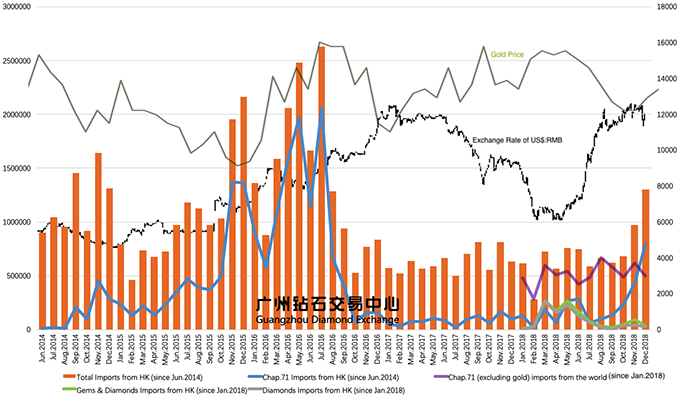
Can the import of gems “ship” US dollars out of Mainland China? (Fig.3) There was a huge increase in jewellery trade imports from Hong Kong S.A.R. to Mainland China from April to October 2015, February to July 2016, and October to December 2018. Meanwhile, the US dollar became stronger in these periods, as jewellery imports from Hong Kong S.A.R. also increased significantly. “Inflated Invoice” or “Over Invoicing” in the jewellery trade seems “expected”. As for gemstones, the shipping out of US dollars (US$90 million) in imports from Mainland China is easy to figure out, compared to the rather big total import of US$40.4 billion. Furthermore, taking gold out from the jewellery imports into Mainland China from around the world, a normal vibration can be observed without any obvious influence from the exchange rate or gold price (see purple line in 2018).
As for gold, in July 2016, when the first rush of imports from Hong Kong S.A.R. arose, a spokesman from the Chinese General Administration of Customs clarified that the rush was due to the increasing demand of gold in the local Chinese market. It is interesting that in the two times when imports increased, the price of gold also increased. Gold price, exchange rate and the state official reserve assets have an interesting balance. Interestingly, the State Administration of Foreign Exchange also increased its official reserve assets of gold in the above-said periods.
Outlook 2019. The import of gemstones, diamonds and jewellery has huge potential. The Chinese government has launched a series of stricter mechanisms in 2018, including reinforcing the anti-smuggling measures at the border, introducing the new VAT system to facilitate the supervision on the full taxation chain, intensifying foreign exchange monitoring, but, markedly reducing the import tariff rates for 706 items including many in Chapter 71. Liang Weizhang, General Manager of the Exchange pointed out that, the response of the jewellery market is to be observed in 2019, including the synthetic diamond sector. Interestingly, China is not only the largest producing country, but also the second-largest jewellery consuming market in the world.
