The 2009 economic crisis has dramatically changed the pre-crisis balance between diamond mining, diamond manufacturing and diamond trading companies and the competition between them under these circumstances has sharply increased. As a matter of fact, the third millennium, in which we have lived through quite a measurable part, is bringing about truly unprecedented changes. While until recently, there were four major companies, that played a key role in the diamond industry, nowadays, the situation is changing fast and second-tier companies are beginning to come to the forefront. Therefore, to assess the prospects for the development of the global diamond mining segment at present, it is essential to better define the place and role of companies in the future ranking within the diamond hierarchy on the basis of strategic analysis.
Such an analysis of their future development prospects (Fig. 1) was performed using the classical model developed by the BCG (Boston Consulting Group) and upgraded by the author of this article based on the dynamics of changes in the production share and the diamond output reached by the four leading companies in 2009-2012 (Table 1).
Table 1
Change in the production share and the growth in diamond output reached by the world’s largest diamond mining companies in 2009-2012
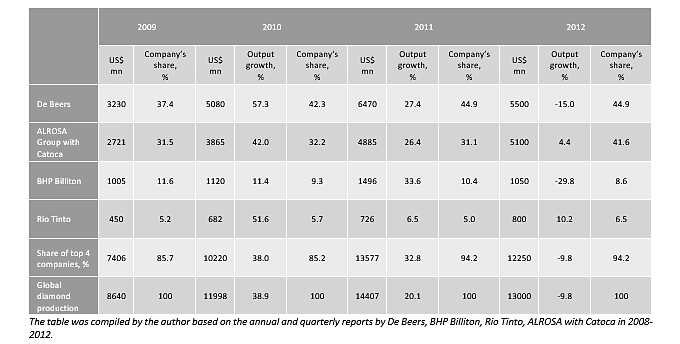
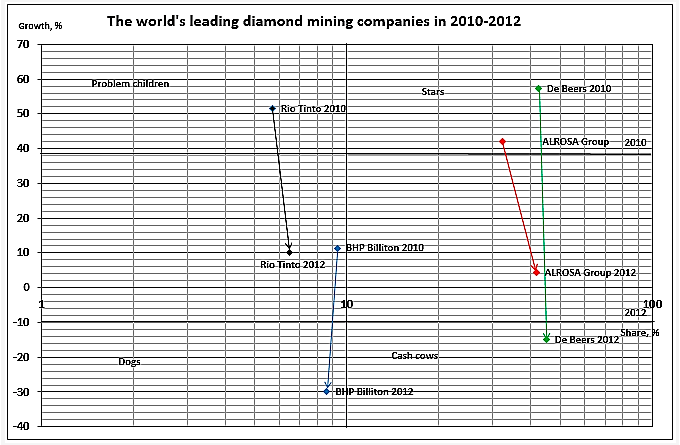
Fig. 1 The world's leading diamond mining companies, 2010-2012.
The dynamic model clearly shows the change in the companies’ position after the crisis and their prospects for the future. While in 2010, De Beers and ALROSA were in the ‘Stars’ field, only the Russian miner retained this position in 2012. De Beers moved into the ‘Cash Cow’ category due to objectively lower performance of this business as well as due to the sale of block of diamond shares by the Oppenheimers.
Rio Tinto and BHP Billiton were in the ‘Problem Children’ position in 2010, but the latter slipped to the ‘[Dead] Dogs’ field in 2012 having sold some of its (non-core) diamond assets to the fast growing second-tier Harry Winston Diamond Mines Ltd. company.
To determine the future development prospects of the five top diamond mining companies, let us consider the dynamics of the change in the production share and the growth in the diamond output in 2014-2018.(Table 2).
Table 2
Change in the production share and the growth in diamond output reached by the world’s five largest diamond mining companies in 2014-2018
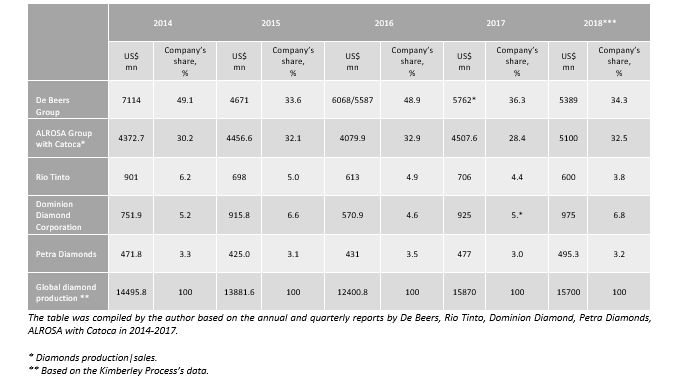
Based on this data, the dynamic model given in Fig.2 was compiled.
The model shows that the multinational companies – ALROSA and De Beers – have the supremacy in the global diamond production. That said, ALROSA is always in the ‘Stars’ position and every year, it strengthens its stand as a leader, and the De Beers Group has been in the ‘Cash cows’ field for a long time.
Moreover, it seems that the De Beers leaders do not consider the rough diamond mining business to be rather promising and gradually, they get rid of the depleted diamond mines and also diversify the business. More than that, lately the Element Six business unit of the company has been growing laboratory (synthetic) diamonds.
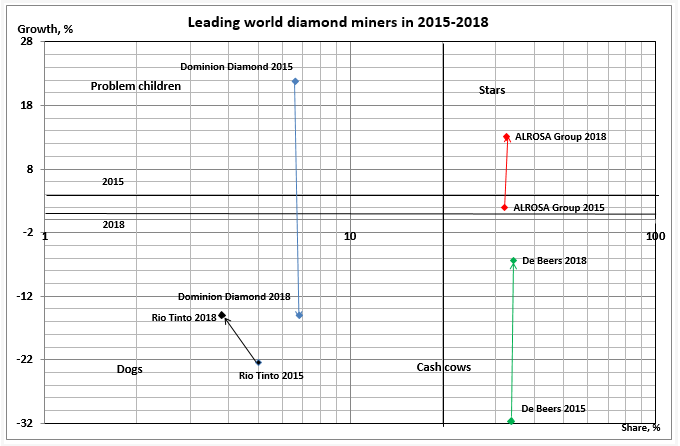
Fig.2. Leading world diamond miners, 2015-2018.
It is probable that the accelerated scientific and technological progress in the nearest future can result in the production of the greater quantities of gem quality synthetic diamonds at a much lower cost. That is why, it seems better to change the ALROSA’s strategy towards gradual decrease in the rough diamonds production and mastering the production of laboratory (synthetic) diamonds. In this case, Yakutia will keep on developing due to the finite natural resources mining as well as the manufacture of the synthetic diamonds on a commercial scale.
Yury Danilov, Ph. D., Lead Research Fellow at the Subsoil Use Innovative Economics Laboratory of the North-Eastern Federal University
