The technologies to recover large rough diamonds from the ore deposits both in Russia and abroad include the disintegration, classification and direct beneficiation according to size categories. The difference lies in the equipment and technological processes used at each of these stages.
The fundamental difference of the national technology is in the disintegration of the diamond-bearing raw material in primary crushers, up to 400 mm, and then autogenous grinding mills are used, while at the factories abroad, three-stage crushing is used. However, this is exactly what leads to different rates of recovering undamaged large stones.
Despite the known hardness, diamonds do not withstand impact stresses in the mining and beneficiation processes. As early as in the Soviet time, the Yakutalmaz NPO studied the issues of recovering undamaged stones. At that time, I worked at the laboratory of the ore preparation at the Yakutniproalmaz, so I was directly involved in testing the undamaged stone recovery. Since the 1980s, rubber lining of mill barrels has been introduced, which, of course, resulted in higher undamaged stone recovery.
However, it is worth mentioning that the maximum size of a mill grate is 50 mm and a larger diamond a priori cannot stay undamaged in the autogenous grinding process. So, an Alexander Pushkin diamond, the second largest one mined in Yakutia in 1989 weighing 320.65 carats, was a sliver of a 2,000 ct stone that was crushed in the autogenous grinding mill.
Comparative testing of two technologies were carried out then at the experimental factories – at the national one with autogenous grinding, and at the foreign one with stage crushing, with the subsequent beneficiation of the products using the same scheme. The tests showed that the foreign technology ensured a several percent higher recovery of undamaged diamonds.
Taking into account the fact that diamond mining in Yakutia is carried out mostly in winter conditions and the ore itself is in the deep-frozen soil, it gets warm during the autogenous grinding process, so it was decided to introduce no change in the technology. Besides, the autogenous grinding mills provided high output of the beneficiation factories - the country needed industrial diamonds at that time - and the lower beneficiation limit was 0.2 mm.
The ore disintegration in primary crushers, autogenous grinding mills remained unchanged at the ALROSA Company and its subsidiaries up to now. It is also used in Arkhangelsk where OAO Severalmaz, an ALROSA subsidiary, mines diamonds. In Angola, the diamond miner Catoca also uses autogenous grinding mills and similar beneficiation schemes because the beneficiation factory was built upon the Soviet engineering projects and by the Soviet specialists.
At AO AGD Diamonds (former AO Arkhangelskgeoldobycha), diamonds of higher quality are mined at the V. Grib diamond deposit thanks to recovering large crystals undamaged using no-blast breaking methods to mine the stones in kimberlites as well as the advanced beneficiation technologies.
Foreign companies use the technology developed by De Beers with the stage crushing using various types of crushers classified by various grain-size categories by means of X-ray units and dense medium separation of the material of size under 5 mm. That said, the upper size limit is from 60 mm, which excludes damaging of large diamonds if they have undergone third stage crushing. The crushed material under 1.2 mm goes to tailings.
Petra Diamonds that bought a number of abandoned mines from De Beers, also uses the stage crushing method, because during shaft mining, the material size allows to exclude primary crushing. With relatively low production, the company ramps-up their shaft mining output at the mines and improves X-ray sorting that enables to recover large type IIa D colour crystals weighing over 100 carats. In 2019, Petra Diamonds recovered four such stones at the Cullinan mine.
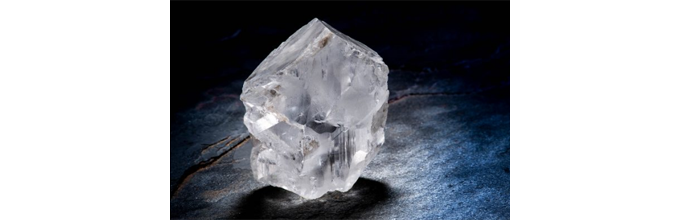
Figure 1. The largest diamond Legacy recovered at the Cullinan mine. Image credit: Petra Diamonds
On March 29 this year, Petra Diamonds recovered a 425 ct D-colour type IIa rough diamond at the Cullinan mine. The stone was called Legacy and will be put for sale.
Among the global diamond miners, Lucara Diamond Corporation is a one-of-a-kind company that - with relatively small diamond production (350-450 thousand carats) - has the revenue at the level of second-tier companies thanks to recovering large stones. That said, the scale of mining large stones due to the technology of undamaged diamond recovery is massive. To produce large diamonds at the Karowe mine, the beneficiation technology is used enabling to recover stones undamaged, with the stage crushing, and beneficiation using the XRT equipment starting with size of 6 mm up to 8 mm. The diamond-bearing product from 8 mm down to 1.25 mm undergoes beneficiation using dense medium separation with additional processing of the concentrate using X-ray sorters. Additionally, using its experience in detecting the possible presence of large diamonds, the company has changed the technology, achieved the upper size limit up to 100 mm and fitted the beneficiation factory with additional equipment.
At the end of the last year, during the commercial processing of ore at the Karowe mine, three large rough diamonds were recovered: Constellation weighing 813 carats and sold in May 2016 for $63 mn; Lesedi La Rona weighing 1,109 carats that will be put for sale on June 29, 2016 (Fig. 3), and the 374 ct rough stone that is set for sale.
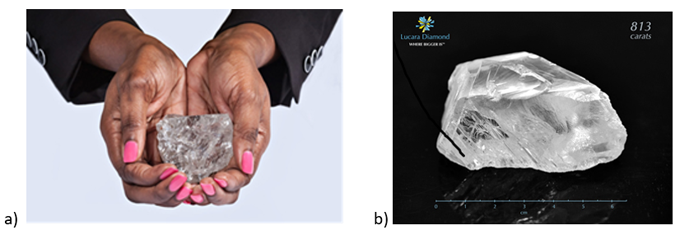
Figure 2. The largest diamonds recovered at the Karowe mine: a) Lesedi La Rona; b) Constellation.
Image credit: Lucara Diamond Corporation
By now, over 100 stones weighing above 100 carats have been mined already. We should take note of the value of the Karowe diamonds that refer to the rare type IIa diamonds as well as to very rare type II blue diamonds, which puts a great value on the stones on sale.
Summary
As the large-scale diamond deposits are gradually depleting and no new discoveries are made, the economic efficiency of the major companies, ALROSA and De Beers, is progressively decreasing. The explosive growth of the synthetic (laboratory) diamond production and further development of the technology to grow synthetic diamonds is aggravating the situation. Probably, that is why De Beers steadily masters the diamond growing process and has recently shut down the Victor mine in Canada.
In such situation, second-tier companies - Petra Diamonds and Lucara Diamond Corporation - specializing in mining large-size natural rough diamonds as well as rare ones become more competitive.
Yury Danilov, Ph. D., Lead Research Fellow at Subsoil Use Innovative Economics Laboratory of the North-Eastern Federal University
