Taking into account that AK ALROSA PJSC incorporated in Yakutia has a diamond cutting unit, the results of its diamond cutting factories in other parts of Russia should be considered together with the results of the diamond cutting industry of Yakutia in spite of their location.
ALROSA rejected the vertical integration concept in 2013 and uses the Group’s diamond cutting factories to monitor rough diamond prices. That said, the polished diamond sales by value are comparable with - or even exceed - the sales of all the major companies of the Russian diamond cutting industry (Table 1).
Table 1
The output by major polished diamond manufacturers in the Russian Federation, 2011-2018
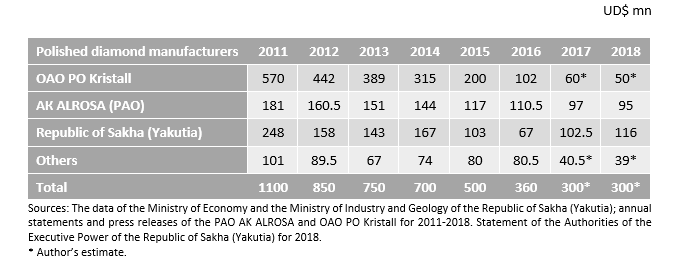
The data shows that all the major companies in the Russian diamond cutting industry have decreased their figures since 2011. Even the renowned industry leader OAO PO Kristall was in crisis in 2018 and started to sell off the company’s non-core assets.
While considering the diamond cutting and jewellery industries of the Republic of Sakha (Yakutia) and the Russian Federation globally, one can see their significant development potentials as the share of Russian cutting in 2018 was 1.5% of the global one and of diamond jewellery manufacturing was 0.65 (Table 2).
Table 2
The position of the rough and polished diamond sector of Russia and the Republic of Sakha (Yakutia) at the global diamond market, 2016-2018
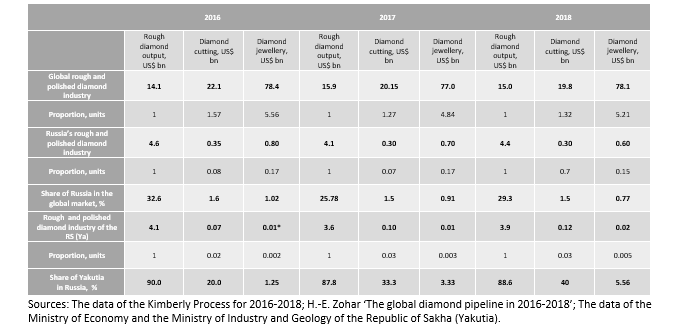
Diamond cutting and jewellery manufacturing being the luxury items production directly depend on the consumer purchasing power and, consequently, on the population’s standard of living in the country and the regions, and it has been constantly declining in Russia and Yakutia lately.
The diamond jewellery cluster of Yakutia
The performance of the diamond cutting and jewellery industries for 2018 is not exciting despite of the cheerful statements of the Authorities of the Executive Power of the Republic. In 2018, the decline in the cutting industry in US$ was 53.3% and in the jewellery industry it was 27% compared to 2011. This suggests that in these industries relating to the processing ones, there still has been a deep slowdown since 2011. As polished diamond manufacture and sale are only an intermediate diamond pipeline segment where the final product is the diamond jewellery sales, the performance figures for cutting and jewellery industry of the Republic are given both in US$ and roubles (Table 3).
Table 3
The performance of the diamond cutting and jewellery industries of the Republic of Sakha (Yakutia), 2011-2018
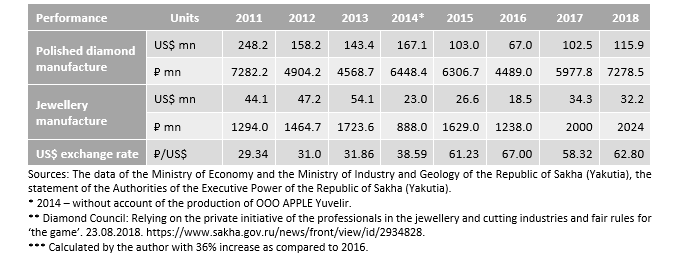
In 2018, only 4 cutting companies operated in the Republic of Sakha (Yakutia). Two companies – OOO Kristall-99 and OOO Tunalgy have gone bankrupt and OOO NPK Apple diamond relocated its units to Moscow in 2014 and keeps on working there.
So, in spite of the availability of the unique raw material resources, the diamond cutting and jewellery industries of the RS(Ya) cannot fully fulfil this potential due to a number of objective and subjective reasons.
The reasons for the crisis
The main reasons for the crisis in the global cutting industry as well as in Russia, including Yakutia are as follows:
First, synthetic diamonds and the polished diamonds made out of them weighing under 1 carat have already started to force out the natural ones from the market thanks to their lower price and changed attitude of the average consumers towards them from the fast expanding economies having large population - China, India.
Second, there is a decline in the population’s purchasing power in Russia due to its inability to pay back high-interest consumer installment loans and real estate credits and partly due to the economic sanctions imposed by the West.
Third, the legislative basis regulating the activities of the enterprises and organizations relating to diamond cutting, jewellery manufacturing and sales in India and Russia do not contribute to their efficient development because of toughening the cutting companies crediting requirements and increasing the taxes.
Fourth, there is still no clear strategy and policy of the development of the diamond cutting and jewellery industries for the future in the Russian Federation and the Republic of Sakha (Yakutia), and in spite of their clear interconnection, they develop independently without using the advantages of the cluster development based on the co-operation in the diamond jewellery market.
Fifth, the sales of goods and poor management still are the vulnerabilities of the Yakutia’s cutting industry. The products of the Republic’s cutting companies are not competitive in the foreign market due to its very small-scale, and in the domestic market – due to the sharp decline in demand. That is why the companies of the Yakutia’s cutting industry are in severe crisis, and it is possible to overcome it via the considerable state support only.
Yury Danilov, Ph. D., Lead Research Fellow at the Subsoil Use Innovative Economics Laboratory of the North-Eastern Federal University named after M. K. Ammosov
