Kimberley Process
The Kimberley Process is an international organization that regulates the global circulation of rough diamonds. The main goal of the process is the fight against the so-called ‘bloody’ diamonds. The ‘bloody’ diamonds were mined illegally and the money from their sale were used to finance armed terrorist groups in the world, as well as the corrupt regimes in the African countries. The organization was named after the South African city of Kimberley where a meeting was held in 2000 at the initiative of South Africa, Botswana and Namibia to find a solution to the ‘bloody’ diamond problem.
At present, over 80 countries are the members of the Kimberley Process. Russia joined the organization in 2000, a few months after its establishing. In 2005, Russia chaired the Kimberley Process. In 2019, the chairmanship was held by India. In 2020, Russia chaired the Kimberley Process. The key idea of the Russia's chairmanship in the KP will be the fight against the inflow of synthetic stones in the global diamond market, as well as the providing of equal conditions for all the participants in this market.
The organization’s main document is the Kimberley Process Certification Scheme (KPCS) adopted in 2002. It was accepted in order to prevent illegal diamonds from entering the market. According to the Kimberley Process terms, since 2004, full statistics on the member countries have been published annually. At the end of July 2019, the annual report for 2018 was released. The figures on the diamond imports and exports by the main diamond trading countries is given below for 2015-2018, according to the Kimberley Process data.
Diamond trade in 2015-2018
If we consider the diamond export-import operations in the countries of the world according to the Kimberley Process data, we can distinguish 8 top countries participating in the diamond trade with virtually no diamond mining in these countries (Table 1).
Table 1
Top diamond importers and exporters, 2015-2018
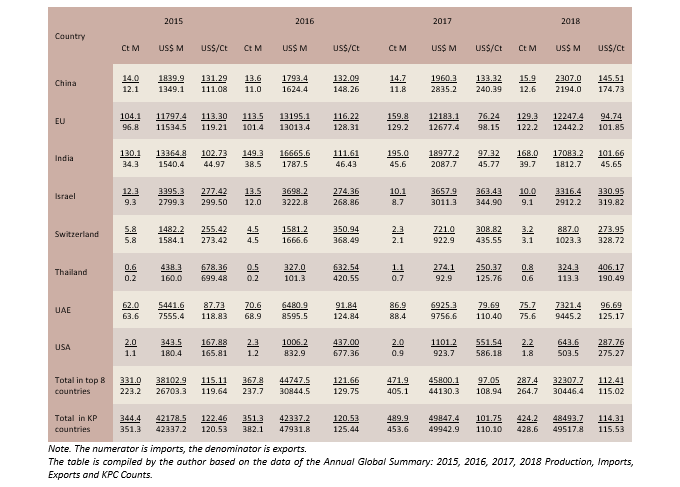
Approximately two-thirds of the world exports by volume and by value usually go through the eight leading diamond trading countries. Given that the jewellery industry is also developed in these countries, it can be argued that rough diamonds are cut there into polished ones that are inserted into jewellery and then sold around the world as the diamond jewellery to provide the final value of the diamond products.
The volume of world diamond imports and exports in 2018 was 2.6-2.9 times higher than the world diamond production by volume, and 3.3-3.4 times by value. This suggests that rough diamonds, before they are cut to become polished diamonds, go at least two more times through intermediaries who receive the additional profit from their resale. Among the intermediary countries, the United Arab Emirates should be mentioned that were able to become the world's leading diamond trading hub in a decade thanks to their advantageous geographical position. In monetary terms, the diamond trade surplus in 2018 in the UAE amounted to $2,123.8 mn.
The results of 2019 and future prospects of the diamond market
Based on the indicators of five top diamond mining companies - De Beers, ALROSA, Rio Tinto, Dominion Diamond Mines, and Petra Diamonds that produce approximately 75% of the world’s diamonds by volume and 80% by value - we can calculate that in 2019, 141.3 mn carats of diamonds worth $13,058.2 mn were mined in the world.
Compared with 2018, in 2019, diamonds were mined by 4.8% less in carats and almost by 9.7% by their sales value. Consequently, the diamond imports and exports will be lower. In 2020, the pressure from the lab-grown diamonds will increase, and it can be argued that the decline in natural diamond production will continue in 2020.
Yury Danilov, Ph. D., independent expert and analyst
