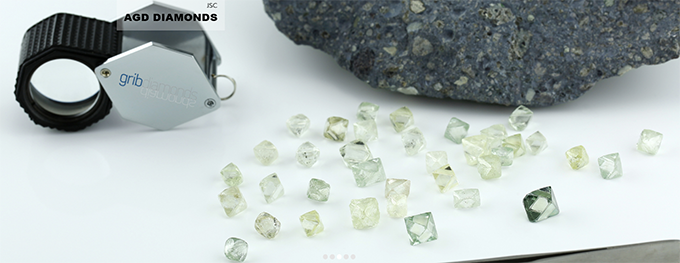
Image credit: Grib Diamonds
With all the changes occurring in the diamond supply pipeline, the big miners may consider the ways they sell their rough to the downstream market.
By Ya’akov Almor
During the past weeks and months, it has become apparent that the diamond industry and trade will never be the same again. We have all entered a new era, in which the old business thinking, methods, and structures will recalibrate. In an earlier article, I referred to the past as BC (Before Corona) and to the future as AC-(After Corona).
I was wrong.
We now live in a new Common Era - the Corona Era. The Corona pandemic, as a disruptor, as a symbol of disruption, and as a game-changer, is here to stay, in one form or another. Going forward, everything we will think, develop, build and do, will be guided by the uncertainty and changes that this disrupting pandemic has instigated.
There is no going back.
The large diamond producers, however, as demonstrated by their conduct during their last sales cycles, seem to think that the old ways of doing business will continue to work well for them. They apparently assume that the buyers from the midstream market will continue to submit themselves to their rather feudal sales models. A few weeks ago, De Beers’ CEO, Bruce Cleaver, lambasted the Indian diamond industry for placing a moratorium on rough buying for at least a month. To say that Cleaver’s “colonial glitch” was not received well is an understatement.
Joshua Freedman of Rapaport’s news service reported that during their sales cycles in June, De Beers and Alrosa had continued to maintain “their prices at pre-coronavirus levels, while other miners holding tenders in Antwerp have sold at prices 15 percent to 25 percent lower than in February.” Consequently, the large producers saw “rock-bottom sales as buyers rejected the miners’ high rough prices in favor of cheaper goods from smaller suppliers.” This makes sense because both manufacturers and traders were already “sitting on large inventories of polished and rough,” the latter they had paid for in cash.
On the other hand, the Russia-based news service Rough & Polished (R&P) reported in mid-June that Grib Diamonds, the Antwerp-based selling arm of diamond miner AGD Diamonds had sold more than 350,000 carats, for more than $20 million. As such, Grib effectively sold more than 90 percent of the goods on offer. R&P reported that “using its online appointments system and having introduced new measures to ensure the safety of all attendees and staff, over 150 companies were able to attend the viewing in Antwerp.”
And note this: “In a display of trust in its well-known sales assortments, some Grib customers that were unable to attend due to travel restrictions were even prepared to bid blind.”
How come?
Why does Grib succeed where the big boys do not?
It’s the system, stupid!
When it established itself in Antwerp, Grib adopted a rough diamond sales system that had earlier been developed and implemented by BHP Diamonds. This system is “a multi-round ascending clock auction. The clearing (winning) price is set by the highest losing bid. This means that the winners do not pay the price they have bid, but the price of the customer who narrowly missed.”
Grib’s “auction system was designed according to the latest auction and game theory. The methodology is based on the Nobel winning economist William Vickery’s auction theory on second price auctions. This gives the bidder the incentive to bid their true value on the goods – and not worry about the ‘winner’s curse.’ ‘The winner’s curse is when the winner, in a tender, tries not to pay too far over other bidders due to incomplete information. As a result of this, bidders “shade” their bids for fear of overpaying, thus not giving a true reflection of the market value.”
The most crucial feature of Grib’s auction model is that it protects the manufacturers and traders from themselves. By extension, it protects the market vertically. The rough producers get prices that reflect the actual market value. On their part, the manufacturers, who are provided by Grib with all the data and information from earlier sales, will feel confident to bid, knowing that when you overbid, you will not get the goods. Grib Diamonds’ website offers a detailed explanation of its auction and sorting systems.
Maybe this is the moment for the large producers, too, to rethink their sales strategies, methods, and structures and adopt a system that will be competitive, transparent, and accountable. The manufacturers, that market segment that is always between the proverbial rock and a hard place, would be best served by this system as the goods have the best chances of ending up in those hands that will handle them best.
Ya’akov Almor is a veteran strategic advisor and communications specialist in the international diamond and gemstone industry and trade.
