Diamond mining in Botswana
At present, in terms of diamond mining, this country rightfully has a world lead in the diamond production and the value of rough diamonds. Botswana is also among the major rough diamond exporters in the world, the dynamics of its diamond production and exports in 2006-2019 is given in table. 1.
Table 1
Botswana’s diamond mining and exports, 2006-2019
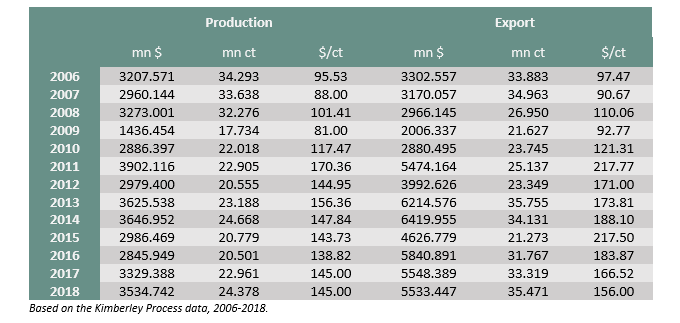
The analysis of the data in Table 1 shows that the leading diamond mining countries mainly export mined diamonds and this is where their participation in the diamond business ends. Botswana is an exception, it buys diamonds from the neighboring poor African countries and sells fairly large rough diamond volumes earning additional income from re-exporting rough diamonds through diamond exchanges in Gaborone and the UAE. In 2018, Botswana ranked 2nd in terms of its diamond production and the value of rough diamonds extracted lagging behind Russia in these indicators.
The Botswana’s diamond exports in 2013-2014 that are record figures in the history of diamond mining in this country show the potential of the country’s diamond mining industry. In 2019, rough diamond sales through De Beers Global Sightholder Sales (DBGSS) in Gaborone fell 25% year-on-year to $4.04 bn due to a sharp decline in the global demand for roughs.
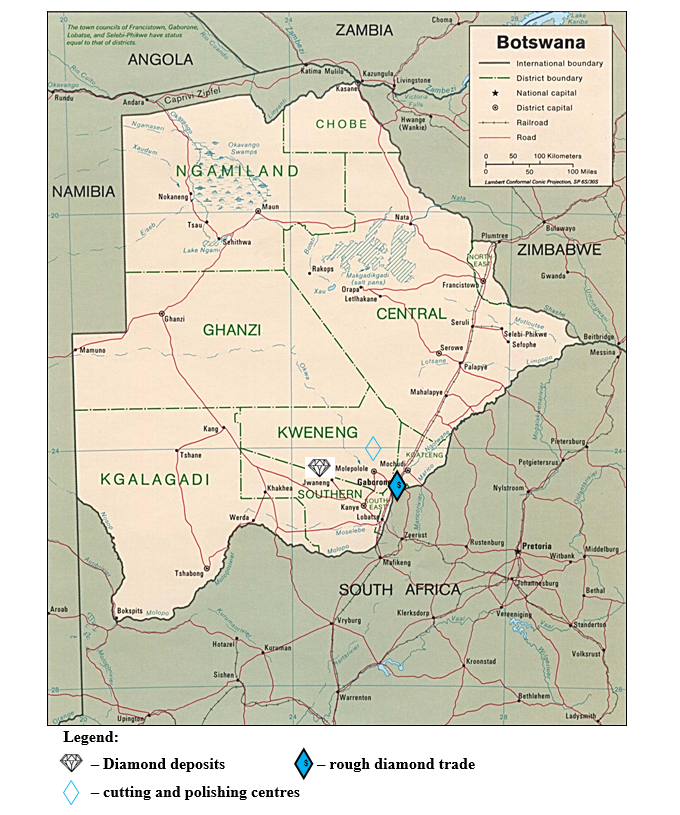
Figure 1. Botswana’s diamond industry.
Botswana accounts for over two-thirds of the De Beers’ diamond production, and rough diamonds account for over 80% of the Botswana’s export revenues and 25% of the country’s gross domestic product, as well as a third of the government revenues. Under the current sale agreement, De Beers moved its diamond tenders to Botswana from London, and the government got the right to sell 15% of Debswana’s diamonds on its own. The Botswana government and De Beers have equal shares in Debswana.
In Q4 2019, Debswana’s rough diamond output declined 7% to 5.9 mn carats as the production at the Orapa mine decreased due to the delay in its infrastructure project coupled with the predicted lower grade ore.
In 2019, the implementation of a large-scale beneficiation programme in Botswana was complicated by a decline in the demand for rough and polished diamonds. In 2020, a new global economic crisis came caused by the coronavirus pandemic.
The prospects for the Botswana’s diamond business development
The current stage of the Botswana’s diamond business development is characterized by the following factors:
1. From November 2013, the De Beers’ diamond trading operations moved to Gaborone, the capital of Botswana, and the required infrastructure was made in the country.
2. The beneficiation process in Botswana faced serious difficulties during the new global economic crisis and is currently stagnating.
3. The implementation of the anticipated scale and volume of the diamond industry development in Botswana raises certain doubts due to the deep crisis of the global economy.
Yury Danilov, Ph. D., independent expert and analyst
