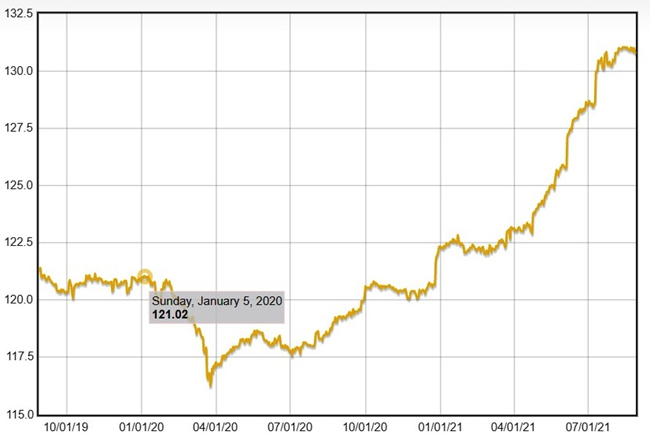
This is the IDEX Diamond Index chart showing the dynamics of the diamond prices from 2019 to the end of August 2021 (source - http://www.idexonline.com/):
And this is the S&P 500 Index chart over a comparable time:
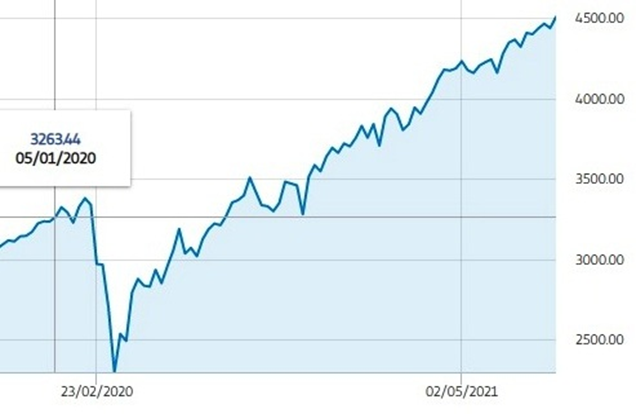
A high positive correlation is evident. It should be noted that in previous years, there was little or no correlation between the movement of the IDEX Diamond Index and the S&P 500 Index. The current situation most likely suggests that the two indicators under consideration are influenced by identical factors, which is understandable as the United States is still the world’s largest consumer of polished diamonds and, apparently, will maintain this status for a long time to come.
The dynamics of the S&P 500 Index in the period under review was determined by two main factors: the COVID-19 pandemic (and, accordingly, the measures to fight against it, including the restricted movement of people and the decline in the service sector) and the unprecedented “injection” of liquidity to the markets by the US Federal Reserve that started in October 2019, growing steadily from $60 bn a month to today’s $120 bn a month. The influence of these factors on the record growth of the American stock indices is so great that all the other reasons can be easily excluded from the analysis. Equally, this statement applies to diamonds as COVID-19 significantly eased the pressure on this market from competing industries (such as a travel one), and the “pandemic” trend of a sharp Internet trade revival, which was very successfully used by jewellery retail, coincided with generous “helicopter money”, which ensured a steady rise in the diamond prices to new high levels.
Such a strong desire of both stock and diamond indices to reach absolute record values made many analysts ask quite reasonable questions, “When will this all burst?” and “What is the reliable sign indicating the bubble is about to burst?” In our opinion, since the reasons for the simultaneous upward movement of the stock and diamond markets are absolutely identical at the moment, the answer to these burning questions lies in the analysis of the inflationary processes and the likely reaction of the Fed to the inflation dynamics.
At present, the Fed is buying back the assets at a rate of $120 bn a month. This intensive money printing led to the inflation hitting a 30-year high in the United States (the price level of consumer spending reached 4.2% with a target of 2%). A significant part of this liquidity has already moved to the stock market, which has to some extent benefited from the inflation as many assets have shown the growth that is difficult to explain from the standpoint of the traditional indicators of economic efficiency. The diamond market fits into the same model as the prices were pushed up mainly by the money that the consumers got as a result of the fight against the coronavirus infection, and not by the unlimited supply of rough diamonds or by innovations in marketing. Thus, both the stock and diamond markets were in the focus of the inflationary pressure.
For the US monetary authorities, the fight against accelerating inflation became the most critical challenge. On August 27, 2021, at the economic symposium in Jackson-Hole, J. Powell, the Chair of the Federal Reserve, announced the possible start of curtailing the asset repurchases this year. Although he did not mention the timeframe, many experts think that the Quantitative Easing (QE) programme can be finally completed in the summer of 2022, which will lead to a steady achievement of the 2% inflation target. Of course, curtailing the QE is an inertial process, and the Fed’s balance sheet will continue growing for some time, although not as fast as today. And as long as this growth continues, one can hope for an increase in the polished diamond prices. But after the growth is over, unfortunately, the charts of stock and diamond indices, in our opinion, will diverge, especially if the interest rate remains near the current values. Most likely, this will happen in H1 2024.
Sergey Goryainov, Rough&Polished
