In 2019, the Moscow publishing house URSS put out a monograph by A. V. Nikolashchenko “World Diamond Market. From Inception to the Present State”. This very voluminous work (over 700 pages) was created by the author having over 35 years of experience in the diamond market as an employee of the Market Research Institute of the Ministry of Foreign Trade of the USSR, Almazyuvelirexport, and ALROSA. The abstract positions the work as the one slightly pulling back the “curtain over the world of the diamond trade closed from outsiders” and intended for specialists “in the field of diamond mining and trade, diamond manufacture, as well as for economists, historians, political scientists”.
Such extensive monographs are published rather rarely. It is all the more surprising that in the two years that have passed since its publication, the book by Nikolashchenko has not received any serious reviews and responses in specialized publications. Perhaps, this is due to the fact that the book does not have an electronic version, and the circulation of its paper version turned out to be insufficient to cover an adequate audience. Meanwhile, the work by Nikolashchenko deserves the closest attention, at least, because of its rather unexpected claim to be absolutely exclusive.
“Neither in the Russian nor in the foreign press, the specifics of the diamond market and trade have never been covered in any detail by people professionally connected with this area. This book is an attempt of this kind”1.
“How come!?”, an astonished reader can exclaim. “The collective monographs “The History of Diamond” (1997), “The World Diamond Market” (1999), “World Diamond Production” (2000), “The Phenomena of the World Diamond Market and Russia” (2017) are well known, as well as other comprehensive books; and the ALROSA’s presidents, analysts of diamond companies and the Ministry of Finance, discoverers of diamond deposits, participants in negotiations with De Beers were among the authors and editors of these books. Is it possible to deny that those people were professionally connected with this area!?” It turns out it is possible, dear reader! In the book by Nikolashchenko, you will not find a single reference to the listed works - apparently, in his view, their “amateurish” attempts are not worth mentioning.
Although such a bold Nikolashchenko’s move strongly resembles a joke about Lieutenant Rzhevsky and D’Artanyan, popular in the Russian-speaking audience, I still have to admit that his book is really exclusive. But not so much in terms of any new information about the diamond market, as in the methodological principle used by the author.
This principle can be briefly described as follows: the diamond market should be studied exclusively as a “closed” system of production and trade relations, without trying to explain the course of events by the factors lying outside the boundaries of the diamond market. To put it even simpler: you cannot interfere with politics in the market analysis, because in this case, it is a “conspiracy” based on rumours, conjectures and irrelevant information instead of analysis.
Nikolashchenko writes, “The most daring speculations said that De Beers was part of the “global power brokers” connected with the intelligence services of the leading world powers, with the British crown, as well as with the financial elite - from the Rothschilds to the Morgans. The monopoly seemed like some kind of octopus with tentacles to every part of the world, it seemed like an all-searching eye from which it was impossible to hide”2. Further, as an example of this kind of harmful “conjectures” is a quotation from my book “The Battles of the Diamond Barons” (2013), to which the author has clearly negative emotions, and all ends with a peremptory verdict “the bridge thrown to geopolitics collapsed at the slightest touch”3.
Nikolashchenko tries to consistently use this methodological principle declared on the first pages of his monograph through the entire text. The result is a very interesting experiment that consists in trying to “free” the diamond market from the influence of political factors as much as possible and studying the market in such a “refined” form. Let’s try to assess how successful this experiment was.
Most of Nikolashchenko’s monograph is, in fact, a literary review of various public sources available in English, from comprehensive monographs to journal articles and corporate reports. The review is great! I have not seen anything like this in the Russian- or English-language literature on the diamond market. His impeccable scrupulousness in describing events, his attention to minor but vivid details, very particular details and nuances of mergers and acquisitions, an elegantly presented history of the pricing control mechanisms - all this makes the book by Nikolashchenko a must-buy for any analyst, journalist or historian writing on the diamond industry. And up to a certain point, the author succeeds in following this methodological principle; he devotes only a few lines even to the political biography of C. Rhodes, although huge volumes have been written about this exceptional man. Politics is separate, market is separate - no “conspiracy”!
But everything changes when the author starts describing the diamond market during World War Two. At this point, the diamond market and geopolitics intersect so clearly that Nikolashchenko’s methodological underpinnings burst like a soap bubble. Until now, no one in the world historiography has been able to give a clear answer to the question “Where did Hitlerite Germany, fascist Italy and imperial Japan receive industrial diamonds from and on what terms?” The Axis Powers did not control a single diamond mine, but their industry had been able to produce huge amounts of the most advanced weapons for many years using technologies identical to those used by the United States, England and the USSR. Therefore, the consumption of industrial diamonds should have been comparable, if not equal. And any researcher who has taken the trouble to study the history of the diamond market has to answer this question. Nikolashchenko also answered it:
“The Nazis continued to receive rough diamonds during the war. The US Office of Strategic Services (OSS, the forerunner of the Central Intelligence Agency) found out that the source was the Forminiere mines in the Chicapa region, the Belgian Congo. The Belgian police chief in Leopoldville was involved in this. All the attempts to trace the chain further ended in the arrest of the informant and the deportation of the OSS agent from the country. De Beers was deeply involved in the diamond industry of the Belgian Congo, and was also involved in ensuring the security of the diamond mines, and could, at least, have information about what was happening”4.
Only one paragraph in the 700-page book, and no “conspiracy”. Unfortunately, that’s not an answer. This is a farce. The Wehrmacht’s large formation of tanks, the Mussolini’s Mediterranean armada, the excellent carrier-based aircraft of Japan could not arise and develop without industrial diamonds. And was all this provided by the native policeman from Leopoldville? The publicly available English-language sources used by Nikolashchenko to write his version of the diamond story do refer to the OSS’s report, which tells about the leak of rough diamonds from the Belgian Congo to Germany in 1944. But this is just a small episode, that delivery did not cover even ten percent of the annual needs of the German (only German) military industry.
Today, the documents of the Committee on captured enemy equipment chaired by K. Voroshilov are at our disposal; the Committee was engaged in recording the industrial diamonds and diamond tools captured by the USSR in the Third Reich. The amount of this equipment was impressive - at least, the volume equal to the 3-year consumption by the Soviet defense industry. These tools were enough for three years of work of the new Soviet factories manufacturing the turbojet engines copied from the German samples, and some tools were left for S. Korolev so that he could imitate the FAU-2 engines. And in the documentation captured with these rough diamonds and tools, the source of supply is clearly seen. And this was not the Belgian Congo. So, when another Wernher von Braun’s masterpiece of engineering fell on the heads of the residents of Kent, Essex and Norfolk, they had to thank not the “chief of the Belgian police” for the unforgettable experience, the “well-doer” was much closer.
The military industry of Nazi Germany did not suffer from a shortage of industrial diamonds from 1933 to 1945. Moreover, the supplier was so generous that the diamond tools captured by the USSR allowed the Soviets to create new industrial sectors in the engine building (the first Soviet plant for the production of diamond tools was launched only in 1959). The motives for this kind of supplies are convincingly described in the monograph by Guido Preparata “Conjuring Hitler: How Britain and America Made the Third Reich” and I will not dwell on them in detail here. I would only like to note that today, we have the opportunity to document these “conspiracy theories”.
The beautiful and harmonious model of the “refined” diamond market collapses completely when Nikolashchenko comes to the export-import rough diamond operations and the formation of the USSR diamond industry. Here, we witness an outright fiasco.
“Were industrial diamonds imported to the USSR? It was not possible to find information on the import of rough diamonds to Tsarist Russia and the Soviet Union. Judging by individual references, they were imported, but the imports covered only about half of the country’s needs”5.
“It was not possible to find”, it is sad... In 2019... The first-ever book on the diamond market written by a professional, and such an unfortunate failure! All he should have done was to go to the State Archive of the Russian Federation, find case 965 in fund 5446 and open page 3. Voi là! The pattern of the USSR’s rough diamond imports is given here as described in the report of the People’s Commissar of Heavy Engineering V. Malyshev to A. Mikoyan, Chairman of the Economic Council under the Council of People’s Commissars of the USSR. All the information is given - both in terms of money, for various years, the commissariats involved, and the areas of use. But there is no complaint that the imports met only half of the requirements. Because this is nonsense - how was the second half covered, in Nikolashchenko’s opinion? Thanks to Holy Spirit or how? The document was declassified 20 years ago. But...”it was not possible to find”!
However, Nikolashchenko did manage to do something, “But M. F. Shestopalov initiated more than just an idea. The letter he wrote to I. V. Stalin, resulted in the establishment of a profile Geological Administration in 1946 that was later transformed into a Second Trust, which included the Central Geological Exploration Department (GED) the task of which was to search for diamond deposits. In 1946, M. F. Shestopalov was appointed the chief engineer and later the head of the VSEGEI’s Central GED”.6 (Note: VSEGEI is the A. P. Karpinsky Russian Geological Research Institute – ed.).
Generally speaking, mentioning the legendary diamond “hero” Shestopalov and his “miraculous” letter to Stalin vividly tells about the author’s lack of adequate understanding of the development of the Soviet diamond industry. Another thing is striking - every author who enthusiastically tells about Shestopalov’s letter to Stalin finds new details of this “sacral deed” that were not found in the previous tall stories. And where do they get them from? I have read the improbable stories about how Stalin sent a limousine and even an airplane to bring Shestopalov, how he stayed in a suite at the best hotels in Moscow, and how he spoke at the Kremlin angrily denouncing the stupid Stalin’s ministers of their unwillingness to explore and mine diamonds. Now, thanks to the efforts made by Nikolashchenko, Shestopalov “was appointed” to VSEGEI in 1946.
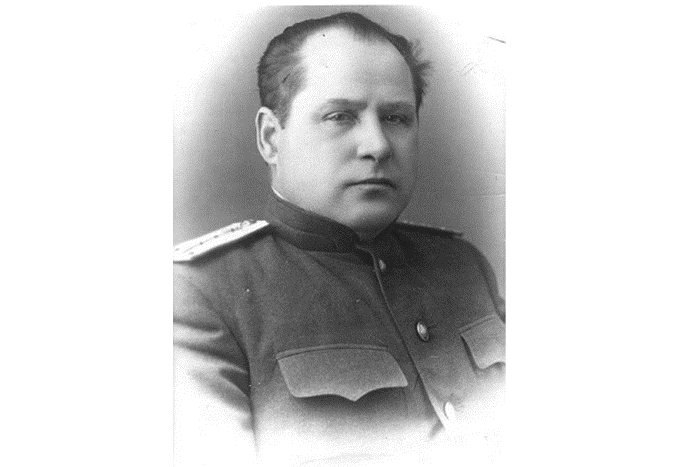
Especially for Mr. Nikolashchenko and other lovers of “diamond epic ballades”, we publish a photo made in 1946 where Comrade Shestopalov is depicted in the uniform of a captain of the Ministry of Internal Affairs. In this rank, Comrade Shestopalov served in 1946, in 1947, in 1948, and in 1949 and, of course, had no relation to VSEGEI. During these years, Comrade Shestopalov was the Chief Engineer of the Uralalmaz Trust, and concurrently Deputy Head of the Kusinsky Penal Labour Camp (KUSINLAG). And the letter written by Comrade Shestopalov to Comrade Stalin “resulted” in only one thing: instead of a prison uniform (on which L. Mekhlis, Minister of State Control Comrade, insisted for Shestopalov for his theft and sabotage) or even a bullet (on which the Minister of Non-Ferrous Metallurgy insisted), Comrade Shestopalov received the shoulder straps of the captain of the Ministry of Internal Affairs and was sent to be the head of the prison camp at the Ural diamond mines. Comrade Stalin’s sense of humor was... peculiar.
While Shestopalov’s adventures, although suitable for a book in the spirit of Dumas the Father, still do not critically affect the overall picture of the Soviet diamond industry development, another Nikolashchenko’s revelation is much more serious. “According to hints in some sources, it can be assumed that during the Second World War, the USSR bought rough diamonds for technical needs, and these purchases were made in England, which means, highly likely, through the rogue companies used by De Beers. With the onset of the Iron Curtain, the supplies stopped, which led to a surge in diamond prospecting and exploration in the country”7.
The mysterious “hints in some sources” - this is just the “Pravda” newspaper dated June 11, 1944, which provided accurate data on the supply of industrial diamonds from England under Lend-Lease. But the assertion that, with the onset of the Iron Curtain, the import of rough diamonds to the USSR stopped is an outright lie. The rough diamond supplies from England to the USSR did not stop in the post-war years, but increased several times compared to the pre-war supplies, and in 1952, they exceeded the pre-war supplies by an order of magnitude! As a result, Gokhran accumulated a rough diamond stock that met the needs of the Soviet industry for future 10-15 years. Consequently, the reason for the “surge in diamond prospecting” could in no way be associated with the fictitious “diamond embargo”. Since we published the archival documents on these deliveries in 2018 (that is, a year before the publication of the book by Nikolashchenko), I have to state that Nikolashchenko deliberately resorted to falsification fundamentally distorting the history.
I could have mentioned many more serious mistakes in Nikolashchenko’s book, but my publication would have turned into a book instead of an article. This is, perhaps, too early, since we have published so far no more than a quarter of the declassified archival documents that are at our disposal, and there are still many “wonderful discoveries” in the future. It should only be noted that we, as “conspiracists” relying on “rumours” and “conjectures”, are ready to put a dozen, or even a hundred, declassified archival documents to prove each of our “conspiracy thesis”, and we know exactly where the rest ones are. But in the “epic work” by Nikolashchenko, there is not a single correct reference to the archival documents.
We would very much like to receive an answer from Nikolashchenko and other real experts in the rough and polished diamond trade to our question - why all the documents on the purchase of rough diamonds in England in 1951 to 1953 were classified “top secret”? Secret from whom? The Soviet side was in the know, the British side was in the know. Who shouldn’t have known anything about these deals? About deals in London at the height of the Korean War, when the Soviet, British, American, Canadian, Australian, South African pilots shot down each other by the hundreds in the name of the triumph of the ideals of communism or democracy - whichever they preferred? And why is nothing mentioned about these supplies of industrial diamonds (perhaps, the largest ones in the history of the diamond market) in the English-language sources so carefully studied by Nikolashchenko? Isn’t there a “conspiracy”, plot, tentacles of the “global power brokers”?
Or here’s another good question - why are the 2nd and 3rd volumes of the “Report of the USSR Ministry of Internal Affairs Brigade on the Results of the Survey of the Vilyui Diamondiferous Region” declassified, and the 1st volume is still classified? Volumes 2 and 3 describe in detail what diamond deposits should be developed by the GULAG in Yakutia in 1952, how many prison camps were to be set up for this, how many prisoners were required there, where roads were to be laid, where harbours and power plants were to be built. What’s in Volume 1? Well, we are the “conspiracists” guided by speculation, all sorts of rumours... So, we can assume (just assume, of course) that there is an explanatory note (as in any project) describing why the Yakut diamond deposits needed to be developed, where these rough diamonds were to be sent... Maybe, they were planned for an immediate export and the counterparty was indicated there. And maybe, out of respect for this counterparty today, 70 years later, such documents continue to remain classified in violation of all legislative norms. Why are the data, for example, on the mission of the officers (mining engineers) of the USSR Ministry of Internal Affairs to South Africa in 1946 to study the experience of diamond mining still classified? There is a decree signed by Stalin, and it has been declassified, but the report on this business trip is not available. The reader is completely at a loss - who was the host, who mined diamonds in South Africa in 1946?
To be continued
Sergey Goryainov, Rough&Polished
1 A. V. Nikolashchenko. World diamond market. M., URSS. P. 9-10.
2 A. V. Nikolashchenko. World diamond market. M., URSS. P. 10.
3
Ibidem.
4 A. V. Nikolashchenko. World diamond market. M., URSS. P. 461.
5 A. V. Nikolashchenko. World diamond market. M., URSS. P. 641.
6 A. V. Nikolashchenko. World diamond market. M., URSS. P. 619.
7 A. V. Nikolashchenko. World diamond market. M., URSS. P. 642.
