Diamond producers reduced their production by 20% in 2020 from 2019 levels to 107 million carats, according to ALROSA.
“The natural decline amid planned decommissioning of large, depleted deposits was exacerbated by COVID-19 and consequent lockdowns,” it said in a market analysis last year.
“A key milestone for the entire diamond industry was the closure of Australia's Argyle mine in November 2020, which accounted for up to 10% of global diamond production.”
Data released by Bain & Company shows that rough diamond prices fell 7% in 2019 and 11% in 2020.
The increase
ALROSA said diamond miners ensured the stability of the industry by following a “'price over volume'” strategy during the crisis, until demand stabilised, creating the conditions for the price growth recovery.
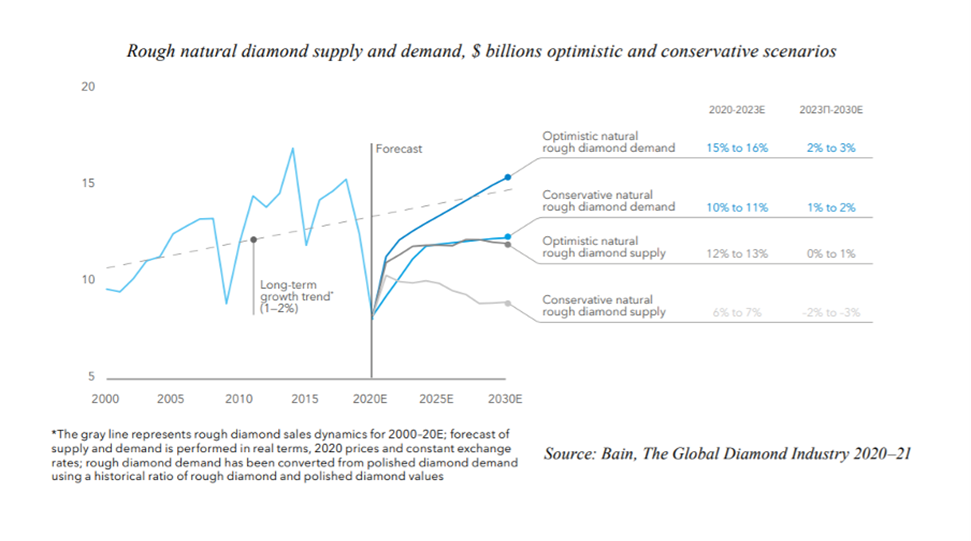
The deficit caused by the scarcity of the diamond supply is expected to increase over time, according to Bain.
“Even if demand follows the conservative scenario while mining production grows along with the optimistic one, demand will still exceed supply by the second half of the 2030s,” ALROSA projected.
“This means that the problem of the widening deficit will be resolved mainly by rising prices for rough and polished diamonds”
We saw De Beers increasing its rough diamond prices by about 23% in 2021.
It did not end in 2021 as the miner continued increasing diamond prices at its recently conducted first rough diamond sale of the year in Gaborone, Botswana.
Bloomberg cited unnamed sources as saying that the diamond giant hiked the price of larger stones by about 5%, while some smaller rough stones registered prices increases by about 20%.
Rapaport also noted that the price increases for larger stones varied between 5% and 12%, while that of smaller stones rose by about 15%.
There was greater demand for diamonds from major retailers in countries such as the US and China last year as sources for diamonds continue to dwindle.
Diamond industry analyst Paul Zimnisky told Rough & Polished that the reason why De Beers increased diamond prices is that there still seems to be a supply/demand imbalance in rough, which seems to be more even pronounced in early-2022 as the industry restocks after the holiday rush.
“After record end-consumer demand for natural diamonds in 2021 along with limited supply, it doesn't seem unreasonable that diamond prices are back at the record high reached in 2011,” he said.
Although the previous price increases were on larger stones, the focus is now on smaller, cheaper stones.
“Smaller diamonds, used in cheaper jewellery sold in places like Walmart Inc., struggled for years amid over-supply. However, they rallied strongly toward the end of 2021 as supply tightened and higher quality goods went up in the price,” writes Bloomberg.
“That led to a frenzy of buying in the secondary market, where accredited De Beers and Alrosa buyers sell to other gem manufacturers. That spurred De Beers to respond by raising its own prices.”
Zimnisky said ALROSA indicated that they see room for moderate price increases in the near term, given the "'structural supply deficit’".
Asked whether the industry would likely see more price increases going forward, he said:
“I do think diamond prices in general end 2022 higher than they started, although I don't think the trajectory of price rise we saw in 2021 is sustainable. So, I do think we see higher prices, but at a more moderate pace.”
Mathew Nyaungwa, Editor in Chief of the African Bureau, Rough&Polished
