Yesterday, the Krasnoyarsk Economic Forum, which traditionally discusses the economic development prospects of Siberia, completed its work in Krasnoyarsk, Russia.
Rough&Polished's Editor in Chief of the African Bureau, Mathew Nyaungwa participated in the forum online panel session, "Global Trends in Human Capital."
This article is a result of opinions and information exchanged between experts.
Mining has been historically a domain for men as it was considered ‘masculine’, while women were relegated to domestic work or the so-called ‘feminine’ jobs.
This perceived binary opposite has defined gendered roles in most mining countries and communities.
According to the World Bank, mining companies rarely employ, on average, more than 10% of women in their workforce.
A 2013 study of women on the boards of mining companies by PricewaterhouseCoopers found that women held only 5% of seats on boards at the top 500 mining companies.
The mining industry was also said at the time to have had the lowest number of women on boards of any sector in the world.
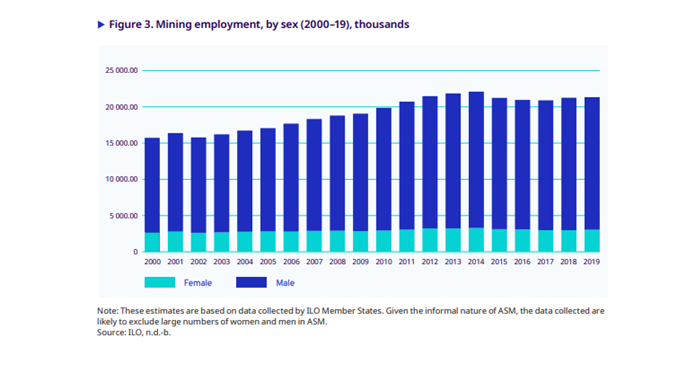
According to ILO modelled estimates, some 21.4 million workers were employed in mining and quarrying in 2019, of which an estimated 18.3 million were men and 3.1 million were women.
While employment in mining and quarrying has grown over time, the number of women has remained relatively stable and the share of women has remained low.
Women in leadership positions
While the mining sector remains male-dominated, women work in an increasingly wide range of roles, including as board members, chief executive officers (CEOs), mine managers, mine engineers, mineworkers, administrative staff, contractors and suppliers, inter-alia.
PricewaterhouseCoopers noted in another report on the top 40 mining companies that the proportion of women on boards rose marginally from 19% in 2018 to 21% in 2019.
In Africa, Lucara Diamond, which wholly-owns Karowe mine in Botswana, is leading other diamond companies in gender inclusivity and quality.
Lucara Botswana’s managing director Naseem Lahri is a woman.
Lucara’s CEO is also a woman.
At least 75% of the executive team at the group level are women and 67% in Botswana.
In Russia, there are efforts to promote the professional development of women in the mining industry.
The Autonomous Non-Commercial Organization (ANCO) was established in 2020 jointly by the leaders of the Russian metallurgical industry to promote women's leadership development programs, popularize engineering professions, and provide a platform for professional communications.
Nornickel is a key partner of the organisation.
In 2021, WIM Russia launched the only Russian Talented Women in Mining Industry Award.
According to the data provided by Daria Kryachkova, Vice President of Norilsk Nickel a total of 237 applications were submitted from 24 companies in the field of mining, and 63 finalists were selected, of which four employees of Nornickel became winners.
These include Olga Merezhko, Deputy Chief Mechanic for Buildings and Structures of the Komsomolsky Mine, Olga Alexandrova, Process Engineer of the Technical Department, Nadezhda Metallurgical Plant and Daria Ermakova, Chief Specialist in the management of sustainable development of the Kola MMC.
In total, 11 representatives of Norilsk Nickel made it to the final of the competition.
In a nutshell, more should be done to encourage women’s participation in the mining industry.
Women should not only be engineers or mineworkers, but they should occupy top positions.
Mathew Nyaungwa, Editor in Chief of the African Bureau, Rough&Polished
