This October, the International Antwerp Diamond Conference-2007 showed that a range of industrial professionals were skeptic towards the idea of developing national lapidary industries in the African diamond-mining countries and that populist argumentation in favour of African diamond cutting had little in common with economic realities.
The pro arguments come down to a thesis very attractive by its simplicity: since diamonds are mined here, they should be cut and polished here as well, because local cutting and polishing will add taxes to the budget and solve the unemployment problem at least partially. As early as 2005, the President of Namibia told, “This (Development of diamond cutting. – Editor’s note.) will not only correspond to the efforts of the Namibian people to add value to our natural resources locally but will also allow to create new jobs and to increase the level of new technologies introduced into our economy.”
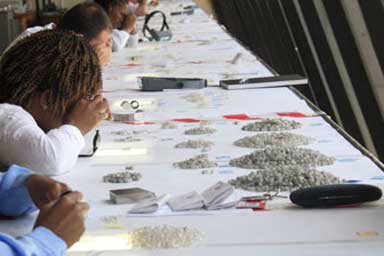 The contra arguments are not so evident but their scrupulous consideration may permit to understand the real reasons of this trend seriously bothering the market.
Let us start with the fact that Africa has once already passed through a negative experience of creating its national diamond cutting industry. After the fall of apartheid (1994) the Diamond Council of South Africa sold over 1000 licenses for cutting enterprises to black citizens of this country but the greater part of these firms quickly went bankrupt while the rest engaged solely in dealer business.
In the decade, which followed, the idea of cutting diamonds in Africa was discussed rather drowsily, but in 2005, it survived a real renaissance. Almost simultaneously high-ranking government officials and political leaders of South Africa, Namibia and Botswana set forth very resolute proposals to establish large-scale lapidary industries in these countries combined with drastic criticism of De Beers. Thus, in July 2005 the President of Namibia meeting De Beers’s owner Nicky Oppenheimer noted that Namdeb – a subsidiary of De Beers in Namibia – was not going to do anything for the country where it was mining diamonds. Namibians, said H. Pohamba, felt that more diamonds should be prepared in Namibia for the international market, and not outside the country. “We view our diamonds as a natural endowment bequeathed to our citizens”, he said. “They are a national heritage that must be used to improve the livelihood of our people.”
This time the standard populist wording of the black leaders was topped with serious organizational proposals to transfer the world center, engaged in sorting out and selling rough diamonds, from London to Botswana, to take up radical legislation acts giving significant preferences to local diamond cutters in accessing rough diamonds, such as the Diamonds Amendment Bill, and to start constructive negotiations with De Beers about setting up joint networks to supply rough diamonds to African lapidaries. Unlike the events, which had taken place ten years before, this process looked much more serious and was hardly to be explained away as another outburst of national self-awareness.
Indeed, in 2005 the world diamond market lived through such events, which, if collated, would lead to an assumption permitting to explain the eagerness of Botswana, Namibia and South Africa to become world lapidary centers and to anticipate the midterm outlook.
By the summer 2005, the prices for rough diamonds reached their maximum in the period beginning from 2000 when De Beers declared its monopolistic market regulation ended and started its Supplier of Choice strategy. At this peak (in July, August and September 2005) De Beers sold three record-breaking sights worth $750 million, $850 million and $750 million correspondingly, which caused a fast drop of prices – by the end of September they were already down by 10% and analysts predicted a long-term recession.
The deck was swept in a superb way, and to topple the whole thing by 2005 De Beers got rid of rough diamond stocks – an efficient but a very expensive instrument of monopolistic market regulation. By that time, the stocks of De Beers were approximately cut down to an average annual value of its three sights, whereas in 1998 they were equal to the value of 14 sights. Thus, De Beers’ stocks were being consecutively decreased in the course of five years on the background of continuous price rise and the process was stopped shortly before the prices went down.
However, the proper output of rough diamonds by De Beers, ALROSA and other producers was increasing during all that time.
In 2005, the tension between De Beers and the European Commission was growing: the joint proposal of De Beers and ALROSA in June to gradually cut the supply by 2008 and – its main point – to keep the annual supply at $275 million starting from 2009 was not supported by the European Commission. In February 2006, the European Commission took a decision obliging De Beers to stop buying diamonds from ALROSA both directly and through intermediaries.
By 2005, the budgets of South Africa, Namibia and Botswana looked well and were noted for great reserves of foreign currency. It was obvious that these countries were able to give necessary current capital (approximately $1 billion per year as a whole) to buy rough diamonds for their national lapidary industries from producers working on their territories (i.e. from De Beers in the first place).
On such a background, the concurrent initiatives of these countries aimed at fast and large-scale development of their own lapidary industries may be easily interpreted as follows. The price drop started in 2005 and the simultaneous increase of diamond mining by major producers made it clear that actual elimination of the basic instrument (De Beers’ stocks) regulating supply in the market had been premature. At the same time, any return to the old pattern was evidently impossible after declaring the end of monopoly and taking into account the disagreements with the European Commission. However, an elegant decision was not long to come – approximately $1 billion worth of rough was to go to the lapidary industry of the diamond mining African countries to form up a unique temporary stock easing the pressure on the market and maintained at the expense of their budgets. The following pattern was to step in: rough would be bought at the expense of budget credits and passed over to the newly established national lapidary workshops, thus leaving the market for a certain time. After that, the market would see African polished diamonds, which may run into serious sale problems first of all due to their questionable quality explained by the lack of lapidary schools and traditions (just remember the experience of South Africa in 1994) and, secondly, due to the blockade by traditional lapidary centers which would hardly be ready to let new competitors to the market networks unharmed.
The above scenario may be detailed by the joint project of De Beers and the government of Botswana aimed to set up a lapidary industry in this country. Within this project, they plan to establish a joint venture with equal participation, which will sell $550 million worth of rough to the newly born Botswana diamond cutters every year. The Botswana government is quite capable to credit the newly built national lapidary industry to such an extent – the foreign exchange reserves of this country exceed $5 billion.
The average price of diamonds mined in Botswana is about $83 per one carat. It is improbable that rough offered to Botswana diamond cutters will belong exclusively to the “Indian commodities” range. It would be useless to compete with Indian diamond cutters in this field and it is not so much because of the low priced labour (the wages received by Botswana diamond cutters will be probably equal to those received by their Indian counterparts) but because of the marketing patterns built during many decades. It is more likely that they will receive rough diamonds whose value will reach 85% – 90% of the downstream diamond cost. But this means that the amount of money allocated for wages in this industry (i.e. the direct social effect) will fluctuate somewhere close to 5% of the rough cost and will be equal approximately to $27.5 million per year in absolute expression. It is difficult to say now whether this industry will be able to obtain profit, to reach a breakeven level or it will go bankrupt. However, let us make a generous assumption that it will manage to follow an ideal pattern, close to the Russian one, gaining a 2% profit from the rough cost or $11 million in terms of money. In Botswana, the profit tax is 10.9%, while wages are zero taxed.
So, putting into circulation $550 million of budget assets Botswana will receive $1.2 million in taxes (at best) and will create $27.5 million worth of jobs staying at a significantly high level of commercial risk. It is difficult to offer a more ineffective way of using budget means. Especially taking into consideration that all that “social effect” is equal to 1% - 1.5% of the annual diamond export of Botswana and it may be reached without any risks just by increasing the export duty to that extent. However, such a simple decision is just out of question since in this case the burden will be born not by the Botswana budget, but by the budget of De Beers.
Half a billion dollars of budget money could be spent more efficiently, if we take into account that only the official unemployment in Botswana exceeds 20% of the employable population (according to some estimates, the actual unemployment is close to 40%), that over 45% of its population are rated as poor and chronically lack drinking water and that Botswana is in the second place in the world by AIDS incidence.
It is unlikely that De Beers’s experts and government officials of Botswana are not able to perform such simple calculations and so there is no doubt that the demands to set up lapidary industries in the above-mentioned diamond-mining countries under the slogans of increasing employment of their population and extending the tax base are nothing more but a populist gimmick used by diamond market players in their own aims but having nothing to do with real measures to improve the living standards of population in these countries.
Rough&Polished
