It was reported on 16 September 2014 that Zimbabwe’s Pen East Investments had teamed up with Vi Holdings through its JSC Afromet subsidiary, to form Great Dyke Investments (GDI), which planned to develop a $3 billion platinum mining project in Darwendale.
It was also revealed at the time that Russia’s Vneshecombank would be the lead financier, while arms conglomerate Rostec was a technical partner.
The Darwendale project, which is located in the mineral-rich Great Dyke belt was touted as the single biggest investment in Zimbabwe since independence in 1980.
The mine had a lifespan of 20 years, with the potential to reach 34 years on further exploration and would see the Darwendale concession on 217 million tonnes of high-grade ore.
“The advent of the Russians in Zimbabwe’s platinum scene will bring an additional 250,000 ounces to our current output of 430,000 ounces within the next 36 months,” Mines Minister Walter Chidhakwa was quoted as saying by The Source, a Reuters affiliate publication in Zimbabwe.
The project was structured in three phases.
The first phase was to run from 2014 to 2017, focusing on exploration and infrastructure development, while the second phase was expected to run from 2018 to 2021 focusing on the construction and commissioning of two underground mines and the second processing plant.
The third stage from 2022 to 2024 was to focus on the construction of additional mines.
Then-President Robert Mugabe and Russia's Foreign Minister, Sergey Lavrov as well as Minister of Industry and Trade Denis Manturov oversaw the signing of the deal.
“We couldn’t do it with enemies. No. We can only do it with our friends,” Mugabe said at the time, after hosting Lavrov at his rural home in Zvimba.
Lavrov and Manturov are still occupying their ministerial positions in Russia, while Mugabe was deposed in the so-called bloodless coup in 2017 and died a bitter man in 2019.
The first stage of the project was initially scheduled to be completed in 2017 with production earmarked for 2021.
The man who took over from Mugabe, President Emmerson Mnangagwa tried to revive the deal when he travelled to Russia in January 2019.
The state-controlled media in Zimbabwe reported on 27 January 2019 that Mnangagwa’s visit to Moscow had “unlocked” $300 million that “will trigger implementation” of the platinum mining project.
Stalled
The Centre for Natural Resource Governance (CNRG) said mining preparatory works started in 2020 with
establishment of two portals for the mine.
"Shortly afterwards, in 2021, the mining project stalled," it said.
So what went wrong?
Bloomberg reported on 28 February 2022 that the joint venture partners were battling to raise $650 million to get the project on track.
They then asked Impala Platinum Holdings to become the project joint venture partner, but its desire to get clarity over the ownership of a state-run company before pumping capital into the project is stalling progress.
The company that Impala was referring to is Kuvimba Mining House, which is 65%-owned by the Zimbabwean government.
Harare established Kuvimba in 2020.
But how did it become the shareholder of GDI?
GDI reported in October 2019 that its local partner was Landela Mining, a subsidiary of commodity trading firm Sotic International Ltd, linked to Zimbabwean fuel tycoon Kudakwashe Tagwirei.
Pen East, owned by the military had initially partnered with the Zimbabwe Mining Development Company to establish GDI before the Russians came on board.
Pen East sold its stake as they were speculations that the military’s involvement in the project was scaring away investors.
GDI then sold a 4.4% stake to Fossil Mining led by Obey Chimuka as it sought to raise $30 million to develop the mine and this left the Russians and their Zimbabwean partners with a 47.8% stake each.
Chimuka is the chief executive of Fossil Holdings, a subsidiary of Tagwirei’s Sakunda Holdings, according to CNRG.
The Landela Mining Ventures' stake in the GDI venture is listed under the Kuvimba Mining House portfolio of assets.
Impala is concerned about the ownership structure of GDI, especially the alleged involvement of Tagwirei.
Tagwirei was sanctioned by the United States and that means Impala, which has a listing in the U.S. and assets in Canada, will have to comply with any instructions issued by the U.S. Treasury concerning the Zimbabwean tycoon.
Bloomberg reports that an agreement with Impala would have made it easier for financiers led by the Cairo-based African Export-Import Bank to raise the funding for the platinum project.
CNRG also commented: “The lack of transparency on who is the owner of Kuvimba Mining House has negatively affected efforts to attract a new funding partner for the Darwendale mine. Investors fear that Kuvimba Mining House is being used to mask the face of the military in the project.”
The organisation suggested that the government cancels the current Darwendale agreement and searches for new investors in a transparent manner.
Although, Harare is not expected to follow such an advice, Vi Holding said early June that it had exited the Darwendale project citing sanctions imposed against Russia because of the Ukraine conflict.
Kuvimba is set to acquire the Russians’ stake, ending 16 years of their involvement with the project.
This development, coupled with the existing challenges as demonstrated above, means the project will remain a pipe dream.
Zimbabwe has the world’s third-biggest reserves of platinum group metals.
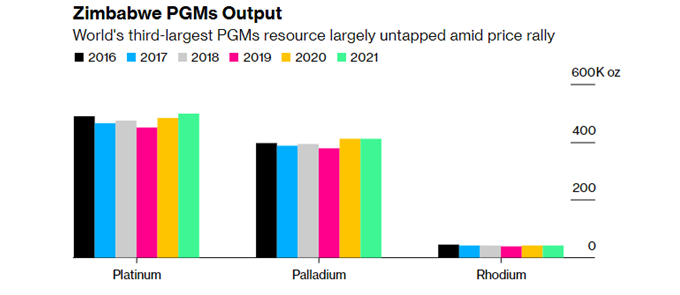
Source: Johnson Matthey/Bloomberg
Zimbabwe's platinum production rose 6% to 475 000 ounces from 448 000 oz in 2020, according to the World Platinum Investment Council.
Total output for 2022 is projected at 465 000oz, down 2.1% compared to last year’s output.
The Darwendale project was expected to produce 800,000 platinum ounces at its peak.
Mathew Nyaungwa, Editor in Chief of the African Bureau, Rough&Polished
