The Reserve Bank of Zimbabwe (RBZ) recently announced plans to start selling gold coins towards the end of July as a store of value to curb galloping inflation, which is eroding the local currency.
The country’s annual inflation reached about 192% in June, according to official figures.
However, American scholar Steve Hanke of Johns Hopkins University said Zimbabwe's annual inflation was now 426%, making it the highest in the world.
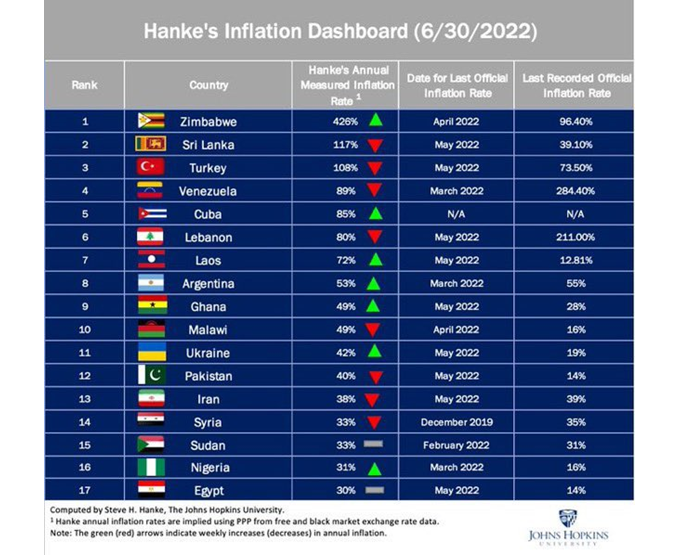
Hyper-inflation is still haunting Zimbabweans who watched helplessly as their savings and pension got eroded let alone enduring food shortages.
The official average inflation, which stood below 20% in the mid-1990s skyrocketed to 231 million percent in July 2008, forcing the government to instruct the body tasked with collecting the consumer price inflation data to stop producing inflation figures.
However, the IMF said following a visit to Zimbabwe in March 2009, that their calculations showed inflation peaked at 500 billion percent in September 2008.
In the second half of 2008, most unofficial rates had collapsed and the only surviving benchmark was the UN rate of $1 to Z$35 quad trillion.
As the Zimbabwe dollar plummeted, markets and the public adopted alternative pricing methods, including barter trade and reliance on foreign currency, largely the US dollar and the South African Rand.
Harare had no choice but to officially recognise the use of multiple currencies, which helped put to an end the hyperinflation.
On March 17, 2009, the new Government of National Unity (GNU) legally demonetised the local currency.
The IMF said the dollarisation saw inflation dropping to 3.2 percent by end of 2010.
When the GNU came to an end in 2013 and ZANU-PF led by the late president Robert Mugabe emerged victorious in the July 30, 2018, general elections, Harare returned to the old habits that brought the country to its knees.
The introduction of bond notes (a surrogate currency of the Zimbabwe dollar) pegged to the U.S. dollar in 2016 saw the emergence of a parallel market for foreign exchange.
The government of the current president Emmerson Mnangagwa then reintroduced the local currency in 2019, but its value has been falling like dominoes.
Magic wand?
Faced with this reality and the growing demand for the US dollar to hedge against inflation, the central bank introduced the gold coins as a store of value.
The "Mosi-oa-tunya" gold coin, named after Victoria falls will have liquid asset status.
“It will be capable of being easily converted to cash, and will be tradable locally and internationally,” said Mangudya, Governor, Reserve Bank of Zimbabwe.
“The coin may also be used for transactional purposes.”
He said the gold coin will contain one troy ounce of gold and will have a purity of 22 carats.
However, some analysts are not convinced that the gold coins will help end the country’s inflation problem.
A Zimbabwean economic analyst Tinashe Murapata said on Twitter that the coins will fuel inflation than curb it.
“What [will] stop the [government of Zimbabwe] from printing money to buy the [gold] coins?” he asked rhetorically.
He said the central bank lacks credibility in the eyes of the public.
“Money is as good as the issuer. RBZ doesn’t have credibility. So its coins must trade at par with gold bars. Only after independent authenticity and weight test,” said Murapata.
“Internationally, it will only be accepted as a gold bar.”
However, some people disagreed with him saying gold is the only true form of ‘money’.
“Everything else is fiat currency, gold has no counterparty risk that’s why it has been used as ‘money’ for thousands of years,” said one user.
The RBZ is not trusted by many people following years of poor monetary policies and at times operating outside its mandate.
As the debate rages on, only time will tell whether the Zimbabwean government has found a solution to halt the inflation through the gold coins coupled with its decision to allow the usage of the US dollar as a legal tender for the next five years.
Mathew Nyaungwa, Editor in Chief of the African Bureau, Rough&Polished
