According to Decree of the President of the Russian Federation No. 1203 dated November 30, 1995, consolidated information about Russian exports and imports of precious stones, except for natural rough diamonds, is classified as a state secret. Thus, it is impossible to assess the role of Russia in the world market of coloured gemstones based on the data of the Federal Customs Service, Federal State Statistics Service or the Ministry of Finance of Russia. Although the data on the precious stones’ balance reserves in the Russia’s subsoil are not secret, as well as the volumes of their extraction from the earth’s depths and production, nevertheless, it is better to focus exclusively on the available data on exports and imports obtained from foreign sources to avoid the risk of violating this Decree.
For an expert assessment, the data on the global trade in rubies, sapphires and emeralds obtained from the Internet platform Observatory of Economic Complexity (OEC) and maintained by Datawheel will be used, (https://oec.world/en/profile/hs/rubies-sapphires-and-emeralds-worked-but-not-set).
According to the OEC, the volume of global exports of cut and polished (worked) rubies, sapphires and emeralds (code HS6 ID 710391) reached $2.83 bn in 2020, which accounted for 64.7% of the entire market for coloured gemstones*.
The OEC allows you to trace the detailed dynamics of exports and imports for this code from 1998 to 2020, which is enough for a clear vision of the situation.
According to the OEC, the Russia’s share in the global turnover of cut and polished rubies, sapphires and emeralds was very small and amounted to only $0.468 mn in exports in 2020 (0.017% of world exports in this subgroup) and $3.88 mn in imports (0.14% of world imports) in this subgroup).
Exports of rubies, sapphires and emeralds from Russia, 2020
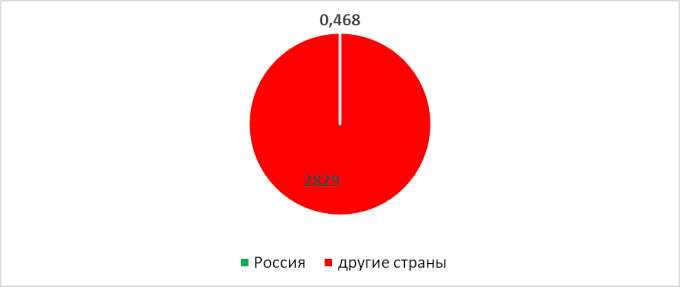
Green - Russia. Red - Other countries.
There is no commercial production and working (cutting and polishing) of rubies and sapphires in Russia at all, so worked emeralds make all the exports in this subgroup. Over the past quarter of a century, the emerald mining has been extremely uneven, which also had an impact on exports. Russia could not boast of regular customers on the world market either. In some years, there was a surge in the exports of emeralds:
- 1999, to the USA ($3 mn);
- 2011, to China ($4.52 mn);
- 2013, to the UK ($3.3 mn);
- 2016, to China ($1.73 mn);
- 2019, to Switzerland ($2.43 mn).
Over 25 years, there was also very insignificant (from less than $0.1 mn to $0.9 mn) and sporadic export of emeralds from Russia to Belgium, India, France, and Japan. Although over the last decade, the exports of emeralds from Russia have more or less stabilized, their volumes remained completely insignificant on the global market, and they showed a downward trend.
Imports of rubies, sapphires and emeralds to Russia, 2020
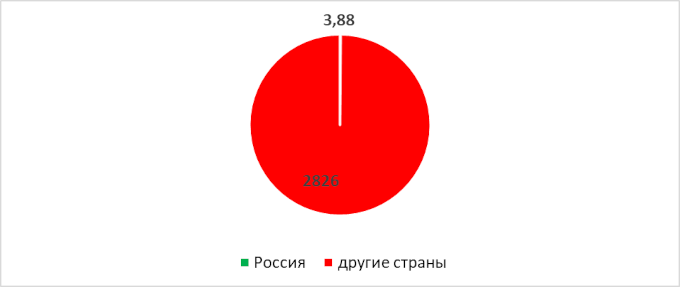
Green - Russia. Red - Other countries.
According to the OEC, imports of cut and polished rubies, sapphires and emeralds to Russia in any noticeable amount began around 2004. At first, the supplies were from Thailand (from $0.316 mn to a peak of $5.16 mn in 2008 and to the latest surge of $3.26 mn in 2014), but in recent years, the imports of these stones from Thailand have decreased significantly (down to $0.466 in 2020).
According to the OEC data, the peak year for Russia in terms of imports of cut and polished rubies, sapphires and emeralds was 2008 when, in addition the gemstones imported from Thailand, they were also imported from Great Britain ($2.66 mn), Hong Kong ($1.98 mn), Germany ($1.47 mn), as well as - in smaller quantities - from India, the United Arab Emirates, and Switzerland.
Since 2010, Armenia began to play the role of the main supplier of cut and polished rubies, sapphires and emeralds to the Russian market due to the development of the EAEU Customs Union. In 2010, the volume was only $0.103, reaching $10.4 mn in 2019. However, in 2020, there was a decline in the imports of these gemstones from Armenia, to $1.69 mn. That year, Switzerland supplied gemstones to Russia for $1.54 mn, Thailand - for $0.466, and Germany - for $0.095.
CONCLUSIONS
Taking into account the fact that in general, the share of Russia in the global production of jewellery is still higher, about 4%, and there is no own mining (and cutting&polishing) of rubies and sapphires in Russia (i. e., all these stones are imported to Russia), the Russia’s 0.14-percent share in the global imports of rubies, sapphires and emeralds is clearly disproportionately small.
The explanation can be simple: since the USSR times, Russian women have been accustomed to jewellery pieces exclusively with low-end studs made of synthetic stones. Countless cut and polished synthetic rubies of huge sizes (up to 10 carats and more) were displayed in jewellery stores in the Soviet times. There were rather fewer synthetic emeralds and sapphires, and coloured crystals were often used in jewellery pieces. In the country, there was no culture of having coloured gemstones at all.
Such asceticism in wearing coloured precious stones was successfully maintained all the years in new Russia, too. This is mainly due to national legislation that prohibits - with surprising persistence - the Russians not only to make transactions with precious stones, but even to store them if they are not in jewellery pieces, and a criminal liability is established.
The absence of a truly free market for coloured gemstones in today’s Russia has led to the degradation of the cutting and polishing industry and the lack of commercial promotion of the very idea of the value of owning natural rubies, sapphires and emeralds.
Today, few Russians understand the real value of high-quality coloured gemstones or have a practical interest in them at all. The Russians understand the value of diamonds, but they think that coloured precious stones are not valuable ... And only a small number of customers know to some extent the price depending on the quality of coloured precious stones.
Of course, there are exceptions to any rule. Some of the wealthy Russians purchased jewellery pieces with high-quality coloured gemstones when they travel abroad. Some bought jewellery items with high-quality rubies, sapphires and emeralds in Russia, mainly, from jewellers manufacturing very exclusive jewellery items that were piece works. But the mass production of jewellery with coloured precious stones in Russia was not of global scale.
In addition to the low demand for coloured gemstones, there are other factors in the Russian market that reduce the imports of rubies, sapphires and emeralds - the majority of the population are not wealthy, and the naive desire of wealthy people to buy some high-end goods at a low price. Therefore, those coloured gemstones that are still imported to Russia are usually of very low quality and small-sized. And the quality of cutting and polishing is poor, too.
And, besides, such gemstones (with a probability of 99%) are also significantly treated. Here is an example: if the gemstones are rubies, they contain much glass; if these are sapphires, diffusion (and not thermal treating) is probably used to improve their colour; if these are emeralds, they are very much impregnated, and it’s good if with colourless substances. That is why they are cheap.
Unfortunately, the domestic sale of high-end, untreated Ural emeralds is not promising in such a market - there is almost no demand for them. At least, there is no mass demand for them.
There are several other factors reducing the capacity of the Russian market for coloured gemstones. But these factors apply both to this particular subgroup, and to all the imported precious and semi-precious stones, precious metals, jewellery, etc. This is, first of all, administering the import procedure is complex and costly. In Russia, in addition to customs control, there is another so-called ‘state control’ applied to the imports of precious and semi-precious stones. And importing these precious goods is only possible through specialized customs points having a necessary competence, and the customs duties must be paid.
It is important that any type of business in Russia related to jewellery and precious metals and precious stones is very tightly controlled by the Russian State Assay Chamber according to the current industry legislation. Such control leads to higher business costs, decreases the margins and, ultimately, makes the business less attractive. And the introduction of the State Integrated Information System in the Sphere of Control over the Circulation of Precious Metals and Precious Stones (SIIS PMPS), made doing business related to precious metals and stones even more difficult and costly.
Is it possible to improve the situation in the coloured gemstones’ domestic market by increasing its potential capacity? Of course, it is possible, because historically, the Russians always loved gemstones. It is not their fault that the people turned out to get accustomed to the low-end synthetic gemstones and not to natural ones. If there is no promotion and advertising of goods - there is no demand; and there is no supply without demand. But no market can exist without being free.
All that needs to be done to develop a robust domestic market for coloured gemstones and increase demand for them is to make the market for coloured gemstones completely free through withdrawing the coloured gemstones from Articles 191 and 192 of the Criminal Code of the Russian Federation, as well as through changing the norms of the Federal Law “On Precious Metals and Precious Stones” by renaming it into the Federal Law “On Precious Metals and Diamonds”. That is, those objects of regulation should be mentioned that are really important for the national economy.
And the private initiatives will help develop the market of coloured precious stones, which, by the way, should be better called not ‘precious’ stones, but ‘jewellery’ (gem-quality) stones. The Russian market will become capacious - although not immediately, but in some years!
Vladimir Zboikov for Rough&Polished
* - other shares of the market of coloured gemstones are grouped under the code HS6 ID 710399 “Worked Precious and Semiprecious Stones,” ($1.13 bn, or 25.9% of the total market for coloured gemstones) and under the code HS6 ID 710310 “Precious, Semiprecious Stones, Rough or Partially Worked,” ($0.41 bn, or 9.39%).
