In this review of Russia’s role in the global market of coloured jewellery stones, the talk is about the rough semi-precious stones. According to the customs nomenclature, this is code 710310 - “Precious stones (other than diamonds) and semi-precious stones, unworked or just cut, crushed or semi-worked” (code HS6 ID 710310). To simplify this text, these gems are called “rough semi-precious stones”.
For an expert assessment, as before, we use the data on the international trade in rough semi-precious stones given by the Observatory of Economic Complexity, OEC (https://oec.world/en/profile/hs/precious-semi-precious-stones-unworked-partly-worke), and publicly available data for 2019-2021 given by the Federal Customs Service, FCS (http://stat.customs.gov.ru/analysis) .
According to the OEC, the global exports of rough semi-precious stones in 2020 dropped by 48.3% compared to 2019 to $0.41 bn, which accounted for 9.39% of the entire coloured gemstone market*.
* - other market shares of coloured gemstones are grouped under code HS6 ID 710391 “Rubies, sapphires and emeralds, worked” ($ 2.83 bn, or 64.7% of the entire coloured gemstone market and under code HS6 ID 710399 “Precious stones and semi-precious stones, worked” ($1.13 bn, or 25.9% of the entire coloured gemstone market).
The share of Russia in the global turnover of worked rough semi-precious stones, according to the OEC, was small, and in 2020, it amounted to $8.48 mn in exports (2.07% of world exports in this subgroup) and just to $473 thousand in imports (0.12% of world imports in this subgroup).
In 2020, the top global exporters of rough semi-precious stones were Hong Kong ($59.3 mn), Singapore ($45.3 mn), Thailand ($44.1 mn), the USA ($31.2 mn) and Brazil ($31.1 mn).
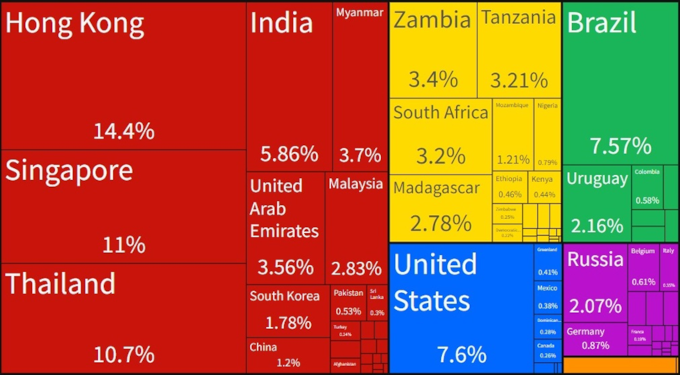
The shares of countries of the world in the exports of rough semi-precious stones
According to the OEC, Russia ranks 15th in the world by value of its exports of rough semi-precious stones. According to https://oec.world, the Russia’s exports of rough semi-precious stones over the last 25 years have been unstable, with spikes and troughs, and only in the last decade, the exports have gradually increased, but plummeted in 2020:
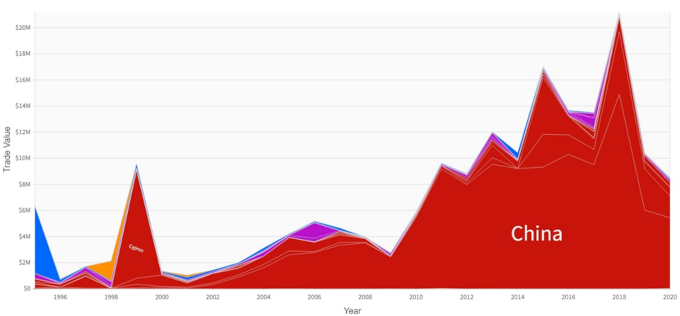
The dynamics of Russia’s exports of rough semi-precious stones, code 710310 (data from https://oec.world)
All these years, the Russia’s exports of rough semi-precious stones have been relatively stable to China, Hong Kong and India, according to the OEC. Moreover, China turned out to be the only country to which Russia’s annual exports exceeded $10 mn (in 2018, $14.9 mn) at least once. Russia’s annual exports to the rest of theses top three buyers have never reached even $5 mn; the record year of Russia’s exports of rough semi-precious stones to Hong Kong was 2018 ($4.82 mn), and to India - 2015 ($4.34 mn).
However, Russia’s exports of rough semi-precious stones to the United States soared ($5.13 mn in 1995, but in other years, it was maximum $475 thousand) as well as to Cyprus ($8.31 mn in 1999, with zero deliveries in other years).
The peak of Russia’s exports of rough semi-precious stones are as follows:
- Australia ($1.51 mn, 1998),
- Switzerland ($1.17 mn, 2006),
- Belarus ($730 thousand, 2017),
- Kazakhstan ($561 thousand, 2014),
- United Arab Emirates ($502 thousand, 2017),
- Germany ($369 thousand, 1995),
- Thailand ($386 thousand, 2019),
- Belgium ($327 thousand, 2017),
- Poland ($291 thousand, 2013),
- South Korea ($234 thousand, 1996),
- Israel ($213 thousand, 1995),
- Canada ($182 thousand, 2007),
- Great Britain ($195 thousand, 2013),
- Malaysia ($155 thousand, 2017),
- Taiwan ($131 thousand, 2003),
- Mongolia ($126 thousand, 2013).
The Russia’s exports of rough semi-precious stones to a dozen more countries were under $100,000 per year.
In 2020, the Federal Customs Service’s data on the Russia’s exports of rough semi-precious stones under code 710310 practically coincided with the OEC’s data:
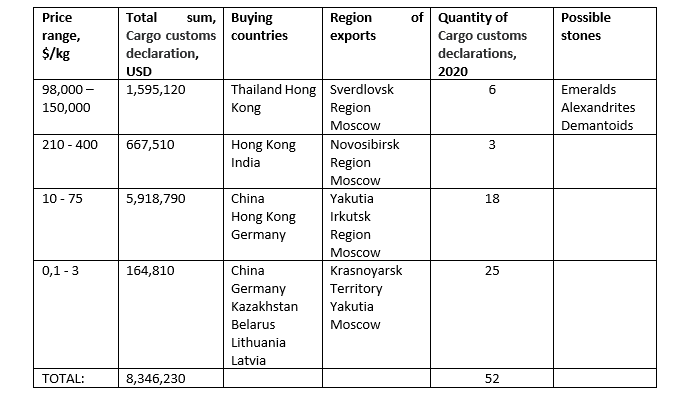
It is not possible to find out the type of stones exported under code 710310 using Cargo customs declarations, therefore, only assumptions can be made (column 6 of the Table). However, it is clear that the share of rough semi-precious stones, such as emeralds, accounted for maximum $1.595 mn.
The Russia’s exports of rough semi-precious stones can be characterized as unstable, irregular and multidirectional - to more than 20 countries, each of them purchased rough semi-precious stones irregularly and for relatively small amounts of money. Only China looks like a stable buyer of the Russia’s rough semi-precious stones, but not precious ones, it purchases semi-precious and ornamental stones.
The volumes of the Russia’s imports of rough semi-precious stones are very insignificant due to the poorly developed cutting and polishing industry. In Russia, there are no large- or medium-scale cutting and polishing enterprises working with semi-precious stones.
And the number of small-scale units cutting and polishing semi-precious stones in Russia as of September 2022, according to the Unified Register of Small and Medium-Sized Business Entities (https://rmsp.nalog.ru/search.html?mode=extended#), is only 112 units, 110 of them are micro-units, and only 2 are small-scale ones. Moreover, the number of units involved in the cutting and polishing of semi-precious stones has been consistently decreasing in recent years. Three years ago, there were 180 of such units in Russia (60% more than now), including 4 small-scale enterprises. And in 2005, there were 12 small-scale enterprises cutting and polishing semi-precious stones in the industry, six times more than today.
The obvious reason for such a dire state and degradation of the semi-precious stone cutting and polishing sector lies in the excessive, completely terrible level of regulation of the precious stones’ circulation, which is based on the norms of the Federal Law “On Precious Metals and Precious Stones” that came into effect in 1998.
According to https://oec.world, the dynamics of the Russia’s imports of rough semi-precious stones under code 710310 for 25 years is as follows:
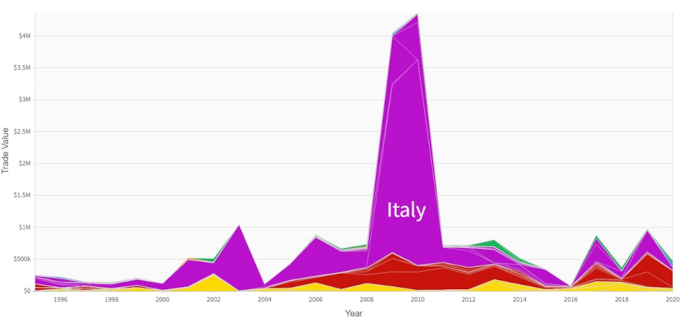
The dynamics of Russia’s imports of rough semi-precious stones under code 710310 (data from https://oec.world)
The most stable, albeit very weak, flow of the Russia’s imports of rough semi-precious stones is from Germany. At its peak (in 2003), it reached $1.04 mn, but in recent years, it has fluctuated around $20,000 a year. And the maximum Russia’s imports of rough semi-precious stones from a single country for all years was from Italy in 2010 and it totaled $3.22 mn.
As in the case of the export of rough semi-precious stones, the volumes of deliveries from other countries were far behind. Thus, the peak values of the Russia’s imports of rough semi-precious stones from various countries are as follows:
- Switzerland ($757 thousand, 2009),
- Great Britain ($583 thousand, 2010),
- Thailand ($347 thousand, 2011),
- Poland ($331 thousand, 2019),
- Armenia ($277 thousand, 2019),
- Lithuania ($274 thousand, 2017),
- Zambia ($244 thousand, 2002),
- Hong Kong ($234 thousand, 2019),
- Tanzania ($118 thousand, 2013),
- Brazil ($109 thousand, 2013),
- Madagascar ($101 thousand, 2006).
More or less serious Russia’s total imports of rough semi-precious stones were seen only once, in 2010, when the total imports under code 310710 made about $4.3 mn. But in other years, it did not rise above $1 mn. And these figures were obtained despite the fact that Russia does not have its own commercial deposits of such important rough semi-precious stones as ruby and sapphire. However, as noted earlier in Part 1 of the review, very small quantities of these gemstones were brought to Russia as cut and polished ones.
Vladimir Zboykov for Rough&Polished
