Production and domestic trade
In recent years, Russian jewellers have maintained a strong position in the domestic gold jewellery market with their own production by volume (in tonnes) at a level of at least 96% of the market.
DYNAMICS OF MANUFACTURING AND DYNAMICS OF MANUFACTURING ANDHALLMARKING OF GOLD ITEMS (TONNES) HALLMARKING OF SILVER ITEMS (TONNES)
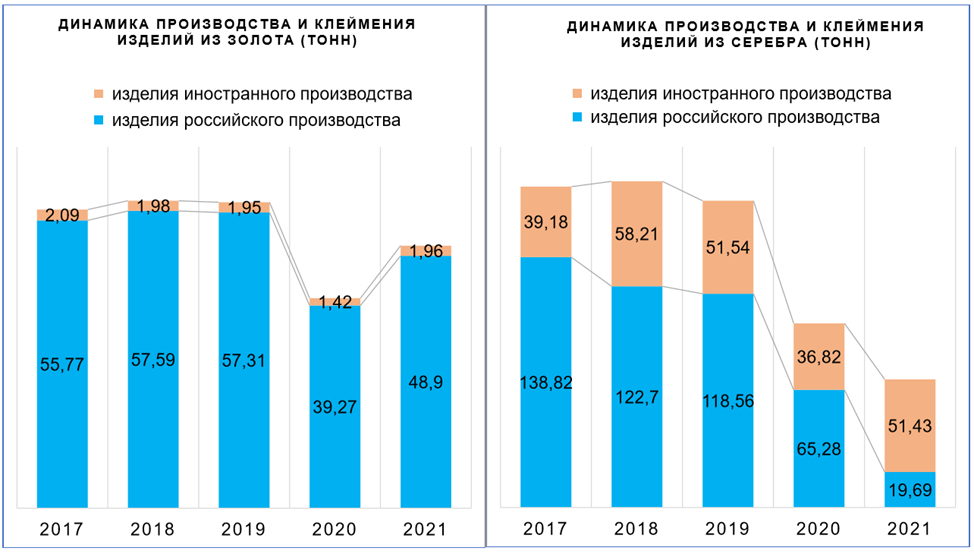
□ items made abroad □ items made in Russia
A correct assessment of the real dynamics of the silver jewellery production using the official statistics of the Federal Assay Chamber is impossible because for the Russian silver products manufacturers, the hallmarking of silver items is not mandatory. But compared to the “pre-pandemic” years of 2017-2019, the silver goods imports remained approximately the same, which may indicate an actual increase or at least the same output by the Russian manufacturers, given the growth in the total share of silver goods market.
According to the Russian Federal State Statistics Service’s data, there was also a growth by value, with a market downfall in 2020. In 2019, a COVID-19 pandemic broke out in the world, the price of gold (and other precious metals) rose by 2020, reaching a new level. Thus, the growth in the jewellery production by value (in roubles) in 2021-2022 is primarily due to the increased cost of precious metals in items and the higher production costs caused by inflationary processes that affected the jewellery production expenditures. This also explains the smaller market downfall in 2020.
Dynamics of manufacturing and retail sales of jewellery in Russia (bn roubles)
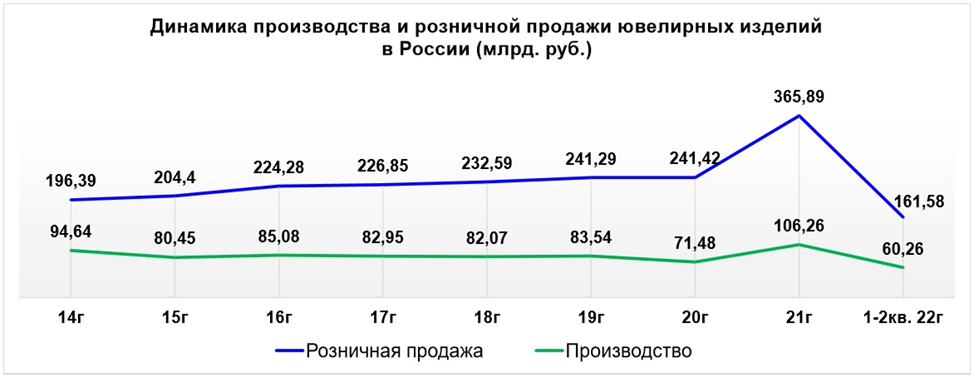
___Retail ___Production 1-2кв 22г - Q1 and Q2, 2022
In the above graph comparing the production and sales dynamics over 8 years, there is a tendency to a gradual decrease in the production of jewellery by value (in rouble) with a slight change in gold prices in the period up to 2020, and a slightly corrected tendency in 2020-2022 against the backdrop of the growing cost of precious metals.
At the same time, retail sales over the same period, on the contrary, showed a gradual market growth in roubles caused by inflationary processes (and by a higher cost of precious metals in 2020-2022).
Exports and imports
The jewellery exports and imports dynamics is also explained by the market failure in the “pandemic” 2020 and the increased cost of precious metals in 2021-2022, showing a high level of correlation between the volume of jewellery foreign trade transactions and the cost of precious metals.
Russia’s jewellery imports and exports (US$, mn)
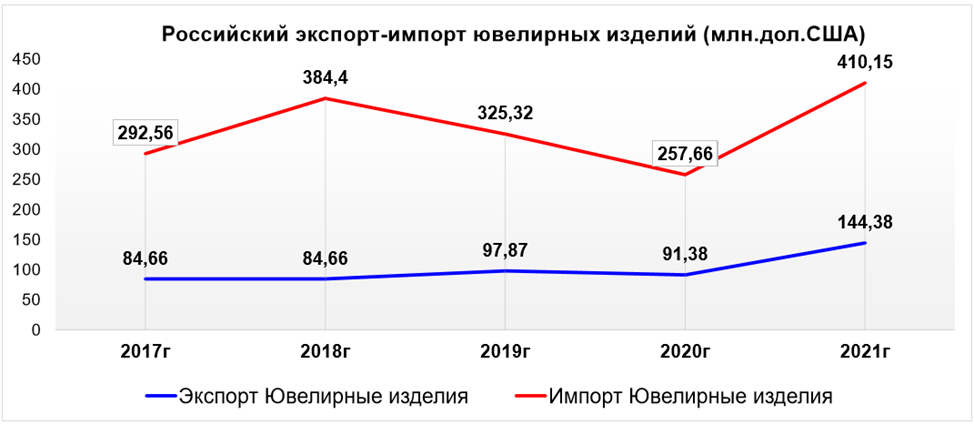
___Jewellery Exports ___Jewellery Imports
Of course, the share of jewellery exports in the total volume of their production is consistently very small. So, in 2017, with an average exchange rate of 58.29 roubles per dollar, the domestic production of 82.95 bn roubles ($1.423 bn) in wholesale prices, the exports amounted to only $84.66 mn, or 5.9%. Moreover, the largest share of exports were the deliveries to the countries of the former USSR.
Industry workforce
The dynamics of the number of small and medium-sized enterprises (SMEs) in the jewellery market shows a steady trend towards their number reduction in production and in wholesale and retail trade. In retail trade, the reduction in the SME number was 37% over 5 years, and it decreased by 54% in wholesale and by 40% in production.
Dynamics of the total number of SMEs in the Russian Federation and the number of SMEs in the jewellery sector
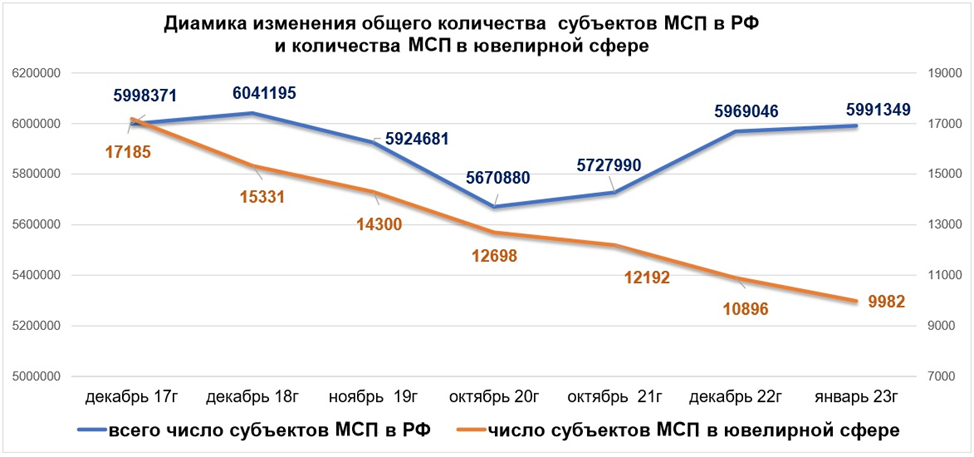
___total number of SMEs in the RF ___number of SMEs in the jewellery sector
декабрь – December. ноябрь – November. октябрь – October. январь – January. г - year.
However, in one month of the SMEs’ operation under the conditions of the ban on using the STS (simplified taxation system) and PTS (patent taxation system), the number of SMEs in the industry decreased by 8.4%, with an overall decrease by 42% over 5 years, which indicates a trend towards a sharp acceleration in the decline in the number of SMEs in the industry. Against the backdrop of a full recovery in the number of SMEs after the Covid-19 pandemic in all sectors of the economy, the decline in the total number of SMEs in the jewellery sector by 42% over 5 years clearly demonstrates a steady and higher decline in the attractiveness of SMEs in this sector of the economy, which characterizes the working conditions in this sector as extremely unfavorable.
Taking into account the positive dynamics of jewellery sales by value (in roubles), it can be argued that the disappearing jewellery market volumes are occupied by medium and large manufacturing and trading companies. It means that there is a process of rapid jewellery business enlargement of the manufacturing sector and trade.
An assessment of the dynamics of the SMEs’ total number of employees in the jewellery sector over 5 years gives an even worse figure, 58%. This is due to the fact that many survived SMEs had to reduce the number of employees because the growth of the wage fund - that was by 28% to 60% higher in the industry over 5 years - no longer allowed working with the same number of employees due to insufficient profitability of their business.
Profitability of business
The profitability of the goods production in Russia depends on many factors, but is largely limited by the gradual increase in expenses, including the growing wages and higher administrative pressure from the governmental authorities. In addition, the real purchasing power of the population has been falling for the last three years, holding back the possibility of rising the selling prices for most goods, especially for non-essential ones.
For clarity, let’s compare the official data of the Russian Federal State Statistics Service on the profitability of doing business in six production areas, including jewellery, clothing, computers, perfumes&cosmetics, toys, and medicines.
The lowest average profitability of the jewellery business in 2021 was demonstrated by the jewellery manufacture - only 2.71% against 10.62% in the production of clothing, 11.87% in the production of computers, 20.78% in the production of perfumes and cosmetics, 27.3% in the production of toys, and 45.16% in the production of medicines.
The profitability of jewellery manufacture rose slightly in 2020, but then dropped sharply in 2012 (apparently, due to additional costs for servicing the State Integrated Information System in the Sphere of Control over the Circulation of Precious Metals and Precious Stones (SIIS PMPS) and a surplus inventories formed during the pandemic).
The wholesale trade in jewellery performed slightly better, with an average profitability of 3.8%, approaching the profitability of the wholesale trade in computers (4.31%) and medicines (4.34%), but significantly inferior to the profitability of the wholesale trade in toys (8.13%), clothing (11.32%), as well as in perfumes and cosmetics (12.18%).
The profitability dynamics of wholesale trade as an intermediary environment between manufacture and retail trade, depending on external circumstances, can play a compensatory role by maintaining a more stable level of purchase prices for retail trade. For example, in 2018-2019, there was a sharp increase in the profitability of the wholesale trade in toys (probably, due to the import of cheap toys), but in the same period, there was also a decline in the toy production profitability.
In the jewellery sector, the flow of goods in Russia is formed mainly due to domestic production, that is why the profitability of wholesale trade is not opposite to the profitability of domestic production, but, on the contrary, the trends of changes coincide. So, after a successful year for the wholesale jewellery trade in 2020, the expenses incurred by manufacturers and jewellery wholesalers increased sharply after the introduction of the SIIS PMPS, which led to a drastic (multiple) decline in profitability in 2021.
And only the retail jewellery trade showed an industries’ average result in 2021 that was a good level of average profitability of 14.65% against the negative profitability of the retail trade in medicines (minus 0.14%), a small profitability of the retail trade in perfumes and cosmetics (2.36%), the retail trade in toys (6.88%), second only to the average profitability of the retail trade in computers (39.74%) and clothing (40.94%).
As it was noted, the wholesale trade, as an intermediary between the manufacturing sector and the retail trade, can play a compensatory role in maintaining the price stability for retail buyers. So, from 2017 to 2018, the profitability of the wholesale trade in the jewellery sector was declining but the profitability of the retail trade was growing in the same period. At the same time, the increase in the expenses incurred by retail jewellery in 2021 (due to the introduction of the SIIS PMPS) against the backdrop of a decreasing purchasing power of the population could not but affect the profitability.
Changes in the industry regulatory framework over the last five years
In 2017, a two-fold increase in the amount of the national duty for the state assaying and hallmarking of jewellery was purely fiscal to compensate for the expenses incurred by the Federal Assay Chamber for their work (i.e., the state control of the market) at the expense of the market players.
The new norms of law introduced in 2018 to amend 115-FZ and Government Decree No. 1052 were intended to introduce total de facto control over citizens participating in the PMPS market as sellers and buyers of the PMPS - from business owners in this sector to the clients of companies (legal entities) and buyers (individuals).
In 2019, there was a significant event when the “Regulatory Guillotine” mechanism was launched in the economy and the “Precious Metals and Precious Stones Working Group” was set up within its framework. Unfortunately, a representative of an export-oriented diamond mining company was assigned as Co-Chair of the Working Group in February 2023 instead of the representative of the jewellery industry, which will inevitably significantly reduce the effectiveness of protecting the jewellery community interests by the Working Group.
In 2019, curtailing the rights of SMEs operating in the jewellery sector began, when a step was made that discriminated against a SME sector operating in the PMPS field, that is, the “Supervision Holidays” were terminated relating the assay supervision.
In 2019, although the introduction of licensing activities for recycling the precious metal scrap and waste and their purchase from individuals imposed licensing requirements on the market participants, it is still better than a purely administrative procedure for approving a list of enterprises that are allowed to do this.
In 2019, the vector of the state’s attitude to the PMPS sector was completely determined (not support and development, but control and supervision) and the Federal Service of the PMPS sector was formed - the Federal Assay Chamber. Thus, the state showed suspicions over the use of market relations in the PMPS sector.
However, over the last three years, the statutory regulation of the PMPS sector has given important easing of some requirements to the market as well:
- Internet trade in jewellery was legalized,
- silver jewellery of any weight has become eligible for voluntary hallmarking,
- the right for Internet trading was given as well as the right for participants in international jewellery exhibitions to sell goods for foreign currency without concluding a contract.
But the SIIS PMPS came into effect, which created many material and other problems for all the PMPS market participants, and it sharply reduced the attractiveness of doing jewellery business in Russia. The market participants have even greater concerns and expectations of new expenses because of the expected introduction (in 2024) of mandatory hallmarking of jewellery items directly on the metal surface.
The launch of sales of VAT-free refined precious metal bars to individuals turned out to be implemented according to the most unfavorable scenario for legal entities and private entrepreneurs engaged in jewellery as the VAT on precious metals was retained for them.
In 2021-2022, the discrimination in the rights of SMEs continued, especially in the rights of the PMPS sector’s SMEs, this process began in 2019 when the SMEs were deprived of the right to the “Supervision Holidays” as for the assay supervision.
In 2021, SMEs in all sectors of the economy were deprived of the right to use unified tax on imputed income (UTII), and pawnshops, in addition, were not allowed to use the simplified taxation system (STS). And a year later, the SMEs operating in the jewellery manufacture and trade were completely deprived of the right to apply the simplified taxation procedure.
In addition to the above, over the last five years of tightening the state regulation in the PMPS sector, there has been the tightening of penalties for administrative violations and crimes in this area. Moreover, the tightening affected the production and circulation of both precious metals and precious stones, but also semi-precious stones, which, in principle, do not come within the provisions of Law 41-FZ.
Although special attention was paid to the norms of the Code of the Russian Federation on Administrative Offenses and especially the Criminal Code of the Russian Federation as regards toughening the penalties for offenses and crimes related to the extraction of precious and semiprecious stones that are not directly related to the jewellery industry, a number of norms of the codes also apply to jewellers. Thus, Articles 15.46 and 15.47 of the Code of the Russian Federation on Administrative Offenses relating to the violation of mandatory requirements for the PMPS circulation are of particular importance for jewellery manufacture and trade, with regard to accounting, storage, and reporting.
The increased risks associated with erroneous prosecution for offenses and crimes in the PMPS sector, unfortunately, has significantly reduced the investment attractiveness of this sector.
Vladimir ZboIkov for Rough&Polished
