The Russian sectoral regulatory framework in the mining and circulation of precious metals and precious stones is based on Federal Law No. 41-FZ “On Precious Metals and Precious Stones” that introduces the legal term “precious stones” as follows:
“precious stones are natural rough diamonds, emeralds, rubies, sapphires and alexandrites, as well as natural pearls in raw (natural) and processed form. Unique amber formations are referred to precious stones in accordance with the procedure established by the Government of the Russian Federation. Materials of artificial origin that have the characteristics (properties) of precious stones are not precious stones”.
As can be seen from the above list, in addition to rough diamonds, precious stones include a number of coloured gemstones that are conditionally distinguished varieties of certain minerals, and even conditionally distinguished samples of organic matter - amber. According to the logic of the name of these stones (“precious”), all of them should be “high-priced” ones. In relation to their circulation in Russia, there are numerous prohibitions and restrictions set for individuals and numerous specific mandatory requirements that must be implemented by legal entities and private entrepreneurs (that is, professional market participants). And violation of these specific prohibitions and requirements is punished severely by administrative and criminal laws.
This is the stand taken by the government on the precious stones. And what is the stand on precious stones taken by final consumers, i.e., by precious stone buyers (the population and the jewellery trade selling jewellery studded with precious stones)? Are they in demand among buyers? What do buyers understand by the term “coloured precious stones”? How much money are buyers willing to pay for them? Is a particularly strict control over their circulation (obviously, not a free-of charge control) important, taking into account the attitude of the consumer community and market participants towards such stones?
To understand these issues, a number of surveys were conducted among the heads of jewellery companies involved in the manufacture and trade of jewellery studded with precious stones. The task was to show the buyers’ opinions, i.е., what the real Russian market needs. The charts below show the responses of small-scale jewellery companies. The opinion of large-scale jewellery companies is given separately, although in most cases, it is the same as that of small-scale jewellery businesses.
10 questions were asked about coloured precious stones. The vast majority of buyers have no idea that at the legislative level in Russia, there is only a certain limited list of stones used in jewellery, and any loose stone for a jewellery item (insert) is referred to as a “precious stone”. Any loose stones, including those made of minerals that are not related to precious stones, and those made of synthetic stones ...
So, the results of the survey are as follows.
1. In your opinion, does it matter to buyers whether the coloured inserts in the jewellery pieces are made of synthetic stones or natural ones?
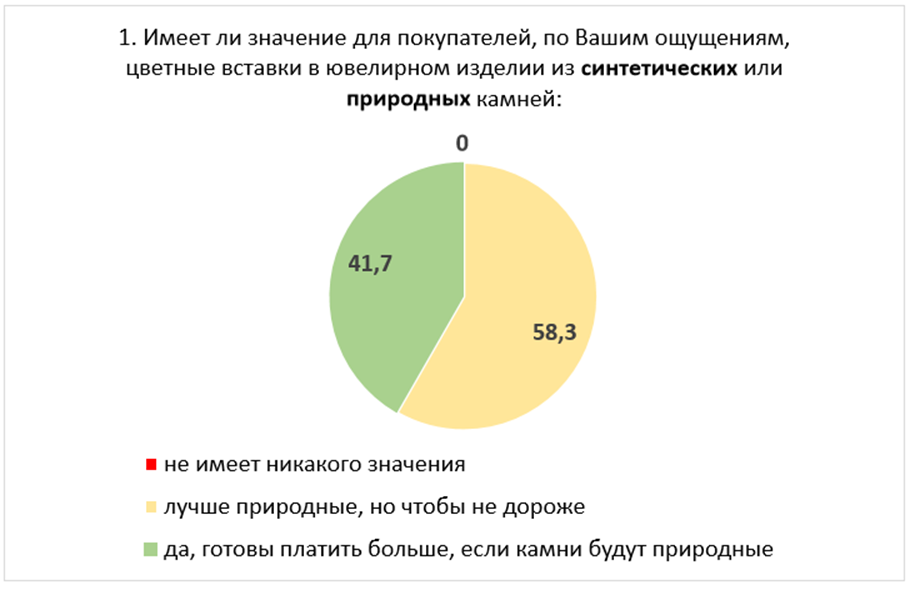
□ - It doesn’t matter.
□ - They prefer natural gemstones, but not more expensive ones.
□ - Yes, they are ready to pay more if the gemstones are natural.
The answers to the first question give a surprise due to the naïve approach - is it reasonable to have a desire to buy goods studded with natural precious stones at the price of goods studded with synthetic stones? In a developed market, it would be inappropriate to ask such a question, but, as it turned out, almost 60% of buyers in Russia do not expect much difference in the cost of natural precious stones and their synthetic counterparts at all...
A similar opinion on this issue was expressed by major market participants.
2. In your opinion, how many coloured gemstones do jewellery buyers know?
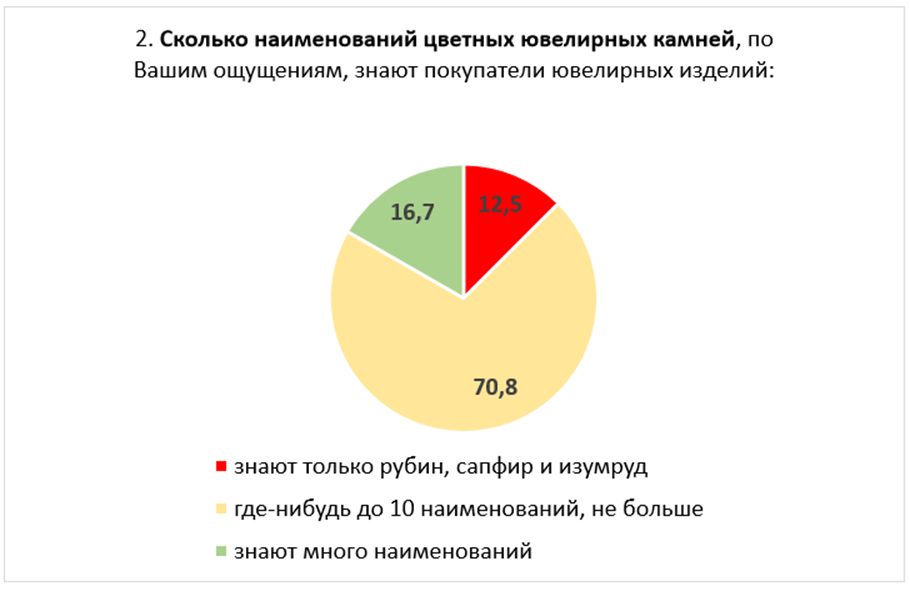
□ - They know only rubies, sapphires and emeralds.
□ - Up to 10 gemstones, not more.
□ - They know many gemstones.
Perhaps, it is a good result for the market. The shares of those who know only the most famous coloured precious stones and those who know a large number of gemstones are close, which indicates a sufficiently advanced consumer awareness in this issue. Still, Russia is a country of highly educated people! And historically, gemstones have been popular among the people. And the big jewellery businesses also agree with this.
The answers to the following two questions should be given in combination, and they are disappointing.
3. In your opinion, how big is the current demand for gold jewellery studded with natural gemstones? ...
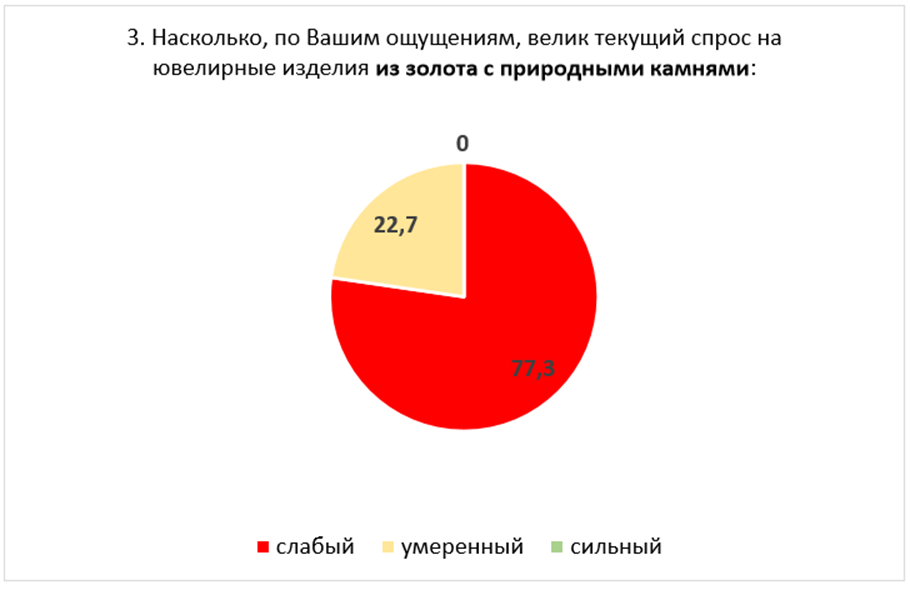
□ - Weak. □ - Moderate. □ - Strong.
4. In your opinion, how big is the current demand for silver jewellery studded with natural gemstones?
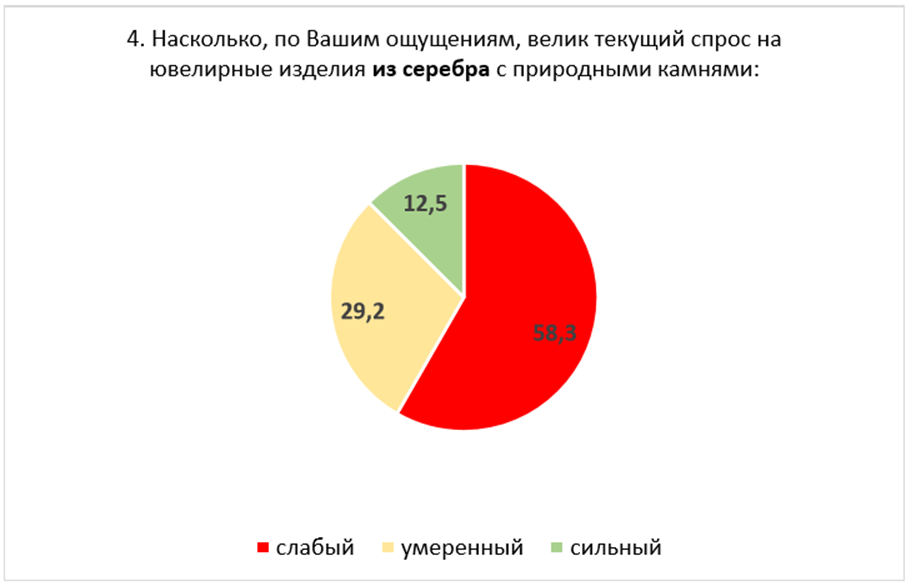
□ - Weak. □ - Moderate. □ - Strong.
What are the results? The buyers consider the presence or absence of natural coloured gemstones in gold jewellery negligible! And only in silver jewellery, the presence of natural coloured gemstones is of some (small) importance.
This means that most buyers consider natural coloured gemstones to be very low-end goods, and, perhaps, only silver jewellery should be studded with them! And maybe, only the jewellery made of gold should be studded with diamonds.
It is clear that each buyer evaluates the concept of a “precious” stone based on the personal income, and not on the basis of the average world price of a particular stone featuring certain characteristics. And yet, 77% of stores have WEAK demand for gold jewellery with coloured gemstones. And none of the sellers believe that the demand for such products is “strong”.
By the way, major market participants are in favour of moderate demand for jewellery with coloured gemstones in the segments of silver and gold jewellery.
The answers to the following question also confirm the extremely low buyers’ estimate of the expected value of natural coloured gemstones:
5. In your opinion, are buyers ready to purchase jewellery pieces studded with natural stones instead of the similar jewellery pieces studded with synthetic stones (featuring the same quality), if:
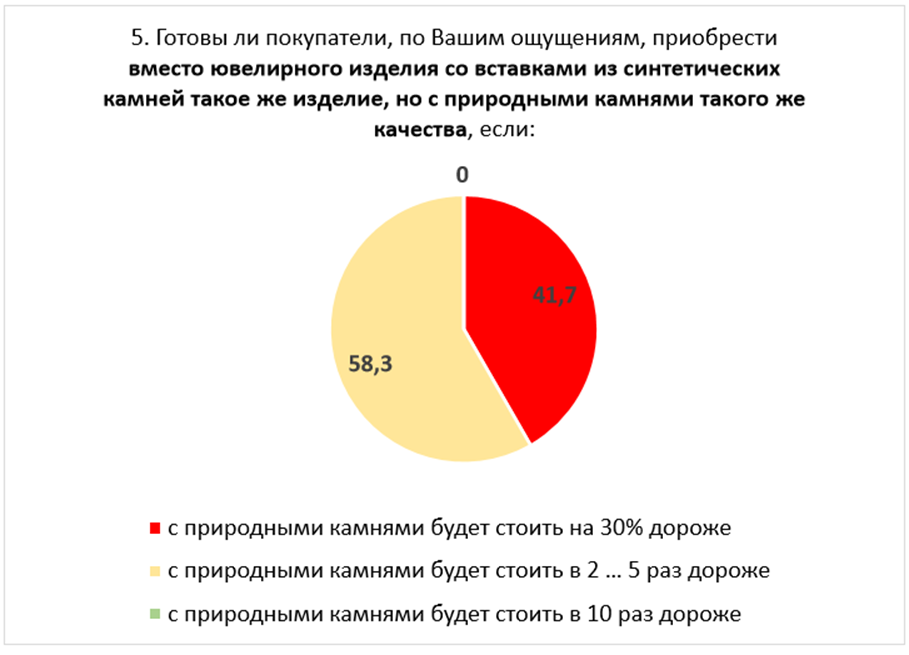
□ - the price of a jewellery item studded with natural gemstones would be 30% higher.
□ - the price of a jewellery item studded with natural gemstones would be 2 to 5 times higher.
□ - the price of a jewellery item studded with natural gemstones would be 10 times higher.
Comparison of the real market value of inserts made of natural coloured precious stones and their synthetic counterparts with the Russian buyers’ expectations, poorly corresponds to reality but is still encouraging. The buyers understand that the prices for natural coloured gemstones and their synthetic counterparts are different. But the problem is that 100% of buyers are not ready to pay the price for natural coloured gemstones that is higher than by 5 times, and there are simply no inserts with good characteristics on the market for such money ...
The opinion of major jewellery companies is that buyers are ready to pay maximum 30% more for the natural gemstones.
So, maybe buyers are ready to pay only a little more for natural gemstones, knowing very well that these gemstones will not look as beautiful as synthetic ones? The answers to this question were as follows.
6. In your opinion, are buyers ready to purchase jewellery pieces studded with natural gemstones (featuring the lower visual quality) instead of similar jewellery pieces studded with synthetic stones, but at the same price?
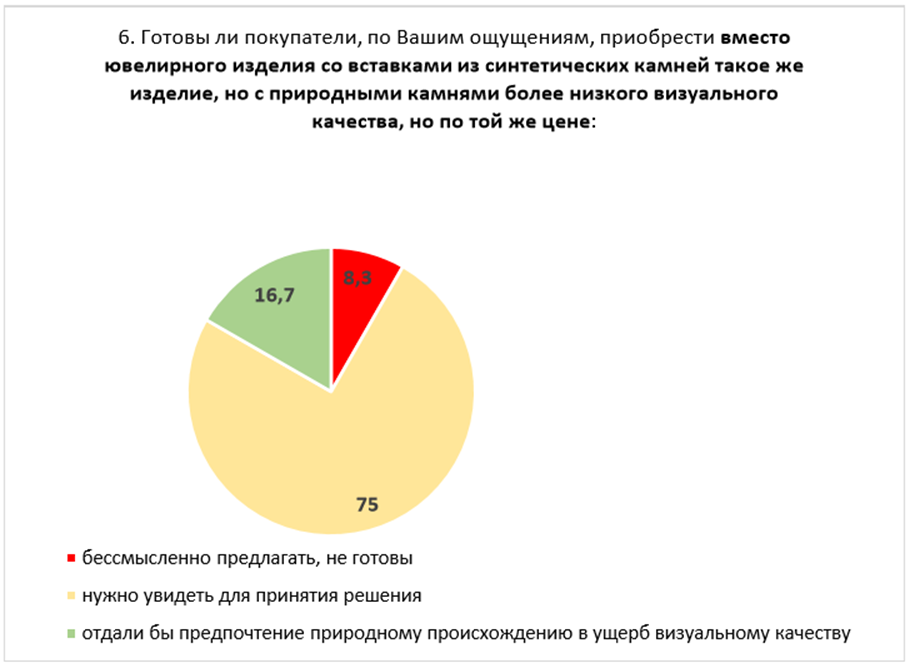
□ - No use to offer, they are not ready.
□ - They would like to view the stones to take a decision.
□ - They would prefer the natural gemstone at the expense of its visual quality.
It turns out that only 16 percent of buyers are ready to agree to a lower visual quality of coloured gemstone studded in a jewellery piece in favour of their natural origin, while maintaining the same price. At the same time, more than 8% of buyers would always prefer synthetic stones to natural gemstones if the synthetic ones look more beautiful! However, it is good that most of the buyers, 75% (including clients of major companies), would still prefer to view the goods before taking their decisions...
The following answers to question No. 7 confirm the above considerations: most Russian buyers of jewellery (almost 80%) have no idea about the real value of coloured natural gemstones in jewellery. And only 4% of buyers are (in their opinion) aware of the prices and realize that coloured gemstones can be more expensive than polished diamonds:
7. In your opinion, do customers consider natural coloured gemstones valuable?
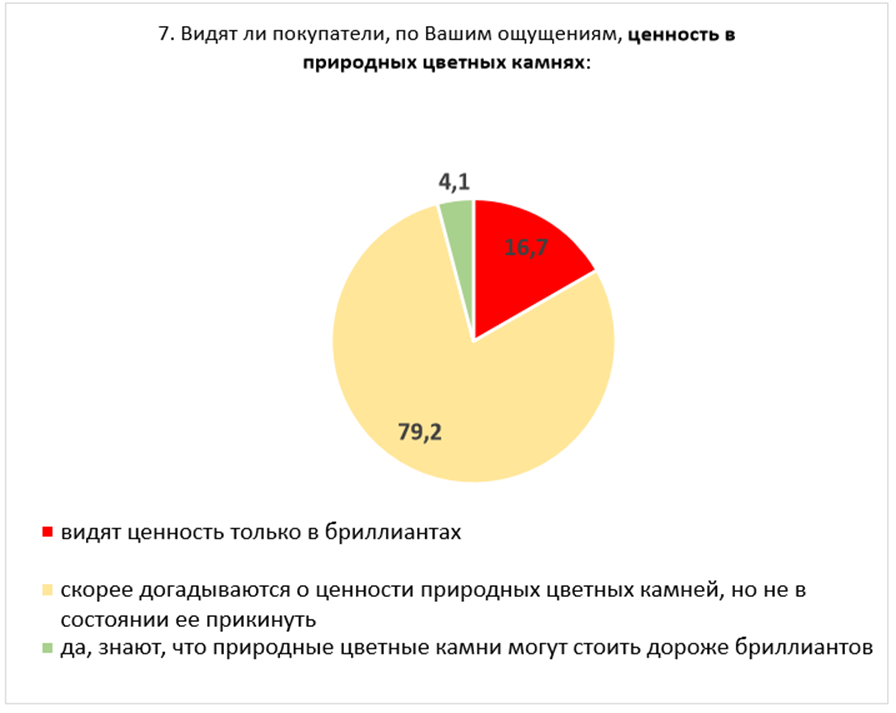
□ - They consider only polished diamond as valuable stones.
□ - They rather guess about the value of natural coloured gemstones, but are not able to estimate it.
□ - Yes, they know that natural coloured gemstones can cost more than polished diamonds.
On the whole, the population on the precious stone market considers only a polished diamond as a “real” precious stone (although only about 17% of buyers admit this, according to jewellery companies’ managers). About 80% of jewellery buyers have some idea about the possible value of rubies, sapphires and emeralds, to say nothing about amber, even unique pieces. The Russia’s major jewellery businesses are of the same opinion.
A logical question arises: realizing the unpromising situation on the market, will Russian companies import really high-end coloured gemstones to Russia? Maybe, they will import single samples, already ordered and with an advance payment. And for the sake of such possible surprisingly rare cases, is it necessary for the state to have not only customs, but also state control over the import of loose gemstones for jewellery? It is highly unlikely...
Market participants are well aware of the effect of the treatment and its methods on the gemstone price. Do users know anything about this? As the answers to question No. 8 show, slightly more than 8% of Russian jewellery buyers have some idea about this (and major Russian jewellery companies agree with this opinion):
8. In your opinion, do customers know what a natural coloured gemstone treatment is?
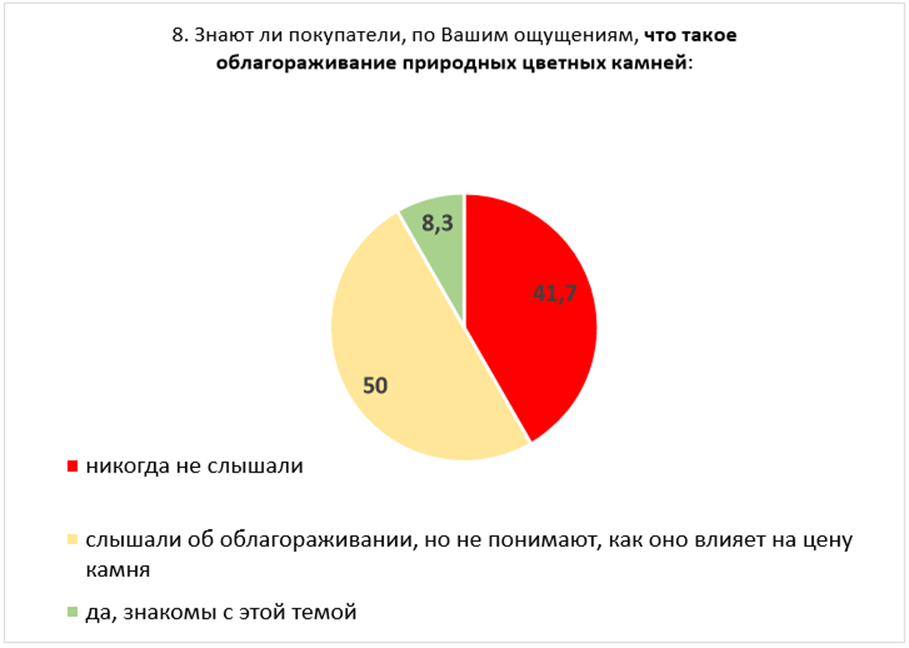
□ - Never heard.
□ - They heard about treatment but do not understand it’s effect on the gemstone price.
□ - Yes, they are aware of it.
To hear something about the possibility of treating the gemstones, but to have no idea how it effects on their pricing, means to know nothing about this. From the point of view of protecting the rights of buyers, it makes no sense to indicate on the jewellery tag even the fact that the gemstone has been treated. In our market, it is completely unrealistic to find an untreated coloured natural gemstone set in a jewellery piece. Nobody imports such gemstones. After all, business is not charity but making profit, the size of which is greatly influenced by the treatment of the gemstones. Moreover, no one would be able to see the true value of an untreated gemstone, anyway!
For market participants, recording the treated gemstones is an additional, completely useless (from the point of view of common sense) but mandatory work: according to the regulatory documents, it is required to enter the information about the gemstone treatment into the State Integrated Information System in the Sphere of Control over the Circulation of Precious Metals and Precious Stones (SIIS PMPS), and also indicate the treatment method. But this is a topic for a future article.
But back to the range of gemstones sold on the Russian jewellery market. Maybe, buyers have requests for something that the market does not offer?
No, there are no special requests, which is explained by an economic reason; buyers want some gemstones but they have no idea about their price:
9. Do customers have requests for jewellery studded with coloured natural gemstones that are not in stock?
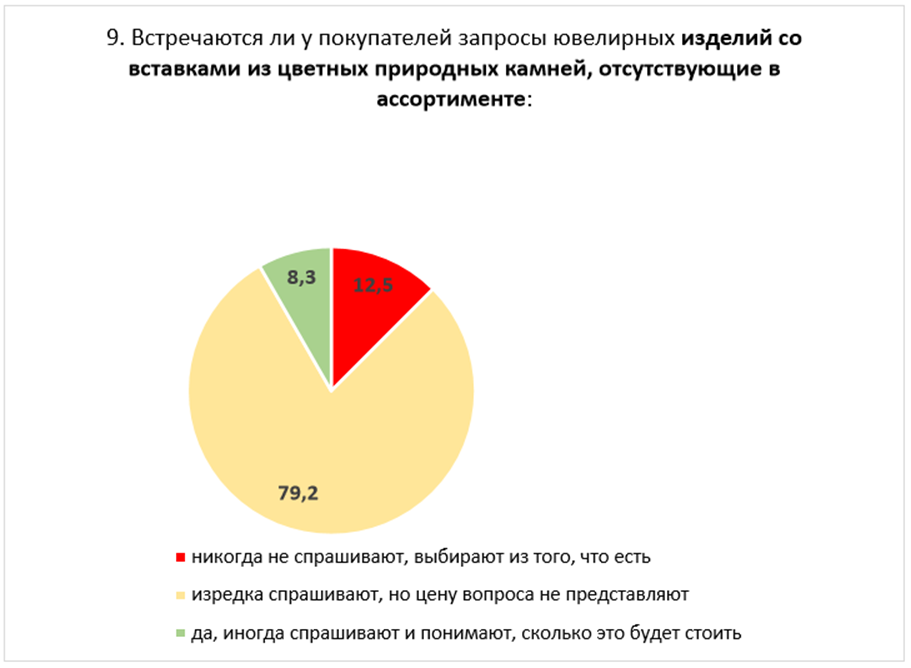
□ - Never ask about such gemstones, they choose from the available stock.
□ - Occasionally they ask about such gemstones, but have no idea about their price.
□ - Yes, sometimes they ask about such gemstones and have an idea about their price.
There is a small part of buyers who are more or less aware about gemstones. Based on the survey, such advanced buyers on the market (aware to a varying degree) make from 4 to 16 percent. The question is whether these buyers are able to pay. After all, being interested in an item and having a real opportunity and intention to purchase it are two different things! Moreover, according to the survey, almost 80% of buyers have no idea about the price of the goods they want (and the major jewellery businesses are convinced of this).
And here is the final question, to which the answers have been given.
10. Do you think there is a need for a wider use of natural coloured gemstones in jewellery?
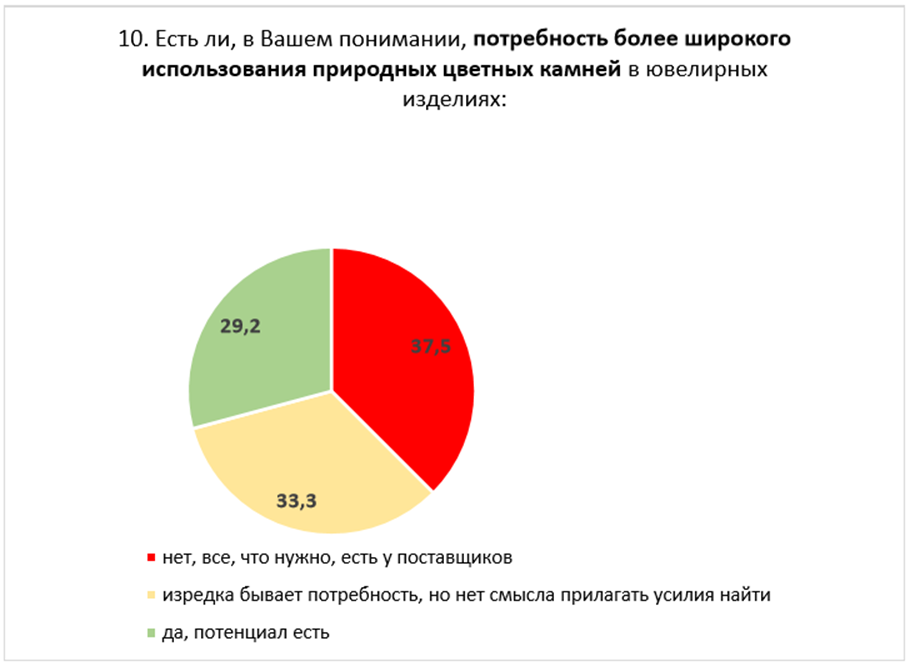
□ - No, the suppliers have all they need.
□ - Occasionally there is a need, but there is no point in making efforts to search.
□ - Yes, there is a potential.
The most optimistic answers turned out to be on this question No. 10: the market has divided into three approximately equal parts. It means that two-thirds of the market sees the potential, although they understand that resolving the issue may not pay off the efforts. And the major Russian jewellery companies also believe that “the game is not worth the candle” and they are happy with what is available on the market.
CONCLUSIONS:
1. The market for natural coloured gemstones in Russia is very poorly developed, it is mainly explained by economic reasons (lack of purchasing power), although there is some consumer interest (hypothetically).
To transform a hypothetic consumer demand to a real one in this market, three conditions must be met simultaneously:
- increasing the income of potential buyers;
- conducting a large-scale educational advertising campaign aimed at explaining the possible value of natural coloured gemstones to the population (including their investment value);
- creation of a free and open secondary market for natural coloured precious stones.
However, even with the current well-being level of the population, the Russian market capacity for jewellery studded with natural precious stones could be many times higher if two other conditions were met.
2. The needs of the Russian jewellery market for loose natural gemstones are very much limited not only by low incomes of the population, but also (and above all) by the lack of the understanding of the coloured gemstones value among the population that is not ready to pay adequate global prices for them.
One of the main reasons why buyers perceive coloured natural precious stones as low-end goods is the historically established practice (since the Soviet times) of selling jewellery studded (almost exclusively) with synthetic stones on the Russian retail market.
3. Due to practical absence of own production base for cutting and polishing coloured gemstones, the entire volume of gemstones required for the jewellery industry is imported.
Following the market demand, the key direction in the development of the loose coloured gemstone market for jewellery in Russia today is the import of synthetic loose stones.
4. Insignificant imports of natural coloured precious stones to Russia consist mainly of significantly treated stones, and often importers are not aware of the treatment method used. Almost always, these are low-end loose precious stones.
5. State control over imported loose coloured precious stones (in addition to customs control) is a costly procedure for business and it is not a free-of-charge operation for the state that does not have any practical sense due to the above.
Taking into account the condition of the market, it makes no sense to use any price lists for imported coloured precious stones, and it would be enough to apply the value of the contract indicated in the invoice to calculate the VAT and customs duties. However, customs duties on imported precious stones (raw materials for the Russian jewellery industry) are also a factor reducing the competitiveness of the Russian jewellery industry.
6. Description of the characteristics and the treatment of loose coloured precious stones in the SIIS PMPS by market participants in the process of circulation is a costly operation for the jewellery business, but it has no economic sense for the state. In addition, the transfer of this information is also an additional useless load on the SIIS PMPS.
7. The domestic market of emerald, the only coloured precious stone mined in Russia (except for the extremely small production of alexandrite), could receive an impetus and boost demand (and, as a result, trigger the market development), but this requires a completely free, uncontrolled emerald circulation and large-scale advertising campaigns.
However, if coloured precious stones could get rid of specific controls, many small-scale market participants could be able to raise the level of the emerald’s popularity without costly advertising campaigns.
8. The solution to all issues of the coloured precious stone market development in Russia can be achieved by simply withdrawing them from Federal Law No. 41-FZ “On Precious Metals and Precious Stones” and by transforming this law into the Federal Law “On Precious Metals and Diamonds”.
A polished diamond is the only precious stone on the legislative list today, and its high cost can, at least, be explained and is recognized by Russian buyers.
Vladimir Zboykov for Rough&Polished
