The price of palladium, after reaching an all-time high of $3,117 per ounce in early March last year, fell to $1,500 by March 2023. While major producers in South Africa and the Americas are facing increasing operational difficulties and the risk of sanctions on the Norilsk Nickel supplies has not disappeared, the situation looks even more worrisome on the demand side. The former main driver - the tightening of emission standards - is offset by the expansion of electric vehicles and the decline in the share of gasoline-powered vehicles (with internal combustion engines, ICE), which will limit the need for palladium. Suki Cooper, Director of Precious Metals Research at Standard Chartered,came to the disappointing conclusion “This is likely to be the start of palladium’s market share falling.”
Norilsk Nickel, the major palladium producer with a market share of more than 40%, believes that expanding the scope of application of this metal can reverse the negative trend. While the threat to palladium comes from the electrification, an area of the ‘green’ economy, the salvation may come from its another area - hydrogen energy. This emerging market could solve the problem of climate change by offering one of the ways to drastically reduce carbon emissions. One of the main beneficiaries of this trend is platinum, similar in properties to palladium, used in fuel cells. However, detailed studies on the prospects of palladium in this area are still to be made in the future, as can be shown by the dynamics of this precious metal’s price.
HOPES AND FEARS OF PALLADIUM MANUFACTURERS
“You need to look at the metal price for the last 7 years. The price of palladium has indeed declined, but it has declined from absolute all-time highs. Before falling from $2,500 to $1,500 per ounce, there was a 5-fold increase in the price,” says Mikhail Borovikov, Director of the Investment Community Department at Norilsk Nickel.
At the beginning of the last year, market participants began stockpiling palladium amid fears of sanctions against Norilsk Nickel. But when it turned out that there were no sanctions, and the recovery of the automotive industry was delayed as the level of 2019 in the production of ICE-automobiles has not yet been reached and is not expected to be reached in 2023, there was a decrease in demand and decline in prices, Borovikov explained.
Since palladium production last year was still less than its consumption, the inventories increased in the anticipation of the expected recovery of the auto industry played the role of a balancing factor, but catalyst manufacturers are out of stocks now, Borovikov stressed. Therefore, if expectations for the automotive industry restoration this year are met, then sooner or later, the manufacturers will need to do restocking.
“Therefore, we expect that this year will be quite good,” says Borovikov. This can be supported by the new operational problems the South African producers are facing now.
Energy dominant company Eskom has been restricting energy supplies for years to avoid destroying its aging grid infrastructure. Due to power outages last year, the PGM production in South Africa was 6% below the original producers’ guidance, the worst result in two decades, Bloomberg reported, citing a UBS report. According to Sibanye-Stillwater spokesman James Wellsted, worsening blackouts could lead to the early closure of some marginal shafts. The power crunch also risks stifling appetite to invest in future production.
Loadshedding for Anglo American Platinum (Amplats) could make the largest platinum supplier’s production decrease by 5% this year, the company said. The Amplats’ refined PGM output fell by 25% last year, to 3.83 mn ounces, amid the power outages, delayed reconstruction of the Polokwane plant and lower grade of ores. Sibanye-Stillwater, another major platinum and palladium producer, is also experiencing operational difficulties for the second year in a row. Last year, the US-based Stillwater facility shut down its production for a month due to a flash flood, bringing the PGM production down to 421 koz from the originally planned 550-580 koz. In March this year, damage to the mine infrastructure from a non-fatal accident at the mine in Montana will result in a reduced production of 25 koz to 30 koz of the PGMs (the current forecast is 500 koz to 535 koz).
MARKET BALANCE
In early February, Norilsk Nickel published new expectations for the market situation in 2023, reducing the deficit forecast from 800 thousand ounces to 300 thousand ounces. Last year ended with a deficit of about 500 thousand ounces. At the same time, the company noted that the deficit was mainly statistical, not a real one. Metal consumption was under pressure due to a slow recovery of the auto industry after the COVID pandemic; low demand encouraged major consumers to reduce inventories rather than to buy the metal on the market, Norilsk Nickel explained.
Market balance2: maintained deficit partly covered by consumers’ surplus stocks in 2022, mn troy oz
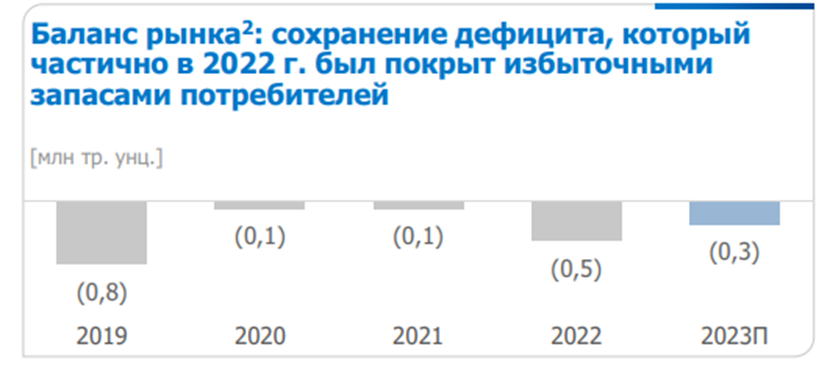
Norilsk Nickel expects that a strong recovery in the automotive industry in 2023 will lead to a 4% increase in demand for palladium, to 9.8 mn ounces. World passenger car production will recover to more than 86 mn cars (up 6%) from 81 mn cars in 2022.
Global primary production of refined palladium is set to rise marginally by 1%, to 6.4 Moz in 2023, against the backdrop of reduced supplies from Russia, which will be offset by the recovery of the production in South Africa after temporary power outages in the country in 2022. The risks associated with power outages will remain high, Norilsk Nickel believes.
Upper chart:
Consumption: Slower Recovery in ICE1 Automobile Production and Replacement of Pd with Pt, mn troy oz]
Lower chart:
Production: Decline amid technical problems in the US and South Africa, mn troy oz]
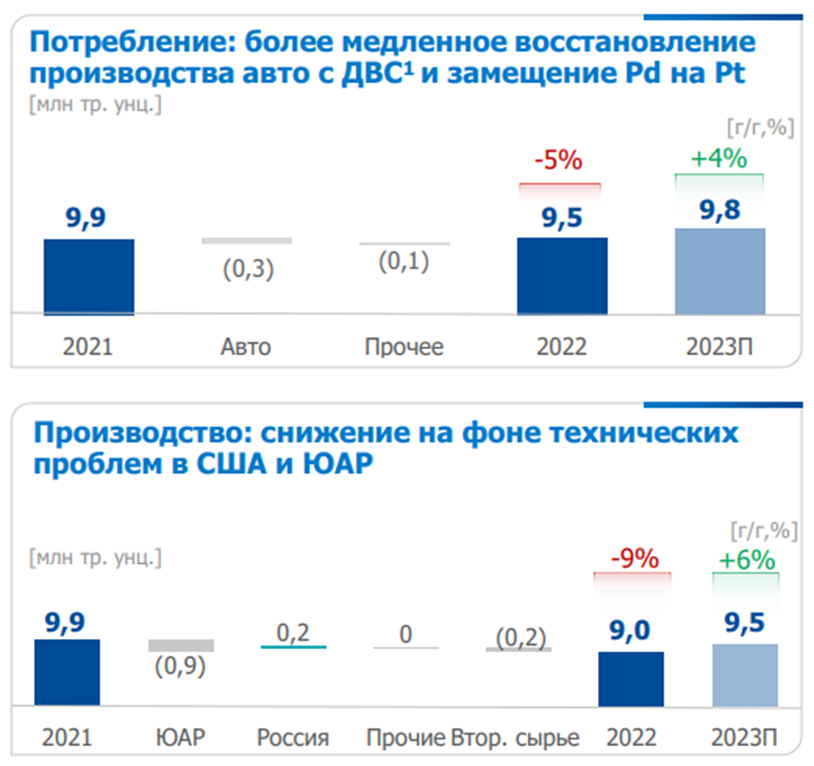
Авто - Automobiles. Прочее - Others. ЮАР - South Africa. Россия - Russia. Прочие - Others. Втор. cырье - Recyclable materials. г/г - year-on-year.
Amplats expects the deficit to narrow even more sharply in 2023, to around 80 koz. After that, the market will move into a surplus due to weaker production of gasoline-powered vehicles in the medium term.
According to Sibanye-Stillwater, the deficit of palladium this year will decrease to a minimum for the last 5 years, and from 2024, the metal will enter a long-term cycle of excess supply.
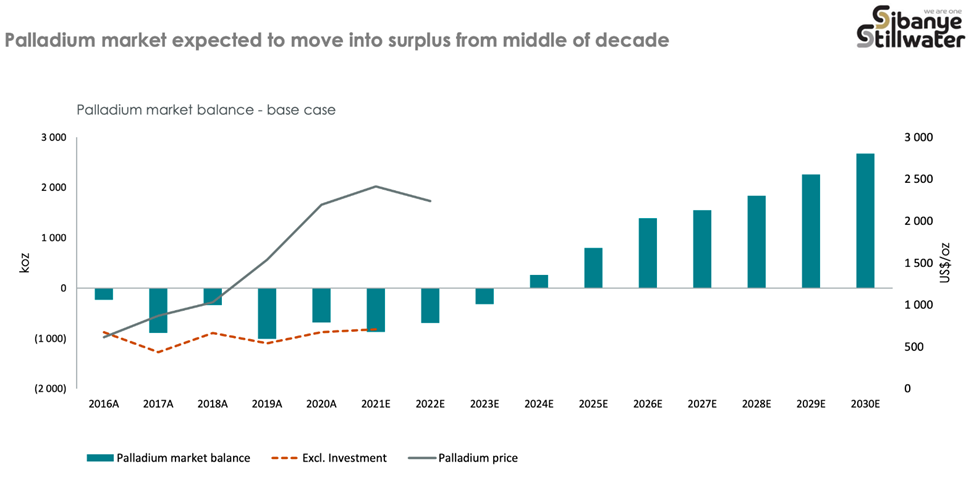
Among other things, palladium will be the leader among all PGMs in the growth rate of secondary production, which reflects the demand trends of automakers in the mid-2000s, Amplats notes. On the other hand, when the automobile production starts growing, the total recycling volumes also start growing, since the automobiles to be recycled have higher quantities of metals.
Norilsk Nickel also notes that this year, due to reduced disruptions in the supply chain, there will be a significant increase in the recycling of platinoids from autocatalysts. Increasing the availability of new automobiles will encourage the recycling of used ones. As a result, recycling of palladium from autocatalysts and scrap metal will increase by 19% this year, to 3.1 mn ounces. However, Norilsk Nickel believes that the growth in the supply of secondary raw materials will be fully offset by an increase in demand against the backdrop of the automotive sector recovery.
Higher recycling volumes this year contribute to a modest increase in supply, while demand for palladium will be fairly stable this year, says Edward Gardner of Capital Economics. As a result, the global market deficit will be reduced to about 320 koz. The fact that automobile production in many developed countries is still below its pre-pandemic levels suggests that pent-up demand remains, Gardner adds.
Even with the gradual replacement of palladium and increased production in South Africa and North America, the deficit will remain in the market in 2023, as there is significant uncertainty about the volume of metal sales from Russia, according to Marcus Garvey of Macquarie Bank Ltd. However, the structural challenges caused by rising purchases of electric vehicles and rising supply of scrap metals are becoming more significant, he notes.
REPLACEMENT OF PALLADIUM WITH PLATINUM
Another structural problem is the growing replacement of platinum with palladium. In 2022, it is estimated at 340 thousand ounces, in 2023 it will increase to more than 500 thousand ounces, which is more than 2 times higher than in 2021 (240 thousand ounces).
At present, this is a relatively small pace, says Norilsk Nickel’s Borovikov, explaining that replacement has certain limits as for physical and chemical properties. Approximately ¾ of all metals are concentrated in close-coupled catalyst located in close proximity to the engine. It is difficult to replace palladium there because it withstands high temperatures better, unlike platinum that sinters and stops exhaust gas post-processing. In another part of the catalyst located near the exhaust pipe where the remaining ¼ share of metals is used, replacement is possible, the Norilsk Nickel’s representative explains.
“Substitution of palladium (with platinum) in both light and heavy-duty vehicles threatens palladium’s relative market share in the automotive space, but more challenging still is the threat of absolute demand destruction from the rising market share of battery electric vehicles and the lack of any sizeable new demand area for palladium,” warns Jonathan Butler of Mitsubishi Corporation.
EV THREAT
The electric vehicle (EV) market remains the fastest growing sector in the ‘emission-free energy’ industry, the International Energy Agency (IEA) states in its study. In 2021, EV sales doubled to a new record of 6.6 mn units, bringing EVs to nearly 10% of global vehicle sales and the total number of EVs on the world’s roads to about 16.5 mn, three times more than in 2018.
About half of this increase accounts for China, the world’s leader in transport electrification, where the government subsidies for this type of vehicles were an important driver of growth in 2020 to 2022. With the end of subsidies in 2023, the expectations for the EV growth are moderate, which results in slightly lower lithium prices, and have already made manufacturers, including Tesla, Ford and Xpeng, to decrease the price of some models. As a result, with no more subsidies, the share of EVs will increase only slightly from 26% of all passenger cars last year to 27.5% in 2023. At the same time, the ING predicts that the share of electric vehicles (PHEV + BEV) in China will exceed the share of traditional vehicles before 2030, ahead of the Chinese leadership’s target by 5 years.
In the long term, electric vehicles pose a serious threat to palladium, the Norilsk Nickel representative admits. “We don’t see any particular problems in the next 5 years. Even if the most active growth in EVs occurs, the total number of ICE vehicles remains quite large, and emissions regulations will only get tougher. But in the next 10 to 15 years, EVs are a serious threat,” says Borovikov.
The situation forces the largest palladium producer to look for new applications for this metal. “We are currently creating competencies within our company to cooperate with some scientific platforms in the search for new applications of palladium,” the Norilsk Nickel’s representative said.
Norilsk Nickel believes that the most obvious area of palladium use is in the hydrogen energy industry, which so far has traditionally used platinum instead of palladium.
ROLE OF PALLADIUM IN HYDROGEN ENERGY
Norilsk Nickel was exploring the prospects for using palladium for catalysts in the growing hydrogen energy market, the company announced in March. Together with the scientific community, the company created a prototype of a palladium-based catalyst, a nanosized metal material for membrane electrode assembly used to generate electrolytic hydrogen.
“The market for hydrogen energy is still being formed, but it is already obvious that sooner or later, hydrogen will occupy its technological niche, where it will become a profitable alternative to traditional energy sources. We have a good opportunity to become one of the key players in this industry, which is now open for launching new innovative products - just the ones we are working on,” commented Vitaly Busko, Vice President for Innovation at Norilsk Nickel.
Today, there are catalysts based on platinum and iridium in the hydrogen energy market. Norilsk Nickel is considering the possibility of increasing the catalyst efficiency by partially replacing these metals with palladium. Due to its extremely high chemical resistance, palladium is more effective in catalysts than other platinum-group metals, the company explains.
The properties of the catalyst are not inferior to commercial analogues, the company estimates. Norilsk Nickel plans to test prototypes in the Chinese market to weigh the prospects for their commercial production.
Norilsk Nickel sees prospects for the development of not only catalysts, but also other segments of hydrogen energy like technologies for the membrane production of high-purity hydrogen, its storage and transportation. Norilsk Nickel specialists study the prospects for using palladium on the anode and cathode of a hydrogen-air fuel cell and an electrolytic cell with a proton-exchange membrane.
Palladium has a number of exceptional properties that allow its use in many hydrogen-related technologies, according to a study published in ScienceDirect. This metal absorbs large volumes of hydrogen at room temperatures and atmospheric pressures to form palladium hydride.
Palladium will also likely play a role in fuel cells, but it is not yet known how significant its role could be, according to a clarification on the International Platinum Group Metals Association (IPA) website. Palladium can be used to produce, purify and store hydrogen. As a thin membrane, palladium allows hydrogen to pass through the membrane but it blocks all other gases. The development of stable palladium-silver alloys and their membranes has made it possible to purify hydrogen using palladium-silver membranes, the IPA says.
PRICE FORECASTS
The analysts surveyed by Reuters predict an average price of palladium at $1,828 per ounce in 2023 and $1,733 in 2024, according to the material published by the agency at the end of January. Three months earlier, the analysts had expected an average price of $2,037 per ounce.
Most analysts believe that the supply of palladium remains insufficient. Both palladium and platinum could have a surge in demand from the automotive industry as the global economy recovers this year.
Meanwhile, as the RBC analysts believe, the palladium market will begin to return to a surplus from 2024, which may result in the price decline to the $1,000 per ounce.
The LBMA Annual Precious Metals Forecast Survey suggests an average palladium price of $1,810 per ounce, down 14.3% from the 2022 average ($2,112). At the same time, even the most pessimistic forecast ($1,550) is 10% lower than the current price.
Unlike platinum, "palladium has no role to play in the approaching hydrogen economy," says René Hochreiter of NOAH Capital Markets and Sieberana Research, forecasting a price of around $1,700 per ounce. He believes the price of palladium will “soften” this year because inventories continue rising as the Russian supplies remaining at “normal levels” despite Western sanctions. As a result, this situation will be “effectively causing an oversupply...despite cutbacks from South African suppliers.” At the same time, replacement with platinum is slowing down the demand for palladium for gasoline autocatalysts.
The same conclusion was reached by a PGM specialist Wilma Swarts at Metals Focus who speaks of the “growing awareness that 2024 onwards will see surplus conditions” in supply and demand in the market. “After a decade of tailwinds, palladium will be buffeted by strengthening headwinds this year,” says Swarts at Metals Focus, predicting an annual price of $1,810 across 2023,” At the same time, a slower-than-expected recovery in demand will be complicated by further prudent use of palladium by automakers looking to reduce the amount of palladium needed for each application.
Sergey Bondarenko for Rough&Polished
