The world of jewellery is diverse and colorful, and its history spans thousands of years. Individual pieces created by local individual jewelers or by multi-billion dollar international brands can equally capture our attention and have a symbolic meaning for the wearer.
In this world, a new trend has emerged: branded jewellery from multinational conglomerates is poised for growth in international market despite the fact that about 80% of it is dominated by non-branded pieces. But to achieve the projected growth, branded jewellery has to face quite a few challenges – from increased competition with independent jewelers to varied regional preferences – amidst worsening economic conditions.
Can branded jewellery win over a larger customer base and at what cost? What strategies will local jewelers employ to protect their market share? And what is "branded" jewellery, anyway? Let's find out.
What is branded jewellery?
For a long time, jewellery industry was very different from what it is today, dominated by small local companies and even individual jewelers. The 20th century saw jewellery brands rise in prominence and consumer awareness, with such companies as Cartier, Tiffany & Co. and others creating their own stories and history. However, jewellery brands should not be confused with "branded jewellery" as, counterintuitively, the two terms are not the same.
There are a few aspects of jewellery branding that are worth mentioning in this context. First off, a branded item comes from a well-known company and reflects its identity, personality, product design, brand awareness and loyalty. Secondly, the item must be distributed through a retail model and not wholesale, so that independent jewellery stores can choose to stock branded jewellery. As an example: you can buy branded sportswear from world-known brands (Adidas or Nike etc.) both in brand boutiques and in regular multi-brand outlets. By contrast, you can't buy new pieces by Tiffany anywhere except in this company's stores. Lastly, and more importantly, a branded item is a product category in any particular store. Pieces from established renowned jewelers with specialized stores all over the world are still considered branded, but this term is generally more comprehensive.
Branded jewellery does not necessarily mean fine jewellery only. Branded category may comprise demi-fine or even costume jewellery, featuring anything from silver earrings with vermeil plating (a thick plating of gold on top of a solid sterling silver base) to inexpensive copper bracelets with imitation stones. Despite this, a branded jewellery piece is almost guaranteed to have a higher margin than a non-branded one, which is especially true for fine jewellery.
Big piece of a pie
With classification out of the way, let's talk money. According to some studies, branded jewellery takes up only around 20% of global jewellery market, while the remaining 80% is non-branded, sold at countless independent stores around the globe. This is, undoubtedly, an enormous market, and luxury brands want to tap into it.
We are not talking about established jewellery companies like Cartier and Van Cleef & Arpels who have already got their own distribution networks. It's nonjewellery luxury brands in adjacent categories such as Dior, Hermès and Prada introducing jewelry collections or expanding their assortment to secure this tasty market share. Lower-end jewellery manufacturers and big but local companies such as Pandora and Chow Tai Fook respectively also seem to take interest in luring customers away from independent or smaller jewelers.
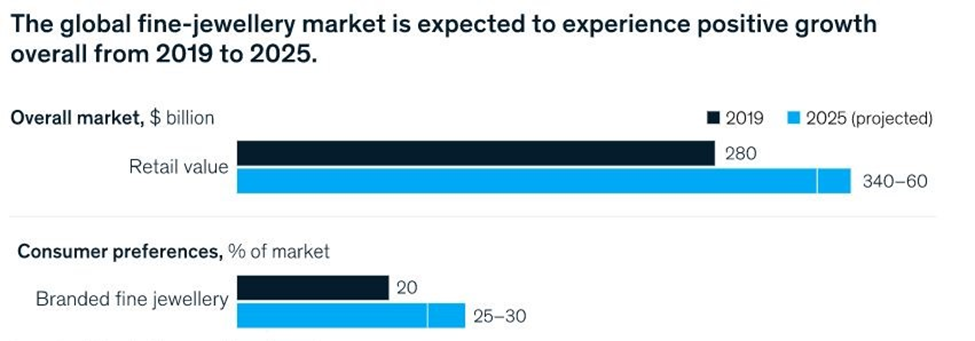
Source: McKinsey
To achieve this, global luxury market players want to replace this rather anonymous jewelry with their own marketed, branded and labeled jewelry. According to a forecast published by McKinsey, by 2025, the proportion of non-branded jewelry items will fall from 80% to 70%.
In future, the global fine jewellery market is likely to become more branded, more digital, and more sustainability-focused. Branded fine jewellery will be on the rise, with an expected compound annual growth rate of 8% to 12% going into 2025. This means that branded fine jewellery will grow approximately three times faster than the total market. Because price points in branded fine jewellery can be around six times higher than for unbranded products, competition between established luxury jewellery brands, fashion brands, and new direct-to-consumer companies will heat up as players compete to win customers who are turning toward brands that reflect their distinct points of view.
Key markets
There are two markets that are of particular interest in terms of converting non-branded jewellery share into branded – India and China. Although both of them have their own unique set of challenges and intricacies to consider, they are well worth the effort. According to the World Gold Council, India and China accounted for more than 50% of the global gold jewelry demand in 2018, and consumer preference towards branded jewelry has increased among the emerging upper middle class or wealthy consumers in these regions.
In India, small local jewelers have been taking advantage of cultural practices during traditional holidays - festivals like Diwali and wedding seasons. This is a sizeable and diverse market that luxury brands would like to tap into. They will however have to compete both with local brands like Tanishq and Malabar, and with small regional jewelers in tier II cities. To win over customers, global brands can take advantage of advertising, in-store experience, and customer service, focusing on unique designs and quality. Awareness about gold hallmarking in India can leverage the adoption of branded jewellery as opposed to small shops and manufacturers via transparent provenance.
On the other hand, some Indian buyers are conservative in their choice in jewellery and it may be hard to sway their opinion in favor of branded items. Non-branded jewellery generally reflects local and regional designs and customers who are looking for old patterns or authentic craftsmanship from a particular area can get maximum advantage. Local jewelers have a fixed and loyal customer base, and their prices may be significantly lower than at branded stores. However, according to some sources, the trend is changing and younger customers prefer branded jewellery over traditional pieces.
Things in China are a bit different though. Although the median income in China is a few times higher than in India which means more disposable income for luxury, the competition is also high. Global luxury brands will have to compete with big and established local players like Chow Tai Fook and Lao Feng Xiang. Though brands like Cartier and Tiffany are getting traction in this market, it remains unclear if they are able to increase market share of branded jewellery and find a place in a highly competitive Chinese market. To achieve growth, global players like Dior and Prada have to invest in local marketing and design fitting the Chinese cultural code.
Still, the global jewelry market size is expected to reach $518.90 billion by 2030, growing at a compound annual rate of 8.5% from 2022 to 2030. In this environment, luxury brands have to move fast to secure their place in a growing global jewellery market. But they are not the only ones to take advantage of new developments.
Independent jewelers
New technologies and, consequently, modern sales channels have played an important role in bringing designer, non-branded jewellery to prominence. Thanks to social networks like Instagram or TikTok, a small jeweler can reach astounding audience and become a celebrated creator overnight. Thousands of independent jewellery manufacturers – from individuals to local companies – are promoting their unique pieces on the endless newsfeed, and customers who value uniqueness above all flock to those artists' social pages that may feature an audience ranging from a couple hundred to hundreds of thousands active followers.
New generation of jewelers is tearing up the product design rulebook, embracing the radical, finding opportunity in inconsistency, breaking binaries and subverting convention, while encompassing both the avant-garde and mainstream.
These creators manufacture jewellery not seen in any branded store but what's more important, their prices are usually way lower. And if they reach a certain audience or a celebrity notices their craft, such jewelers can become serious contenders to traditional luxury brands, at least en masse. Nowadays, getting into jewellery business with unique designs is as easy as ever.
Here is what it takes to make unique jewellery piece: a couple of hundred dollars for a cheap 3D printer with a specific polymer for a technique similar to lost wax casting, a PC with free 3D modelling software and a nearby jewellery workshop to bring the project to life. In this environment, no wonder that new designs emerge every day and the competition is fierce. Top players from this field are highly flexible and can easily adjust to fashion trends, and even bigger companies are mulling over a similar approach to their product lifecycle.
This is getting more important during the time of macroeconomic and geopolitical turmoil, as looming economic crisis and regional conflicts put pressure on consumer sentiment. In this climate, adjustability is key.
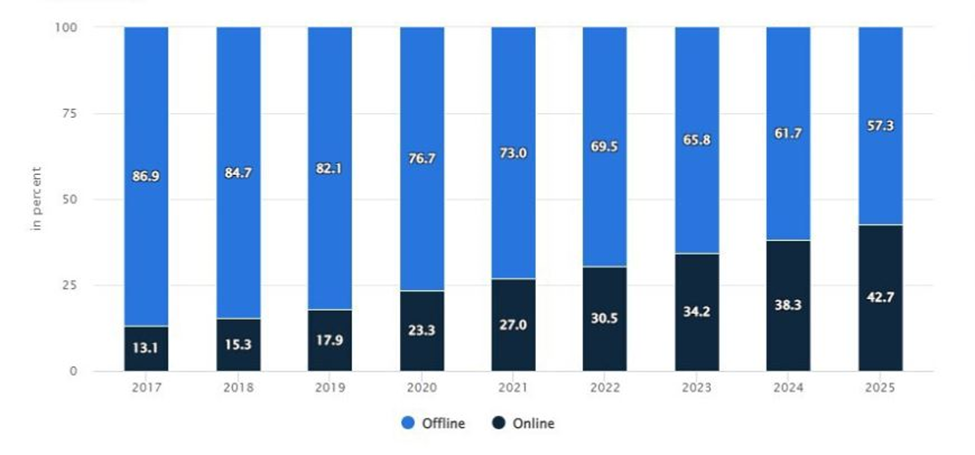
Source: Statista
Through the pandemic, e-commerce has been a breath of fresh air for retailers, which were required to navigate the challenges of nonessential store closings and lockdowns. While these times were a catalyst of digitalization, jewelry brands realized that selling their products online brings a significantly wider range of benefits that they could leverage even when the pandemic would be over.
Indeed, e-commerce enables jewelry sellers to offer their consumers a more in depth look at their offerings, compared to physical shops, allowing them to display all their products, without worrying about security or holding a high level of stocks. By developing e-commerce platforms and expanding their capabilities, jewelry players penetrate a market with less limitations and more opportunities.
On the other hand, shortening the length of the design process and bringing in more jewellery collections throughout the year may lure new customers of branded jewellery by giving them more choice and a range of items to choose from.
Theodor Lisovoy for Rough&Polished
