Long-term support for platinum comes from the emerging hydrogen economy. “The platinum market is in a unique position amongst most commodities in having a new emergent end source of demand in the form of the hydrogen industry, which is expected to become a material driver of demand moving into the 2030’s,” said the World Platinum Investment Council (WPIC) in its survey.
The LBMA Annual Precious Metals Forecast Survey places platinum at the top of the list this year as well. The consensus of the analysts surveyed by the LBMA assumes an average price of platinum this year at $1,080 per ounce, which is 12.5% higher than the average price in 2022 ($958 per ounce) and 8% higher than the average price prevailing in the first quarter of this year. According to experts, palladium will show a decrease by 14.3%, gold will rise in price by 3.3%, and silver - by 8.8%.
DEFICIT COMING
In May, the World Platinum Investment Council released a new annual global platinum deficit of 983 koz, which is up 77% compared to its forecast of 556 koz made three months ago. The deficit corresponds to 12% of the expected annual demand for the precious metal.
WPIC expects the platinum supply to decline by 1% compared to 2022 (to 7.913 mn ounces), while demand will grow by 28% (to 8.176 mn ounces). An important driver of growth will be the glass capacity additions in China enabling the increase in the industrial demand by 382 koz (or by 17%) this year, the highest level since records began.
Prior to this, a platinum market was in surplus for two consecutive years (854 koz in 2022, 1.29 mn oz in 2021).
Norilsk Nickel is more cautious about platinum prospects and expects a small metal surplus this year (200 koz) as the supply recovery will outpace growth in demand from the automobile manufacturing industry. This surplus metal is expected to be absorbed by the investment demand.
Johnson Matthey estimates a platinum shortage this year at 128,000 ounces. The metal supply will increase by 4% (to 7.33 mn ounces, including primary metal production - by 5% to 5.8 mn ounces), and the demand for platinum will grow by 19% to 7.46 mn ounces. In addition to a robust demand from industry, the increased introduction of trimetallic catalysts in gasoline vehicles will play an essential role.
“Despite the economic uncertainties and relatively high interest rates, we believe that most platinum demand is well protected against downside risks,” the WPIC review said. Risk-protected sectors include the ongoing platinum for palladium substitution in automotive applications, and already committed glass and chemical capacity additions in China, both supported by increasing investment demand, Trevor Raymond, the WPIC’s CEO Trevor Raymond, said.
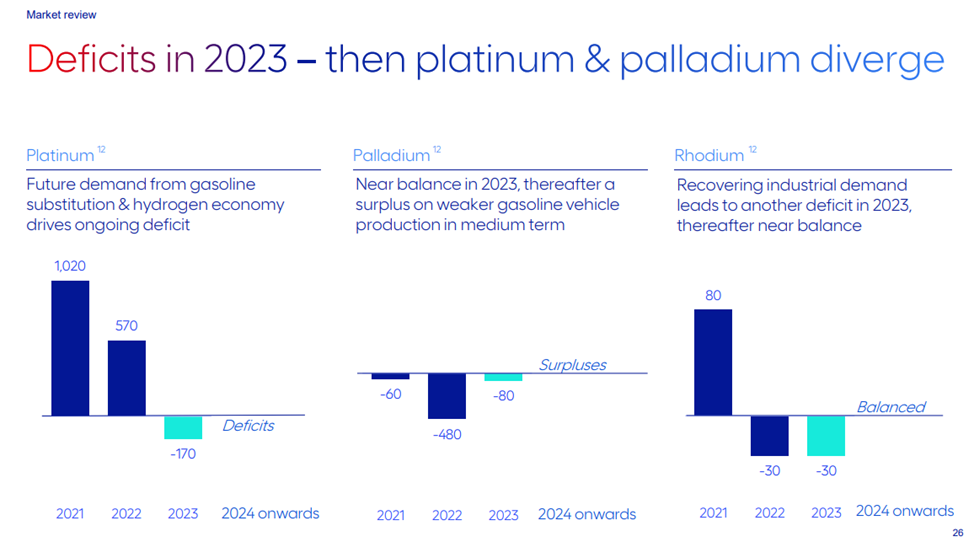
Anglo American Platinum (Amplats) expects a short-term deficit in the three main platinum group metals (170 thousand ounces for platinum). Unlike palladium, platinum will remain in short supply beyond 2023 on the backdrop of substitution in gasoline vehicles and the development of a hydrogen economy.
(Amplats Annual results presentations 2022)
In the first quarter of 2023, platinum deficit was 392 koz on the backdrop of strong demand from the automotive and industrial sectors and a recovered investment activity. Prior to this, a significant shortage of the metal has not been recorded since the third quarter of 2020.
Supply in the first quarter of 2023 was 1.614 Moz, down 9% year-on-year. Demand was higher by 28% compared to the same quarter last year, amounting to 2 mn ounces.
PROBLEMATIC PRIMARY PLATINUM …
Metal supplies fell by 1 mn ounces last year due to the energy crisis in South Africa and operational problems in Russia caused by the sanctions imposed on the country. Mining in South Africa has experienced the significant effects of failures at a small number of smelters where the flows of raw materials come from the deposits that provide 70% of the global platinum mining output.
Platinum supplies from Russia fell by 10% in 2022 due to geopolitical tensions caused by the military conflict with Ukraine that impede the transportation of goods. WPIC believes that international transportation problems could become a bottleneck in logistics, but it is likely that the supplies will continue due to the reorientation of the sales channels from Europe to Asia. At the same time, due to operational difficulties and scheduled repairs, the production will be 8% lower than its average level. Johnson Matthey also believes that Norilsk Nickel’s PGM shipments in 2023 will be close to the last year’s level (about 2.6 mn ounces), as the company is mobilizing the metal reserves unsold in the past year despite the anticipated reduction in production in Russia by 7 to 12 percent.
However, given the unpredictability of the situation in South Africa, platinum production is again vulnerable this year, according to WPIC, and is estimated at 5.511 Moz, which is roughly in line with the 2022 figure and 6% below the average since 2013.
WPIC warns that the completion of the refurbishment of smelters in South Africa should provide greater stability of supplies, but the growing energy crisis is causing significant uncertainty over the timing of the release of semi-finished stocks resulting from downtime. That is why WPIC expects the supply in the region to remain, at best, largely unchanged compared to the last year.
Norilsk Nickel estimates that global primary platinum production will rise by 6% this year (to 5.9 mn ounces) as South African producers will release the work-in-progress’s volumes accumulated in 2022 due to power outages and lack of smelting capacity.
The South African manufacturers’ problems are illustrated by Amplats’ reports. The Amplats’ refined metal production fell by 13% in the first quarter of this year (after falling by 26% in 2022) due to a prolonged refurbishment of the Polokwane smelter and power outages. To ensure energy self-sufficiency, Amplats has set up a JV with EDF Renewables to build a 600 MW renewable energy facility, and the construction of solar plants will begin in the second quarter of this year. The Amplats’ production forecast remains dependent on power supply and does not see any growth for three years, with its lowest point in 2025. The company’s costs rose by 11% last year against the backdrop of growing global inflation, and are expected to increase by another 16% this year.
In the first quarter, platinum production fell by 7% year-over-year to 1.2 mn ounces as metal output growth in Russia only partly offset the decrease in South Africa amid soaring power shortages.
... AND SECONDARY PLATINUM OFFER
Secondary production has been low over the past two years because vehicles have been in use longer due to reduced availability of new vehicles and changing consumer habits. The amount of platinum jewellery being recycled last year also declined. In 2023, secondary production will decrease by 1% due to continued restrictions on the supply of scrap metal, according to WPIC.
Nornickel, on the contrary, expects secondary supply to rise by 13% to 1.7 mn ounces as supply chain disruptions decrease and more new vehicles are available.
The volume of recycling in the first quarter of 2023 decreased by 12% year-on-year to 413 koz due to a continuous shortage of auto scrap metal. Users are forced to use old vehicles longer, while jewellery recycling has been affected by declining sales of new jewellery in China.
REVIVAL IN THE AUTO INDUSTRY
According to WPIC, demand from the automotive industry will rise by 357,000 ounces (12%) this year. Replacement of palladium in catalysts for gasoline engines is on the rise, and use of platinum group metals (PGMs) is on the rise due to tighter emissions legislation. There is an active entry of platinum-based systems into the Chinese heavy-duty vehicle market.
At the same time, WPIC proceeds from the forecast for an increase in the car production in 2023 to 86 mn vehicles. This is up 4% compared to 2022 and significantly more vehicles than in 2020/21 affected by COVID, but still below the pre-pandemic levels.
The main reason behind the lower figures, most notably in Europe, Japan and North America, continues to be semiconductor deficit, which cost the industry 3 mn vehicles last year (compared to 9 mn ones in 2021), according to the Johnson Matthey’s survey. In addition, there was a shortage of wiring harnesses delivered to the assembly lines of German automakers from Ukraine.
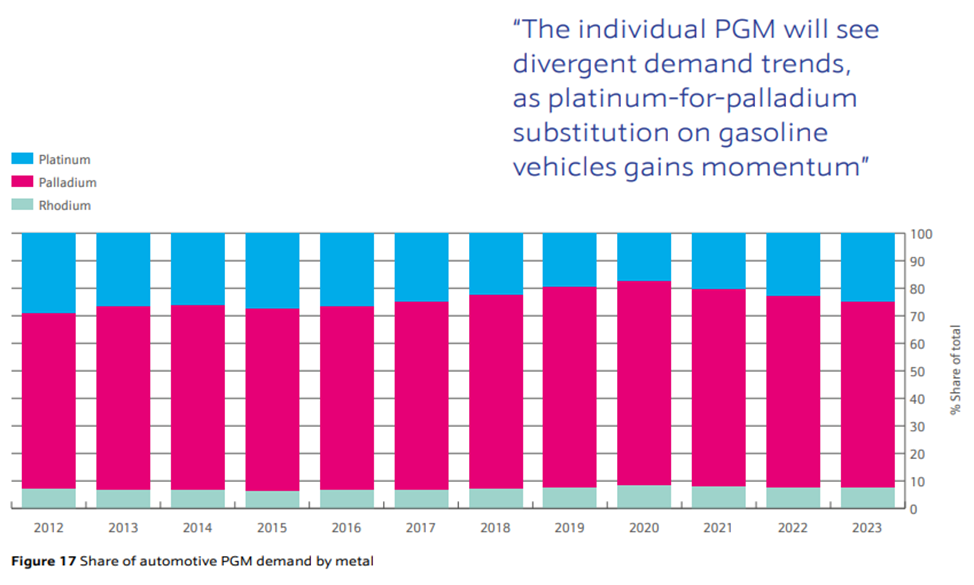
Johnson Matthey also forecasts double-digit growth (11%) in platinum demand from the auto industry, that means above 3 mn ounces for the first time since 2017. At the same time, demand for palladium will fall by 2%, reflecting affordability concerns due to the Russia’s large share in palladium production, as well as high palladium prices over the past four years. The platinum-for-palladium substitution gains momentum, notes JM. Although palladium prices have declined in recent months, this is unlikely to have a short-term impact on catalyst programmes.
(Johnson Matthey PGM Market report May 2023)
Another manifestation of the trend in favour of platinum is the increased use of tri-metal catalysts, with lower content of palladium and rhodium. The still high prices of the two metals encourage cost-saving efforts and encourage the replacement by platinum, JM notes.
At the same time, the total global demand for PGMs for vehicles in 2023 will grow just by 1% to 12.2 mn ounces, according to JM. The growth in the car segment this year will come from battery electric vehicles (BEVs), their share in the global auto market rose from 6% to 10% last year, JM says. While engine emission regulations are tightened, most automakers can already meet the new requirements without significant increases in the use of PGMs in autocatalysts.
According to Norilsk Nickel, the continued platinum-for-palladium substitution will help offset the negative effect of optimizing the use of platinum in heavy-duty vehicles in China and a further decline in diesel vehicle manufacture in Europe.
WPIC notes that while the demand for platinum for catalytic converters will gradually decline as vehicle electrification increases, fuel cell electric vehicles (FCEVs) are expected to account for some of that electrification, and the overall demand for platinum is likely to increase significantly, including the demand for hydrogen used not for vehicles.
Demand for platinum from the automotive industry increased by 9% in the first quarter of 2023 to 806 koz.
RECORD DEMAND FROM INDUSTRY
An increase in glass making capacities and, to a lesser extent, putting of new chemical facilities into production are the main growth drivers in overall industrial demand for platinum in 2023, WPIC notes. These factors compensate for weaker demand from the oil and power generation segments.
With interest rates rising, the active investment by industrial consumers of platinum could become too much of a burden, but most of the additional capacities are in China where financing is available at more attractive rates, the WPIC’s survey says. In addition, the continued increase in the chemicals segment’s capacity (9% of total demand) appears to be partly due to ongoing diversification of major energy companies into the petrochemicals industry to mitigate risks associated with an energy transition that threatens the demand for crude oil and gas.
Investment demand, despite weak coin and bullion bar purchases in late 2022 and early 2023, looks much better than in recent years, mainly due to high interest in ETFs. As a result, the investment demand will leave the negative zone - as WPIC predicts - and reach 433 thousand ounces this year.
In the first quarter, the investment demand was positive at 175 koz compared to negative one (-54 koz) three months earlier, which happened due to a shift from ETF outflows to inflows in the amount of 43 koz. The demand from industry rose 8% year-on-year to 570 koz.
Sergey Bondarenko for Rough&Polished
