It's no secret that synthetic diamonds are getting traction and there are reasons for this development. However, the diamond market is not the first one to be shaken by synthetic gemstones but almost certainly the most recent, with a significant impact being observed in the last five to ten years give or take.
Such precious gemstones as rubies, sapphires, emeralds and even pearls among others that used to be rare and luxurious, have all been made easily available and mass-produced thanks to technological advancements. Some markets have adapted to man-made stones and some have been shaken to their very core, with whole industries falling into oblivion.
Can we prognosticate the prospects of natural and synthetic diamond markets through history of similar industries? What lessons can we learn from the past in relation to current events in the diamond sector? And, ultimately, can natural diamonds still shine while facing a fierce competition from readily available synthetics, like some other precious stones seem to be able to do? Let us find out.
Pearls
One of the most prominent examples of man-made goods overtaking the natural market is, indeed, pearls. Although a pearl has an organic origin and is not a mined mineral, this gemstone had been associated with extreme rarity and luxury throughout most of humanity's history. For example, one legend narrated by the classical-era historian Suetonius says that the Roman general Vitellius financed an entire military campaign by selling just one of his mother's pearl earrings. In 1917, jeweler Pierre Cartier purchased the Fifth Avenue mansion that is now the New York Cartier store in exchange for a matched double strand of natural pearls Cartier had been collecting for years; at the time, it was valued at $1 million.
During the long history of pearls, the principal oyster beds lay in the Persian Gulf, along the coasts of India and Ceylon, and in the Red Sea. Chinese pearls came mainly from freshwater rivers and ponds, whereas Japanese pearls were found near the coast in salt water. Nearly all pearls in commerce originated from those few sources. The discovery of Americas added a handful more, and until mid-20th century virtually all pearls were of natural origin. It is important to note that pearl hunting brought more than a few pearl-bearing mussel species to a brink of extinction.
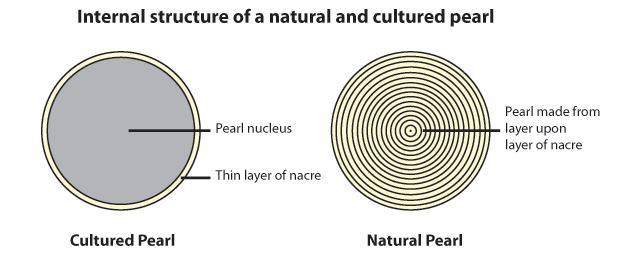
Then, a discovery made in early 20th century changed the pearl market forever. A Japanese entrepreneur Mikimoto Kokichi streamlined a patented method of pearl cultivation developed by Tokichi Nishikawa and Tatsuhei Mise, and started a booming business. Cultured pearls are made by inserting a piece of oyster epithelial membrane with a nucleus of shell or metal into an oyster's body or mantle to form a pearl sack. That sack then secretes nacre to coat the nucleus, thus creating a pearl in a period from a few months up to a few years. The new technology enabled Japan's cultured pearl industry to quickly expand after 1916; by 1935 there were 350 pearl farms in Japan producing 10 million cultured pearls annually.
On the second half of the past century, the market share of cultured pearls constantly grew, and today 99% of pearls on the market are cultured. In 2021, the top exporters of pearls were Japan ($164 million), Indonesia ($83.1 million), China ($69.1 million), Hong Kong ($55.8 million), and Australia ($46.1 million).
There are a few reasons why cultured pearls overtook the natural market. First is the scarcity of naturally-occurring pearls: according to some sources, only one in about 10,000 wild oysters will yield a pearl and of those, only a small percentage achieve the size, shape and color desirable to the jewellery industry. Second, cultured pearls are cheaper than natural ones. Third, when the new product entered the market, natural pearl dealers could not compete with manmade gemstones and could not explain the major price difference to customers. When combined with environmental legislation to protect sea creatures while banning oyster hunting, the pearl market had no other choice but to shape into what it is today.
Rubies and sapphires
The reason why rubies and sapphires fall into one category is that both gemstones are a variant of corundum, or a stable aluminum oxide, albeit different in color due to inclusion of various elements.
Large, gem-quality natural rubies can be more valuable than comparably sized diamonds and rarer. In fact, smaller blue sapphires (1-3 carats) are relatively abundant compared to small, gem-quality rubies. As a result, even small rubies have a relatively high value, even more so for larger stones. Just recently, a 55.22-carat ruby unearthed by Fura Gems has become both the largest and most valuable gem of its kind ever to sell at auction, netting $34.8 million at Sotheby’s event in New York. This is a rare occurrence of an untreated gem of this caliber, however an overwhelming majority of natural rubies on the market undergo heat treatments to improve their characteristics.
Most gemological authorities expect a medium to medium dark-red color tone in a ruby, whereas all other color varieties of gem-quality corundum are referred to as sapphire. However, there is no general agreement on how to draw the line between rubies and sapphires. Most natural rubies come from a handful of active mining operations in Myanmar, Mozambique, Thailand and a few other countries.
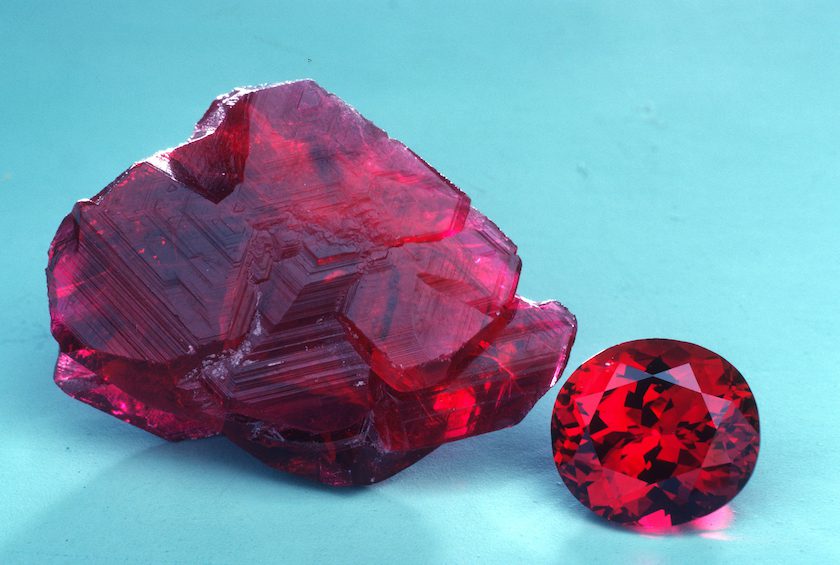
Synthetic ruby. Credit: gemsociety.org
Classical violet-blue sapphires traditionally came from the Kashmir region of India between the late 19th and early 20th centuries. During most of the 20th century, fine sapphires came from only three sources, Kashmir (India), Myanmar (Burma) and Sri Lanka (Ceylon). Australia was also a significant source of sapphires until deposits were discovered in Madagascar during the 1990s. Madagascar is now one of the world's leading sapphire producers.
The world record price for a sapphire was set at Christie’s Geneva auction in November 2014. The Blue Belle Of Asia, a 392.52-carat cushion-cut Ceylon sapphire, fetched a price of around $17.3 million.
Corundum gemstones, both rubies and sapphires, were first synthesized in the late 19th century. In 1904, the French chemist Auguste Verneuil published his work on the flame fusion process, still known today as the Verneuil process. As a result, the production of synthetic rubies and sapphires skyrocketed. Nowadays, three major production methods are used: crystal melt pulling (Czochralski process), flame fusion (Verneuil process), and flux growth from solution. You can even make rubies in a microwave, albeit poor quality ones.
The bulk of synthetic variants of corundum produced is used in industry, thanks to this mineral's strength of 9 on Mohs scale, rivaled only by the diamond. From wear-resistant bearings and abrasive materials to high-end electronics screens and laboratory lasers – man-made corundum has found its way in our everyday lives. Still, despite the fact that you can buy synthetic rubies and sapphires of perfect color for just a few dollars per carat in China, the ultra-luxury market for important natural gemstones exists. There are just a handful of ruby and sapphire mining companies in the world and just a few regions to extract gemstones from, so the provenance of those important gems is relatively easy to trace. And it seems like connoisseurs will spare no expense to get their hands on natural stones despite synthetics being readily available on the market.
Emeralds and others
The next category deals with gemstones that are harder to reproduce in a lab due to the nature of the technology involved. Among them are emerald, alexandrite, spinel and some others.
Emeralds in antiquity were mined in Ancient Egypt since 1500 BC, and India and Austria since at least the 14th century of the current era. Mining in Egypt ceased with the discovery of the Colombian deposits and now this South American country, along with a few others from this region, is the world's largest producer of natural emeralds, constituting 50–95% of the world production. Zambia is the world's second biggest producer accounting for about 20% of the production of gem-quality stones.
Almost all natural emeralds undergo 'oiling' to minimize the appearance of inclusions that are typically present in this type of gemstones. Jewelers use a range of substances – from cedar oil to epoxy resins and polymers with similar refractive index as emeralds, to enhance the finished product. The most expensive emerald ever sold, a 23.46-carat Colombian stone with minimal enhancement, was part of the Elizabeth Taylor collection and went under hammer in December 2011 for $6.5 million.
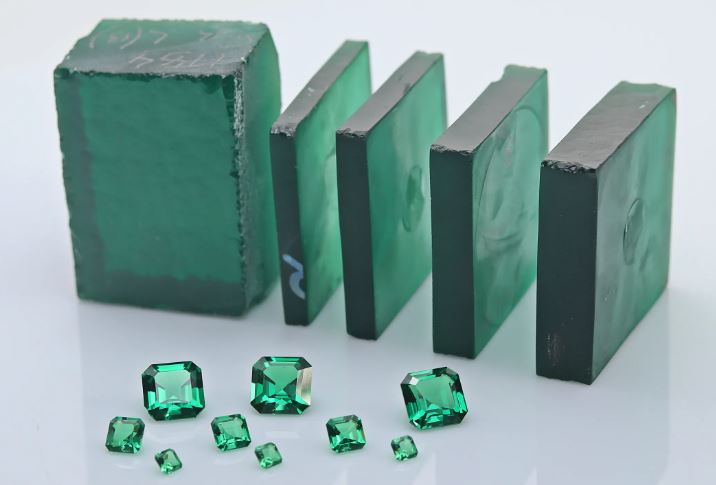
Synthetic hydrothermal emeralds. Source: Alibaba.com
Two major processes, the hydrothermal and flux methods, can produce synthetic emeralds, and both require costly equipment and are energy intensive. After World War II, Carroll Chatham of San Francisco introduced emeralds of large size and fine color. These were the result of research dating back to 1930, and apparently were made using a flux-growth technique. In addition to being one of the more costly processes, the flux growth method is very long and time-consuming, with crystals taking anywhere from two weeks to a year to grow on a colorless beryl seed plate. This technique can create synthetic varieties of alexandrite, corundum, spinel, and emerald. Similar to flux growth, the hydrothermal growth method is time-consuming and expensive, and involves creating an environment with high heat and high pressure.
Synthetic emeralds and alexandrites are more expensive than rubies and sapphires by the nature of their creation process, and best cut and clarity stones can cost up to a few hundred dollars depending on the size. However, if we compare prices that rubies and sapphires fetch at auctions with that of emeralds, the gap between natural and synthetic stones is narrower for the latter. I suspect that this has to do both with scarcity of specific gemstones, rubies being the rarest, and the fact that emeralds are usually not the highest clarity gems by nature, while their manmade variants are created almost perfect and through a complex process. Even the best emeralds have treatments which also contributes to pricing.
Historical knowledge applied to diamond market
As seen from these historical facts, different gemstone markets adapted to synthetics in one way or another, because all these gemstones are still fitted in astonishing jewellery pieces throughout the world. The cost of this adjustment was either devastatingly high – for pearls, when you virtually cannot find natural gems on the market, or not very prominent – for rubies that fetch astronomical sums at auctions despite man-made stones literally flooding the market.
Will diamonds find the same fate as pearls as diamond mines deplete while buyers and jewelers go the synthetics route? Will cheap and perfect man-made gems overcome the market and become a new go-to standard? Or will natural stones stand their ground while cheap and easy to acquire synthetics will be viewed by customers as what they are?
I believe that writing is on the wall for diamonds. You see, the diamond market is a big one. Its value makes any new developments more substantial, and when a shakeout is coming, it is going to be huge and impactful – more impactful in fact than for any other gemstones out there. Synthetic diamond market's rapid expansion has been happening before our very own eyes within less than a decade, transforming from a niche problem of lab-grown melee mixed with batches of natural stones into a full-fledged industry. More than a third of all engagement rings sold last year in the U.S. were fitted with synthetics, according to some sources.
This in a rapid growth to say the least but not surprising if you consider that fact that diamonds are still very highly sought-after gemstones - just like pearls before them. Does this mean that there will soon be no place for natural diamonds on the market? Of course not. There will always be affluent connoisseurs on the hunt for prominent natural stones, there will be people who will get on board with the Natural Diamond Council's marketing campaigns. But there will be a growing number of people who want a diamond for what it symbolizes meanwhile unwilling to pay the cost associated with a natural stone. Then, diamond mines will deplete and the natural product becomes more scarce, elevating prices and freeing even more market share for cheaper synthetics. But then, will we even associate the diamond with what it used to be? At least, before we can mine asteroids for diamonds to bring back the 'cool factor' of the gemstone.
Until then we have a unique opportunity of a lifetime to see old marketing models fail and new players from synthetic segment slowly but surely taking their fair share of the old existing market, at least to a certain extent.
Theodor Lisovoy, Editor in Chief of the European bureau, Rough&Polished
