The nickel price in H1 2023 showed the worst dynamics among any non-ferrous metals on the London Metal Exchange (LME), despite record low exchange warehouse stocks of the metal (equal to 5 days of global consumption) and strong growing demand for Class 1 nickel used in batteries. From the beginning of the year to the end of June, nickel prices fell by 26.5%. “This was caused not only by a 45% price increase (largely speculative) in 2022 and the subsequent correction but also by the weakening market fundamentals,” says Norilsk Nickel in its market review.
Although Class 1 nickel market is in balance or even slightly in short supply, the LME-listed metal price is under pressure from the surplus production of cheaper lower grade Class 2 nickel commonly used in stainless steel production. The supply of such nickel began to overtake the demand in 2022 against the backdrop of an increase in production in Indonesia. The smelters built in this country using China’s financing are ramping up the production of nickel pig iron (NPI) and ferronickel, while a slowdown in the global economy has reduced demand for stainless steel.
The excessive concentration of supply in earthquake-prone Indonesia makes the supply situation unstable, and the high carbon footprint and negative environmental impacts make it difficult to use the metal produced in this country for the purposes of the “green” economy, Nornickel believes.
On the other hand, a positive factor for high-grade nickel producers is the ever-growing use of sodium-ion batteries in electric vehicles. These nickel-containing batteries are seen as an affordable alternative to lithium iron phosphate (LFP) ones that do not contain this metal.
MARKET BALANCE
According to the International Nickel Study Group (INSG), global production of primary nickel will increase by 10% to 3.374 mn tons in 2023 (from 3.060 mn tons in 2022). Consumption will grow by 6% to 3.134 mn tons (from 2.955 mn tons in 2022). Thus, the production will exceed the demand by 239 thousand tons. A year earlier, the surplus was 105 thousand tons, and in 2021, a deficit of 169 thousand tons was recorded.
According to INSG, the surplus is mainly due to Class 2 nickel and nickel chemicals (primarily, nickel sulfate).* A year earlier, the global surplus was also due to a surplus of Class 2 nickel produced in China and Indonesia, which accounts for almost 70% of the global finished nickel supply. The rest of the world was short of Class 1 nickel and this is what kept prices relatively high, notes Wood Mackenzie.
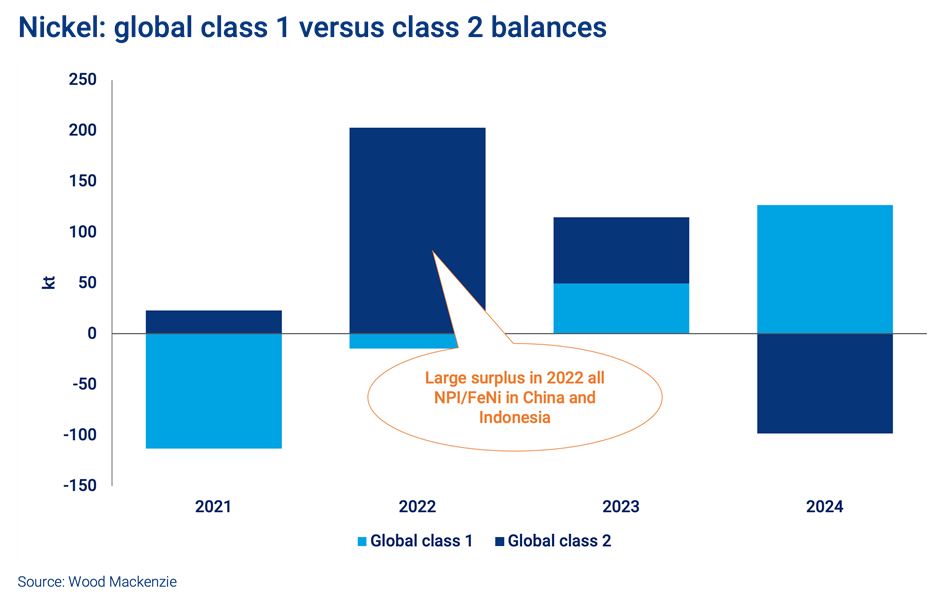
In 2023, INSG expects moderate growth in the stainless steel sector and an increase in the use of nickel in electric vehicle (EV) batteries despite the negative effect of abolishing subsidies in China.
INSG predicts the continued growth of the main driver of surplus - the production of nickel pig iron (NPI) in Indonesia. The volume of processing of NPI into nickel matte and the high-pressure acid leaching (HPAL) plants’ production are also growing in Indonesia; in the spring, the first nickel sulphate production project was launched.
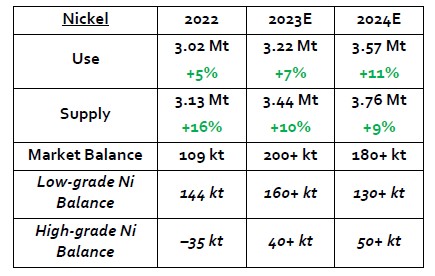
Norilsk Nickel believes that the nickel surplus in 2023 will increase to over 200 thousand tons. Most of it will be low-grade nickel. This estimate was published in May, and earlier, the company predicted a more modest metal surplus equal to 122 thousand tons.
The forecast for nickel consumption in 2023 was reduced from the previously expected 3.34 mn tons to 3.22 mn tons (up 7% from the previous year). Its revision was mainly explained by the lower forecast for the stainless steel production in Indonesia due to operational difficulties at the steel-smelter PT Obsidian. Declining demand in the battery sector amid slowing sales of electric vehicles and increased demand for nickel-free LFP batteries, also had an impact.
That said, the forecast for metal production in 2023 remained virtually unchanged and amounted to 3.45 mn tons (up 10% year-on-year), mainly due to an increase in the production of crude ferronickel in Indonesia and putting into operation of new capacities for the production of nickel cathodes both in Indonesia and in China. These changes have led to increased surpluses in the previously undersupplied Class 1 nickel market. In the high-grade nickel segment, the surplus will be approximately 40 thousand tons.
Source: 2023-05-31 Quintessentially Ni (Nornickel’s estimates)
Fitch Solutions expects the nickel market surplus to increase to 283 thousand tons in 2023 (from 112.8 kt a year ago), which is due to higher supply amid a relatively weaker demand outlook.
The market is “heading for a larger surplus in 2023” and “will not see a deficit before 2028,” according to Ellie Wang, Shanghai-based analyst at consultancy CRU Group. Wang says that global stainless steel production fell for the sixth consecutive quarter amid China’s slow economic recovery and EV sales are also slowing so far this year after the Chinese government ended its EV subsidy policy.
CRU has forecast the three-month nickel contract on the London Metal Exchange to average around $23,700 per ton this year from about $25,600 per ton in 2022, and to steadily decline to below $20,000 per ton in 2026, which, however, remains above historical price levels.
LONG-TERM PRODUCTION AND DEMAND FORECASTS
In 2024, the nickel market will continue to have a surplus of more than 180 thousand tons, with the bulk of it still coming from low-grade nickel, Nornickel believes. Production will grow by 9% to 3.76 mn tons as the NPI producers in Indonesia will continue to ramp up their capacity and convert NPI to nickel matte, and some Class 1 nickel projects in Indonesia and China will be put into operation.
Fitch Solutions forecasts a primary nickel production growth of 5.1% per year on average in the medium-term (2022 to 2026) followed by a slowdown to 1.9% in 2027 to 2031. This growth rate is below the average one of 6.6% per year achieved in 2010 to 2019 thanks to high nickel prices and strong output growth in Indonesia. By 2031, global nickel production will reach 3.15 mn tons compared to 2.24 mn tons in 2021.
With strong growth in demand for Class 1 nickel for batteries, sufficient supply of this metal is critical, Fitch Solutions believes. However, the successful conversion of Class 2 nickel to high-grade metal, which is particularly critical for Indonesia with its predominantly Class 2 ore reserves, remains technically and environmentally challenging at this stage.
According to the Fitch Solutions’ study, this suggests a tightened supply of battery-grade nickel over the next two to three years - at a time when EV sales are expected to boom; the supply of non-battery-grade nickel, on the other hand, will remain ample.
With China’s EV sales expected to recover in H2 2023, nickel demand will pick up and reach 4.3 mn tons by 2027, up from just below 3 mn tons in 2022, CRU’s Wang said. The battery industry will replace stainless steel as the biggest driver of demand, she believes.
Norilsk Nickel also believes that due to the tightening of environmental obligations imposed on governments and automakers, the growth in the production of batteries for electric vehicles will be greater than the use of the metal in traditional areas such as the production of stainless steel, alloys and special steels. In 2024, Norilsk Nickel expects stronger growth in the use of nickel in batteries after a recession-driven slowdown in the first half of this year. Nickel demand in this industry will rise by 30% to 740 thousand tons, supported by the introduction of EVs and increasing acceptance of this type of vehicles by automobile owners, as well as by optimizing battery costs and increasing the variety of models available, the company says.
Nornickel believes that the aggregate demand for nickel will grow by 11% in 2024 to 3.57 mn tons.
“Overall, nickel supply appears so far to be sufficient to meet any demand expectations during 2024, at least in China and Indonesia, while Western markets are expected to be largely balanced due to their dependence on nickel coming from traditional suppliers,” says Norilsk Nickel in its market review.
In the long term, demand for nickel is expected to keep on growing steadily, driven by increased consumption in the battery sector and the construction of renewable energy generation facilities, Norilsk Nickel believes.
PATTERN OF DEMAND
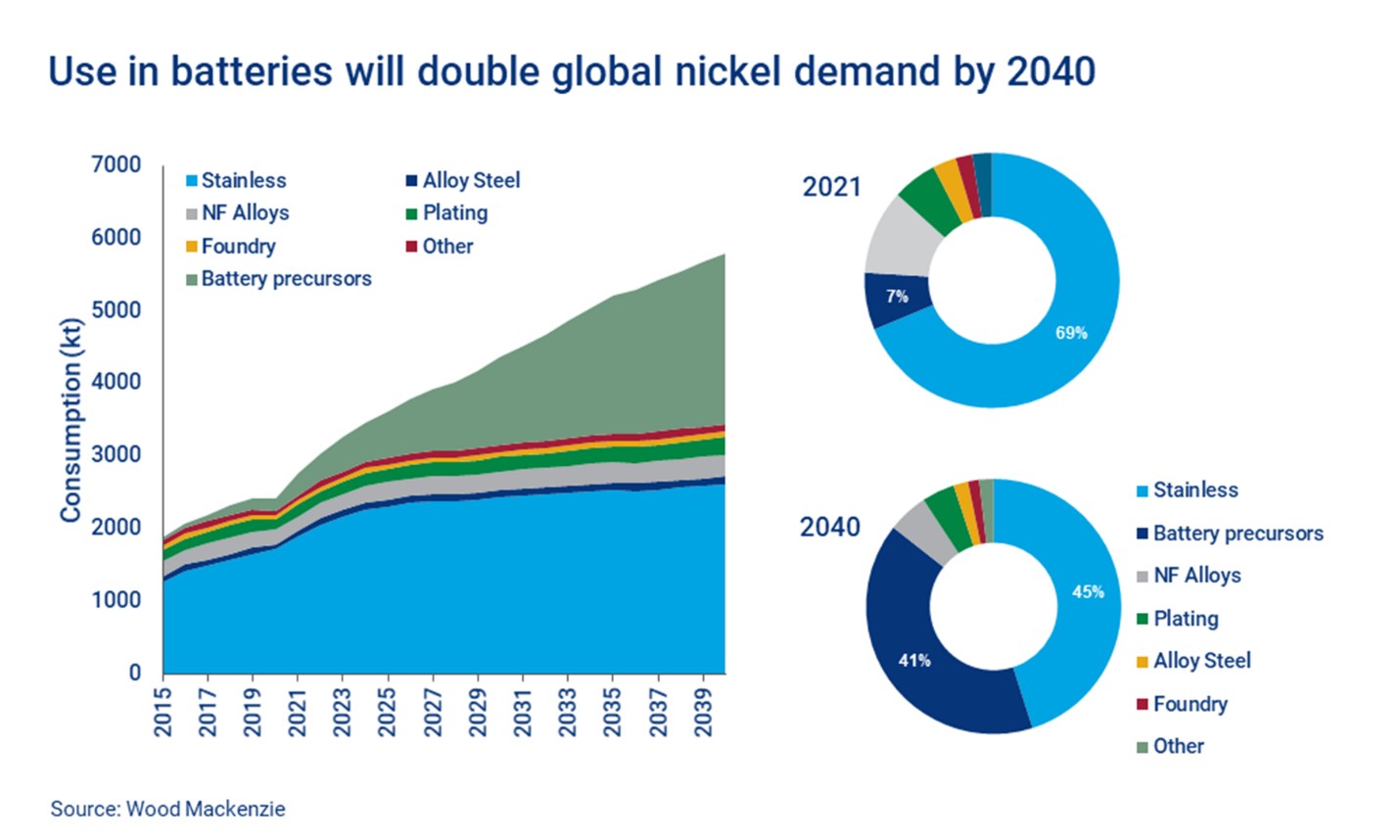
The production of stainless steel remains the largest sphere of nickel consumption (with a share of 70%), with its demand growing by 4-5 percent per year. Another 5 to 10 percent of the global nickel output is consumed in the production of alloys and special steels. The battery sector for electric vehicles now accounts for about 20 percent of nickel demand, but due to high growth rates (by 72% in 2021, 32% in 2022, 20% in 2023, according to Norilsk Nickel forecast, and by 30% in 2024) this industry competes with stainless steel in terms of additional nickel units.
Wood Mackenzie estimates that batteries will account for 41% of global nickel demand by 2040 compared to 7% in 2021. This will double nickel demand to 6 mn tons per year.
The position of nickel in the battery production industry looks very strong as nickel-based cathodes for lithium-ion batteries, including NMC (nickel-manganese-cobalt) and NCA (nickel-cobalt-aluminum), are widely used in electric vehicles, accounting for more than 50% of the battery cathode market.
SODIUM VS LITHIUM BATTERIES
An additional source of demand for nickel is the mass production of sodium-ion batteries for electric vehicles launched in 2023, Nornickel emphasised in its market review. Unlike LFP batteries, they contain nickel. The most common cathode materials in sodium batteries contain 16% nickel.
The development of sodium batteries accelerated against the backdrop of highly volatile lithium prices and a “bottleneck” in this metal production; that is, sodium batteries are actually replacing lithium ones, says Denis Sharypin, Marketing Director of Norilsk Nickel. The capacity of sodium batteries is 10% lower than that of LFP ones, but the cost of sodium is 10 times less than the cost of lithium carbonate.
“[The growing use of sodium batteries] has a positive effect on nickel. They will compete with LFP batteries, both in the car start-up systems and in statiс storage,” says the representative of Norilsk Nickel.
Sodium is the sixth most abundant element on the Earth, there are over 1,000 times more of sodium than lithium on the planet. In addition, sodium-ion batteries are safer than lithium-ion ones, since they set on fire much more seldom, which is critical for electric vehicles.
Nickel-free LFP battery technology is controlled by Chinese battery makers, Sharypin says. They have produced several generations of these batteries, having increased the capacity significantly, but the capacity is still not sufficient compared to lithium-ion batteries that provide a 20 to 30 percent longer drive range of more. Another disadvantage is the unstable operation of LFP batteries at sub-zero air temperatures.
Although the use of LFP batteries is increasing due to the high price of nickel and cobalt, Norilsk Nickel’s Marketing Department Director expects the chemical processes in nickel batteries to evolve, which could increase their capacity by another 10 to 15 percent. “This will eventually result in a cost reduction,” Sharypin expects. In his opinion, in all regions except China, nickel-based lithium-ion batteries will be mainly produced as the supply chains are built and technology develops.
Wood Mackenzie calls sodium-ion batteries a fast-growing technology in terms of commercialization that has attractive prospects in static storages. The advantage of this technology is that it is less sensitive to rising lithium prices.
In the long term, sodium-ion batteries and fuel cells could become an alternative to lithium, says Wood Mackenzie, although the technology still should be improved immensely to be used in the electric vehicle market with battery capacities above 40 kWh.
INDONESIA: PRODUCTION GROWTH ...
Fitch Solutions notes that the main reason for the nickel surplus in the global market is the increase in its production in Indonesia resulted from the increased investment in nickel refining in the country after the government banned the export of nickel ore in January 2020. China’s Tsingshan alone, a key player in the global nickel market, has invested over $6 bn in a smelter, port and power plant and plans to produce 50,000 tons of cathodes a year in Indonesia using nickel matte. Over the past 15 years, Indonesia has increased its share in the production of nickel-containing semi-products from 25% to 60%.
According to Fitch Solutions, the Indonesian nickel production will grow by an average of 12.5% in 2022 to 2026, and by 16% between 2027 and 2031.
Fitch Solutions says that the nickel production is also growing in China where Tsingshan puts new smelting facilities into operation and plans to turn copper smelters into the ones that will be able to produce nickel.
A significant surplus in the Class 2 nickel market formed in 2022 due to surplus production in Indonesia will remain during 2023-2024, Nornickel believes. “As a result, Indonesia creates a surplus and loses its potential income by selling the country’s nickel resources at significant discounts despite the growth in demand for nickel that has averaged 7% per year since 2015,” Norilsk Nickel’s market review says.
... AND RELATED RISKS
Indonesia is the largest and most vulnerable part of the global nickel supply pipeline, emphasizes Fitch Solutions. Any delays in the development of processing capacities could lead to suspending the nickel ore mining in the country and reducing the incentives for miners to increase nickel ore production.
According to Norilsk Nickel, the concentration of such a production volume in one country is very risky. Now, Indonesia is selling nickel-containing materials to China at a discount of 15 to 30 percent, losing its potential revenues, but the preferential conditions can be changed as it has already happened with tin exports, Sharypin says.
But the main thing is an extremely high carbon footprint of the nickel production in Indonesia where all energy generation is based on coal. In terms of CO2, the production of crude ferronickel emits 8 times more CO2 than the Nornickel’s nickel production, a representative of the company said. Added to this are the problems of disposal of rapidly growing tailings and deforestation. The problem of the responsible production gets tougher as the exports of nickel-containing products to Korea increase, and the traceability of the raw materials’ origin is important in this country.
“The use of such nickel in the battery production industry is not environmentally friendly as it has an extremely high carbon footprint and its production is associated with other serious environmental impacts, which contradicts the very concept of electric vehicles as environmentally friendly ones,” Nornickel concludes in its market review.
ESG FACTOR AND THE GROWING RECYCLING
Wood Mackenzie also points out that the ESG factor could be an obstacle to nickel supply stability. Additional demand for nickel between 2026 and 2038 is estimated at 1.65 mn tons, which is quite feasible given that 1.8 mn tons were supplied between 2011 and 2023. “However, the vast majority of new capacity development over the past decade has been in Indonesia and has had significant environmental side effects. Recent pledges by Indonesia to reverse deforestation and cease coal-fired power station development would make repeating these growth rates extremely challenging,” Wood Mackenzie says in its market review.
The ESG factor and the lack of new nickel mining projects outside of Asia encourage the producers from Europe and the US to start processing locally produced raw materials, writes Wood Mackenzie. According to this company, 20% of the demand for nickel for electric vehicles (420 thousand tons) will be obtained by 2040 through the recycling of electric vehicles. In the United States and other countries, technologies are used to cost-effectively recover nickel and cobalt from tailings, and hydrometallurgical methods are under development to recover and recycle batteries from “black mass” (crushed expired battery cells).
This more flexible approach to supplies should reduce the dependence on certain countries and regions as well as the vulnerability of the world commodity markets to resource nationalism, concludes Wood Mackenzie.
* The nickel market actually consists of several types of products. Class 1 nickel is an LME-grade product with a nickel content of 99.9%. This type of nickel now accounts for about 15% of its global production. Class 2 nickel (with the nickel content below 99.8%) includes every other type of nickel products, including ferronickel alloys and nickel cast iron.
Sergey Bondarenko for Rough&Polished
