Negotiations between Botswana and De Beers resulted in the recent signing of a new sales agreement covering the purchase of Debswana's rough diamond production through the year 2033.
As a result of the deal, Botswana's diamond value chain will be expanded, and the proportion of Debswana's supply that will be sold by Okavango Diamond Company (ODC) will rise from its present level of 25% to 50% by the final year.
At the beginning of the new contract period, ODC will be entitled to receive 30% of Debswana's total output.
"For De Beers, it is a privilege to renew our half-century partnership with the people of Botswana. It is a partnership that is highly regarded around the world for the enduring role it has played in creating economic development and growth," said De Beers chief executive Al Cook.
"Our transformative agreement reflects the aspirations of the country, secures the future of our Debswana joint venture, and reaffirms De Beers' leadership position for the long term.”
Additionally, De Beers announced the establishment of a multi-billion Pula Diamonds for Development Fund with an initial commitment of BWP1 billion ($75 million) and the possibility of additional contributions of BWP10 billion ($750 million) over the course of the next 10 years.
The agreement was reached after a lengthy negotiation and a lot of grandstanding from some Botswana government officials, including President Mokgweetsi Masisi, who indicated in January that his country was prepared to walk away from trade discussions if its aspirations for a higher share of local output were not realised.
The fact that he and his government were successful in getting De Beers to give in to their demands is a credit to both of them.
Botswana made these requests despite having a solid understanding of the significance of Debswana to the De Beers family.
Debswana produces the bulk of De Beers’ output as shown in the group’s production report of the first half of 2023 (see table below).
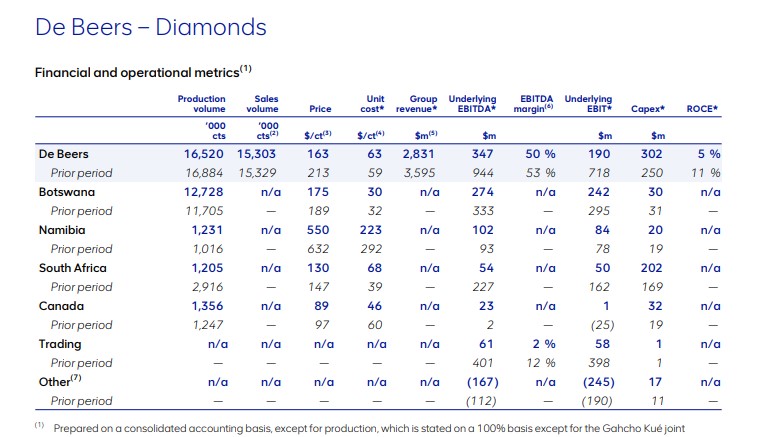
Source: Anglo American
The table shows that De Beers produced 16.5 million carats in the first half of 2023 from four countries it has operations in.
Out of these four countries, Botswana produced 12.7 million carats, Namibia contributed 1.2 million carats, South Africa reported an output of 1.2 million carats, and Canada recorded an output of 1.4 million carats.
De Beers does not provide a breakdown of the number of diamonds sold and the income earned from each of the four countries in which it does its business.
Given the quantity and quality of diamonds that come from Botswana, there is little question that the country contributes the majority of De Beers' earnings.
Botswana needed De Beers due to the fact that diamonds account for 70% of the country's foreign exchange earnings and about 30% of its revenue.
Nevertheless, Botswana was also fully aware of the reality that De Beers needs the country just as much, if not more, than it needs De Beers.
So with this victory being hailed in Gaborone, the authorities at De Beers are presumably worried that Namibia will start demanding for half of the diamonds as their neighbours managed to get.
These are not unwarranted suspicions due to the fact that the exact same thing occurred the previous time Botswana earned big from its negotiations for the 2011 sales agreement.
When the 10-year sales deal was reached in September 2011, it put a stop to the century-long practice of shipping diamonds from Africa to London.
The deal moved the raw diamond sales business to Gaborone.
Before Debswana's production was sold to the Diamond Trading Company (DTC) in London. DTC Botswana was given the opportunity to sort the diamonds and assign a value to it.
The agreement also included an independent sales outlet for the Botswana Government, beginning at 10% of Debswana's mine production and increasing to 15% over a period of five years and to 25% at the end of the deal.
When Namibia entered into negotiations for the 2016 sales agreement, it took a cue from this agreement and demanded a significant increase in the local supply of rough diamonds produced by Namdeb Holdings to the cutting and polishing industry of between 25 and 30% percent, up from 10%.
Additionally, it requested a window on the market that would allow Windhoek to purchase a sizeable amount of Namdeb Holdings' rough diamonds and then sell those diamonds through alternative routes.
Nevertheless, in May of 2016, De Beers and the government of Namibia came to an agreement on the sale of rough diamonds that was the longest one they had ever signed together as business partners.
The deal made it possible for Namib Desert Diamonds (Namdia), a government-owned independent sales firm, to receive 15% of Namdeb Holdings' annual run-of-mine production.
A total of $430 million in additional yearly value was made available to Namibia Diamond Trading Company clients as a result of the transaction, which also enhanced the availability of rough diamonds for beneficiation.
As the current agreement will expire in May 2026, Namibians will undoubtedly make an effort to increase their portion of the pie.
Windhoek is well aware that the marine-based diamonds it produces are high-quality items that attract De Beers, which will require it to go to considerable measures to secure a deal.
In March 2022, Debmarine Namibia, a joint venture between De Beers and the government of Namibia, launched the $420 million custom-built Benguela Gem vessel with the intention of increasing the amount of high-quality diamond production by 500,000 carats yearly.
The vessel was responsible for the recovery of 480 000 carats of diamonds and provided 28 percent of Debmarine Namibia's output in 2022.
Debmarine Namibia was responsible for the production of 1.72 million carats worth of diamonds last year.
This represented almost 80% of the overall output of diamonds in Namibia.
Diamonds mined in Namibia fetch some of the highest prices on average per carat found anywhere in the world.
Due to the success of Debmarine Namibia, Namibia would undoubtedly believe that if Botswana has the right to beneficiate half of its diamonds, then the same may be done in the country.
The South Africans are also keeping a close eye on the situation, and it should not come as a surprise when they finally start making some noise.
Because of this, there will be fewer diamonds available for sale to De Beers' sightholders, which will undoubtedly cause the company headaches in the foreseeable future.
Therefore, it is in the company's best interest for its operations in Angola to be successful so that it may acquire additional diamonds for its vaults.
The GemFair initiative might possibly be expanded by bringing in a significant quantity of diamonds from African artisanal miners, with the expectation that the quality of these diamonds would be comparable to those produced by De Beers.
The new norm in modern Africa is that people demand more from their resources, and they won't stop at anything to obtain it until they achieve what they want.
Mathew Nyaungwa, Editor in Chief of the African Bureau, Rough&Polished
