The global “green” energy transition is impossible without a number of metals, including copper. Analysts at S&P Global, IEA, Wood Mackenzie report a significant future growth in demand for the red metal and the expected copper shortage. In this regard, the question arises, first of all, of intensifying the geological exploration (GE) for copper, but this approach makes it possible to solve this problem only in a very distant future because on average, about 10 years are required from the discovery of a deposit to its commissioning. To partially solve the problem of future shortages “here and now”, it is possible to take a different approach as there are a number of explored copper deposits in the world that have not been developed for a long time for various reasons. These include several deposits - unofficially called the “sleeping giants” - that have unique reserves and resources of the metal.
In this article, ten such deposits are summarized in a certain rating based on the increasing resource base (Fig. 1). It is noteworthy that all the deposits belong to the same geological and mining type - a porphyry copper deposit - including its subtypes distinguished by the dominating certain associated components (porphyry copper-gold deposit, porphyry copper-molybdenum deposit). In addition to the complex composition of the ores, such deposits are characterized by large reserves of relatively low-grade copper ores, on the average, of about 0.3-0.5 percent (although there are exceptions).
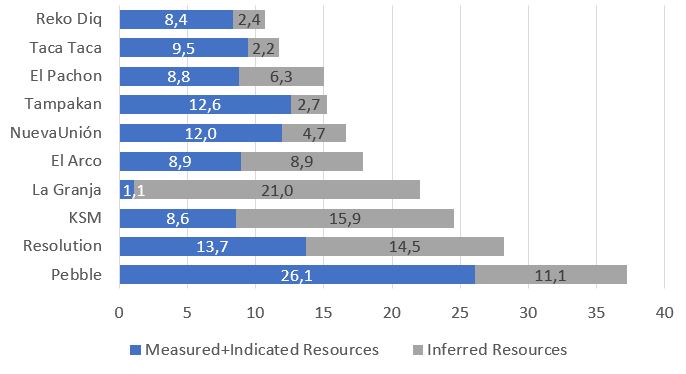
Fig. 1. Copper resources of the largest undeveloped copper deposits in the world, mn tons.
We will take a closer look at each of the “sleeping giants”, find out the reasons for suspending the development of these projects and the prospects for the development resumption because of a potential increase in demand for copper.
The first deposit on the list is Reko Diq that has a very exciting history. A porphyry copper-gold deposit was discovered in the mid-1990s in Pakistan (Balochistan Province). Geological exploration at the deposit was carried out by the Australian company Tethyan Copper Co. Ltd. owned by the Canadian Barrick Gold Corp. and the Chilean Antofagasta plc on a parity basis since 2006. The Tethyan company owned a 75% stake in the project, and the remaining 25% were owned by the Balochistan Province government. In 2008, the work began on the feasibility study for the development of the deposit, which involved open pit mining (the quarry is about 500 m deep) and the construction of an ore processing plant. Capital costs for the construction of the enterprise were estimated at $2.5 bn to $3 bn, and Tethyan spent about $220 mn on exploration. In accordance with an agreement between Tethyan and the government of the Balochistan Province signed in 2006, the company had the right to explore the potential for mining copper and gold within the province. When Tethyan applied in 2011 to lease the area where the Reko Diq deposit was located, the government rejected it. This was the start of a years-long legal fight, during which the work on the deposit was suspended. In 2019, the World Bank’s International Center for Settlement of Investment Disputes (ICSID) ordered Pakistan to pay the compensation in the amount of $5.84 bn to the Tethyan Copper company. For Pakistan, this amount of money was equal to a half of its foreign exchange reserves, the country could not pay this sum of money, and the legal actions continued. As a result, the parties agreed in 2022 to continue their cooperation on the development of the Reko Diq project. Now, a 50% stake in the project is directly owned by Barrick Gold, which is its operator. The remaining 50% stake is owned by Pakistan, including 25% owned by three federal Pakistani state-owned companies, 15% - by the Balochistan Province on a fully funded basis, and 10% - by the Balochistan Province on a royalty-free basis. In December 2022, Barrick Gold announced its plans to invest $10 bn in the implementation of the Reko Diq project. The company plans to update its project feasibility study by 2024 and start developing the deposit in 2028. As of late 2022, the Reko Diq’s indicated copper resources were 8.4 mn tons, its inferred resources were 2,4 mn tons. The mine can operate for 40 years, producing about 195 thousand tons of copper and 9 tons of gold annually during the first five years.
The Taca Taca porphyry copper-gold deposit is located in Argentina and was discovered back in 1960. The Canadian company First Quantum acquired the rights to the project in 2014 through the purchase of Lumina Copper Corp. that had owned the deposit since 2008; by that time, a preliminary feasibility study for the project had been completed. Based on the results of First Quantum’s exploration, the reserves and resources of the deposit were re-evaluated in 2020; measured and indicated resources that include proven + probable reserves, amounted to 9.5 mn tons of copper, and inferred resources were 2.2 mn tons of copper. The ores also contain gold and molybdenum. After commissioning, the Taca Taca project will have a mine life of over 30 years. In the first ten years, it is expected to produce about 275 thousand tons of copper in concentrate a year, then about 200 thousand tons. However, First Quantum is in no hurry to start developing the deposit and focuses on other projects; a decision to commence its implementation may be taken only at the end of 2023-2024.
In the same time (in 1964), another unique deposit was discovered in Argentina. The first feasibility study of the El Pachon porphyry copper-molybdenum project was completed in 1977, however, its implementation was suspended due to a difficult social and economic situation. The next phase of exploration was started after 2006 when the project became the property of the Xstrata Copper company. In 2012, measured + indicated and inferred ore resources were calculated on the basis of new data and were equal to 8.75 mn tons and 6.3 mn tons of copper, respectively, and ores contained molybdenum and silver as well. In 2013, Xstrata was acquired by the Glencore PLC, and no progress has been made in the project since then. In December 2022, there was a message in media about an increased activity at the project, in particular, about hiring new employees; however, those were just rumors, no real actions. One of the reasons for the project’s long ‘freeze’ was the former Glencore CEO Ivan Glasenberg who opposed the commissioning of new copper facilities due to fears of an oversupply in the market and price decline. His successor, Gary Nagle, said in 2021 that he was “from the same school as Ivan” when it came to new mining projects, but the following year, he reported “a huge deficit coming in copper”. A mine at the El Pachon deposit can provide about 400 thousand tons of copper annually and make Argentina a significant producer of the metal. However, time will tell whether the “huge deficit in copper” is enough to launch the project.
The development of the Tampakan porphyry copper-gold deposit on the Island of Mindanao in the Philippines has been delayed due to environmental concerns. The deposit was discovered in 1990, and Sagittarius Mines (Philippines) began its exploration in 1995. The company completed the project’s feasibility study and the environmental impact assessment. The deposit’s measured, indicated and inferred resources of copper have been estimated at more than 15 mn tons. In addition, its ores contain 17.6 mn troy ounces of gold (about 550 tons). After commissioning, the mine could annually produce about 375 thousand tons of copper concentrate and 360 thousand troy ounces of gold concentrate. However, the project was not launched because in 2010, the local authorities of the Province of South Cotabato where it was located introduced a ban on the open-pit mining of mineral deposits. In 2017, when new President of the Philippines Rodrigo Duterte (was in office until 2022) - an ardent opponent of mining activities due to their possible negative impact on the environment - came to power, a similar ban was adopted at the national level. The national ban was lifted at the end of 2021, and the ban in the Cotabato province was partially lifted in September 2022 as it was retained for small mining enterprises. In April 2023, there were reports in newspapers about a mine to be launched at the Tampakan deposit in 2026, but it is still early to declare the success of Sagittarius Mines due to ongoing protest acts held by local communities, which do not want to damage nature for the sake of jobs and social benefits.
The NuevaUnión project involves the development of two porphyry copper-gold deposits - El Morro and Relincho - in the Chile’s Atacama Region. The project is owned on a parity basis by the Canadian companies Teck Resources Limited and Newmont Corporation that merged in 2015 for its implementation. Prior to this merge, each of the deposits was an independent project where an exploration had been carried out for many years. In particular, the mine at the El Morro deposit was planned to be commissioned as early as 2013. According to the latest data (as of late December 2021), the total measured and indicated resources of the two deposits (including probable reserves) amounted to almost 12 mn tons of copper, inferred resources were 6.3 mn tons of the metal. The project’s costs were estimated at $3.5 bn, and its mine life was expected to be 36 years. The project was expected to provide an annual production of 84 thousand tons of copper and 395 thousand troy ounces of gold. However, there is no information about commencing of mining operations at the NuevaUniόn project. The Teck Resources company only says that in 2023, it will focus on developing a cost-effective way to develop the project.
Another unique porphyry copper-gold deposit, El Arco, is located in Mexico and is owned by Southern Copper Corp., which is majority-owned by the Mexican mining conglomerate Grupo Mexico. The deposit is located in an area owned by Southern Copper since 1969. The company completed several stages of exploration at the deposit, but did not start its development due to significant capital costs. As of late 2021, the probable copper reserves at the deposit were 5.3 mn tons, the indicated resources were 3.6 mn tons, and the inferred resources were 8.9 mn tons. The ores also contain gold and molybdenum. Commissioning of the facility will ensure annual production of 190 thousand tons of copper concentrate and 105 thousand troy ounces of gold. In February 2023, Southern Copper announced a large-scale $15 bn investment into its projects over the next decade; among other things, the development of the El Arco project was specially noted, and the company plans to spend a fifth of the abovementioned amount on it. Copper ore mining is set to commence on the project in 2030.
The La Granja porphyry copper deposit in Peru has been owned by Rio Tinto since 2005. From 2005 to 2015, geological exploration was carried out at the deposit, which resulted in the development of the project’s pre-feasibility study involving open-pit mining with ore processing using flotation (160 mn tons of ore per year) and leaching (15 mn tons of ore per year). The deposit’s indicated copper resources are estimated at 1.1 mn tons, the inferred resources are 21 mn tons. The ores also contain molybdenum and silver. In 2017, the project was placed on care and maintenance. In April 2023, Rio Tinto and the Canadian mining company First Quantum Minerals entered into a joint venture (JV) agreement to develop the La Granja project. As part of the deal scheduled to be sealed in the third quarter of 2023, First Quantum will acquire a 55% stake in the project for $105 mn and will commit to an additional investment of up to $546 mn in the JV to bring the project to a feasibility study stage and the subsequent development. All future expenses will be carried out on a pro rata basis in accordance with their share in the project. According to Rio Tinto Copper’s CEO Bold Baatar, “La Granja is an exciting but complex project that has the potential to be a significant new source of the copper that is needed for energy transition.”
As part of the KSM project, work is underway to develop five large porphyry copper-gold deposits in the Canada’s province of British Columbia, including Kerr, Sulphurets, Mitchell, East Mitchell, and Iron Cap. The project is owned by Seabridge Gold Inc., which has been conducting exploration on this area since 2001 and, to date, the company has invested over $650 mn in the project. In 2012, a preliminary feasibility study was completed that initially included only the first three of the five deposits. In 2014, after seven years of reviewing, the project was approved in accordance with the British Columbia Environmental Protection Act, the Canadian Environmental Protection Act and the Nisga’a Treaty (settled between the the Nisgaa Indigenous peoples, the government of British Columbia and the government of Canada). After that, the work at the project continued, including an update of the preliminary feasibility study, taking into account the resources of the new deposits (East Mitchell and Iron Cap). As of December 2022, measured and indicated resources of the KSM group of deposits (taking into account proved and probable reserves) amounted to 8.6 mn tons of copper, inferred resources were almost 16 mn tons of copper. In addition, the ores contain gold, silver and molybdenum. In 2021, Seabridge Gold started to build the infrastructure, including villages, access roads and bridges, as well as preparing the site for the future mine. Mining is scheduled to begin in the summer of 2026.
The porphyry copper-molybdenum giant Resolution in Arizona, USA, was discovered in 2002. The deposit is owned by the joint venture between Rio Tinto (55%) and BHP (45%), and Rio Tinto is its operator. In addition to the unique amount of copper (13.7 mn tons of indicated resources and 14.5 mn tons of inferred resources), the deposit is also distinguished by a very high quality of ores as the average copper grade (in indicated resources) is 1.89%, which is not typical for this type of ores. The ores also contain molybdenum and silver. After putting it into operation, the Resolution mine can produce 600 thousand tons of copper annually, which is about 25% of the forecast US demand for the metal. However, there is one very big obstacle as the deposit is located on the sacred lands of Oak Flat, the North American indigenous tribe. This caused a long-term confrontation between the mining company and the group of indigenous people represented by the Apache Stronghold organization. The fears of the North American indigenous peoples about the possible serious damage to the Oak Flat’s land intensified after a 2020 incident in Australia where Rio Tinto employees blew up 46,000-year-old cave shelters during work. This led to changes in the company leadership and also attracted additional public attention to the company’s activities. In 2014, the US Congress commissioned the Forest Service to prepare a report on the impact of the project on the environment taking into account the North American Indian tribes’ opinions. The report was released in January 2021, but later it was withdrawn at the request of the Joe Biden administration for further and more detailed consultations with indigenous communities. The final version of the report is expected to be made public in the summer of 2023.
The world’s largest undeveloped copper deposit, the porphyry copper-gold Pebble deposit, is also located in the United States. It was discovered in 1989 in Alaska by the Cominco company (now Teck Resources). In 2001, the Canadian Northern Dynasty Minerals Ltd entered into an agreement to purchase the project, and it became a full owner of the deposit in 2005. The company carried out active exploration of the project area and achieved very significant results; it explored new ore bodies and increased the figures on resources of copper, gold and associated minerals. In 2007, Anglo American acquired a 50% stake in the project for $1.5 bn, but Northern Dynasty bought it back in 2013. This was the end of the active development of the Pebble project due to the failed attempts made by Northern Dynasty to obtain regional authorities’ permission to build a mine. The problem also lies in the location of the deposit - it is situated near Bristol Bay, and according to environmentalists, its development may have an adverse effect on the waters of the bay where salmonid fish species annually come to spawn. The Northern Dynasty’s battle for metals with environmentalists and authorities lasted for several years and its next stage ended in January 2023 when the company lost out. The US Environmental Protection Agency effectively imposed a veto on the project, citing the provisions of the Clean Water Act. As of early 2023, the measured and indicated resources of the Pebble deposit were over 26 mn tons of copper, and inferred resources were over 11 mn tons. In addition, the ores contain gold, silver, molybdenum and rhenium. The development of the deposit would provide stable, well-paid jobs for up to 2,000 people.
It should be noted that until recently, the unique Udokan deposit of copper sandstones located in Russia (Zabaikalsky Territory) was a part of the “sleeping giants” group. The deposit was discovered by the Soviet geologists back in 1949 and remained undeveloped for over half a century due to the lack of industrial technology for processing these ores. Currently, the deposit is owned by the Udokanskaya Med (Udokan Copper) company (part of Alisher Usmanov’s USM Holding) that is now mining ore at the quarry as part of mining and capital works, and it is carrying out the start-up and commissioning works at the ore processing plant. The ores will be processed using a new floatation and leaching technology. The first start-up complex is planned to be commissioned before the end of 2023. The measured, indicated and inferred resources of the facility, calculated according to the JORC classification, are 26.7 mn tons of copper; the ores also contain silver that is expected to be recovered as a by-product. It is noteworthy that among the global “sleeping giants”, the Russian Udokan deposit was the first to wake up.
So, using ten unique undeveloped copper deposits as an example, one can see that the reasons to “freeze” the implementation of the projects can be very different, including financial-and-economic, social, environmental, and political considerations. A serious increase in copper demand and the threat of its shortage can “wake up” the projects suspended for financial and economic reasons. After all, a large (and unique) deposit requires significant capital expenditures for its development, including the construction of its infrastructure, and its development will be unprofitable in a weak market. Actually, political activity is also adjusted to the market, but social and environmental reasons are a completely different matter, much more multifaceted. On the one hand, the world needs copper supplies, but on the other hand, people are forced to endure environmental pollution at present to create a “green” future. It just sounds weird, doesn’t it?
Anastasia Smolnikova, Senior Expert Analyst, Institute for Natural Monopolies Research, for Rough&Polished
