In mid-August, ALROSA published its first financial statement in a year and a half. It did not contain many details but gave an affirmative answer to the question whether the sales of the company that has been under the US sanctions since last spring continue or not.
As a result, the company’s financial performance for H1 2023 turned out to be better than the analysts’ expectations. A strong cash position and negative net debt allow the company to share profits with its shareholders for the first time since the fall of 2021. The interim dividends recommended by the supervisory board for H1 2023 were conservative but this is a good option taking into account that the vast majority of the Russian players of the metals & mining sector, including the companies not hit by sanctions, made a decision to not pay dividends.
Before investors had time to evaluate the benefits of ALROSA’s coming out of the information shadow, a new threat appeared on the horizon. According to the New York Times, the G7 and EU countries are going to impose a ban on Russia’s rough diamond imports to undermine the country’s revenues from this business estimated at about $4 bn annually. Unlike the American sanctions, the embargo in this case may affect gemstones cut and polished in other countries. New sanctions could be announced in September and take effect in January 2024, after the holiday sales.
Although these sanctions and the associated mechanism for tracking the origin of gemstones have been discussed in one way or another for a long time, their consequences for the diamond market seem to be unpredictable. On the one hand, 30% of the global diamond production have apparently already moved into the ‘gray zone’, which has resulted in a price correction. On the other hand, this volume is so large and significant that it is unlikely to be ‘digested’ only by the markets of China and the Middle East where consumers are not yet very much concerned about ethical implications.
STABLE FINANCIAL INDICATORS...
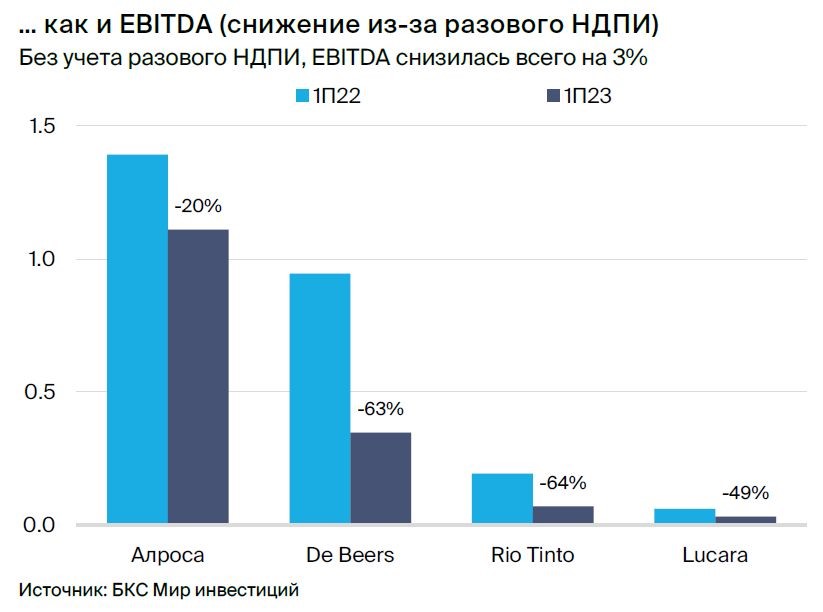
ALROSA’s revenue in H1 2023 amounted to 188.2 bn rubles compared to 188.9 bn rubles last year and 182 bn rubles in H1 2021. EBITDA also remained virtually flat from last year, without taking into account the one-time mineral extraction tax (MET) of 19 bn rubles paid by the company in Q1 2023, according to BCS World of Investments’ experts.
BCS World of Investments compared the dynamics of revenue and ALROSA’s EBITDA with those of the competing companies. The diamond market slump in the first half of the year had a negative effect on the performance figures of all companies.
ALROSA’s revenue for H1 2023 is higher than that of its competitors. Peers’ revenues fell by more than 20% year-on-year, with 1% at ALROSA
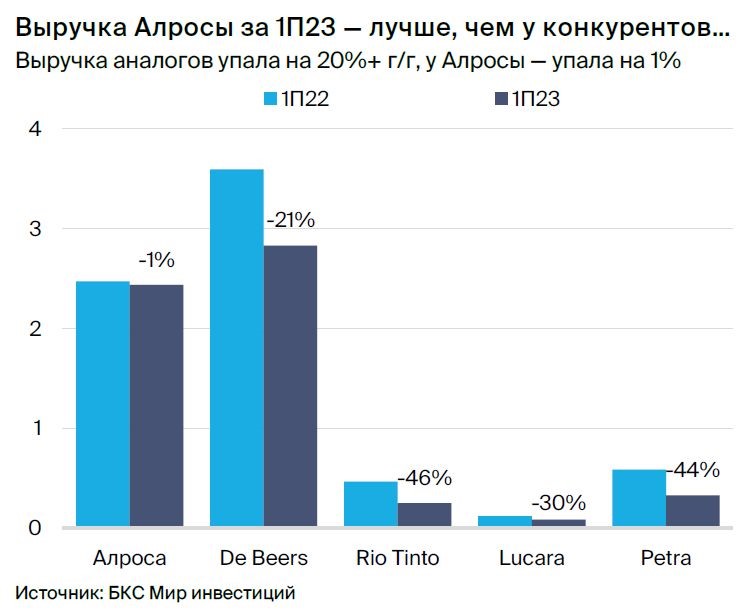
… as well as EBITDA (decrease due to one-time MET)
Source: BCS World of investments.
Text in tables above: Без учета НДПИ. EBITDA снизилась всего на 3%. - Excluding mineral extraction tax. EBITDA decreased by 3% only. 1П22 - H1 2022. 1П23 - H1 2023. Алроса - ALROSA.
That said, the structure of ALROSA’s reserves indicates some difficulties with sales. The estimate of rough diamond reserves increased over a year and a half by more than 7.5 times, from 6.12 bn rubles to 46.8 bn rubles, although since the beginning of 2023, it has decreased by 11%. The estimates of intermediate products (ore and sands) also increased. Due to an increase in ore and sand reserves, increased costs for fuel and lubricants and other factors, the ALROSA’s working capital increased by 24.4 bn rubles compared to a year ago.
|
RESERVES |
|
|
|
June 30, 2023 |
December 31, 2022 |
|
|
Materials for mining and repair |
63,762 |
56,160 |
|
Rough diamonds |
46,790 |
52,459 |
|
Ore and sands |
30,484 |
21,338 |
|
Polished diamonds |
6,328 |
4,785 |
|
Consumer and other goods |
1,829 |
1,627 |
|
Total reserves: |
149,193 |
136,369 |
Apparently, the company faced difficulties related to financial logistics and advance payments from customers, which resulted in an increase in working capital, according to Alfa Bank’s Boris Krasnozhenov. But he believes that in the future, the accumulation of working capital will decline.
ALROSA’s net profit in H1 2023 fell by 35% year-on-year, amounting to 55.57 bn rubles. The company will use half of this amount (27.8 bn rubles) to pay dividends (3.77 rubles per share, dividend yield is 4.4%). ALROSA has not paid dividends since H2 2021; the supervisory board explained this by ‘exogenous uncertainties’ and the need to increase the company’s stability. However, the company did not announce dividends for the previous period (some analysts did not rule this out) that could be financed from unappropriated balance or deposits. Under possible tightened international sanctions and sluggish market, the company management preferred a conservative position.
ALROSA’s performance figures generally exceeded the forecasts, according to Sinara’s Dmitry Smolin. Thanks to stable rough diamond sales, revenue remained flat compared to last year. EBITDA was 19% higher than the Sinara’s forecasts. Net income exceeded the expectations by 27%. But the free cash flow, amounting to 20 bn rubles (a decline of 38% year-on-year), was 4% below the forecasts.
Akhmed Aliyev of BCS also considers ALROSA’s results to be generally positive. “The results turned out to be quite good, we see the sales are stable, which is reflected in revenue and operational cash flow,” he says.
The generation of cash flow over the past year and a half has allowed ALROSA to reach the level of negative net debt (5.5 bn rubles of net cash on the balance sheet at the end of a six-month period), analysts at My Investments wrote.
According to Vasily Danilov of Veles Capital, the ALROSA company successfully adapted to new conditions despite tough sanctions and demonstrated confident growth in key indicators based on the results of Q2 2023. The cash pile increased to 133.4 bn rubles (compared to 61.3 bn rubles in late 2021), while total debt almost did not increase and amounted to 127.8 bn rubles (compared to 122.5 bn rubles in late 2021).
... AND UNSTABLE PROSPECTS DUE TO POSSIBLE SANCTIONS
The current US sanctions apply only to rough diamonds of Russian origin cut in the country. “Given 90 percent of diamonds are cut and polished in India, and can therefore be classified as Indian gems, the current regulations aren’t as strict as you might think,” says Paul Zimnisky. In addition, many major luxury manufacturers, such as Richemont and LMVH, have ordered their suppliers to exclude rough diamonds of Russian origin.
At the same time, according to Zimnisky, “the Russians have ramped up diamond sales in recent months in an attempt to claw back market share lost last year following the disruption in trading.” The Kimberley Process (KP) statistics show that Russia’s rough diamond exports remain relatively stable despite the clear-out of many traditional buyers. According to KP, Russia exported $3.9 bn worth of rough diamonds in 2022, which is just slightly less than $4 bn in 2021. Although there was a decrease in volumes (by 24%, to 36.7 mn carats), this may be partly explained by a high base of 2021 when there was an increased demand for rough diamonds due to the rapid recovery in jewelry sales following the Covid-19 pandemic.
The G7 countries account for almost 70% of global rough diamond purchases. If an import ban on rough diamonds of Russian origin is agreed upon, their ability to enter the market will reduce greatly, says Brad Brooks-Rubin, senior adviser to the Office of Foreign Asset Control of the U.S. Department of the Treasury (OFAC), in his article published in the New York Times.
The restrictions will likely only apply to stones weighing 1 carat or more, although smaller stones of Russian origin may be sanctioned later, Brooks-Rubin explained.
The introduction of this embargo seemed unlikely for a long time due to the devastating consequences for the Indian diamond cutting and polishing industry. The industry employing about 1 mn people suffered greatly because of the US sanctions imposed last year, which resulted in massive layoffs of cutters and polishers due to a shortage of rough diamonds. This summer, 300 thousand workers in Surat were placed on 20-day unpaid leave due to a shortage of rough diamonds, and 15-20 thousand workers lost their jobs. Indian industry participants also face the threat of secondary sanctions as OFAC has recently begun to freeze their dollar payments, suspecting that they are intended for their Russian counterparties. And although imports of polished diamonds from India to the United States decreased by almost 50% by September (due to fears of importing the polished diamonds of Russian origin, as well as due to recessionary expectations), the Indians are apparently not ready to ignore the request of the largest player in the luxury goods market. There is currently almost no demand from China, the second-largest market, according to local media.
At present, the negotiators on the sanctions’ terms are finalizing the conditions for tracking rough diamonds and the lists of accompanying customs documents, the New York Times reports. The increase in polished diamond prices due to restrictions is expected to be gradual as the industry has expected these sanctions to be imposed. “The diamond industry has had time to digest all of this, so while I do not expect a pending supply shock, I do see the way that the diamond supply chain works to be fundamentally transformed in the medium term,” says Zimnisky.
ALROSA is too large of a rough diamond supplier to the global market to be excluded from it, says Boris Krasnozhenov from Alfa Bank. “The company will find ways to optimize the financial component as well as its distribution logistics,” he believes, mentioning the good fundamental conditions still existing. “The market is on track to face a shortage of rough diamonds in the medium term as demand grows and major deposits are depleted around the world. Industry sources predict a 25% drop in rough diamond production by the end of the decade,” Krasnozhenov believes.
THE PROBLEM OF TRACKING THE ORIGIN
The big question is whether an industry made up largely of small operations specializing in segregating diamonds based on very different criteria - diamond quality, size and color - can move to segregating the rough diamonds by their origin, the New York Times notes. The problem will be aggravated by numerous loopholes in the supply chain. According to Hans Merket of the independent research agency International Peace Information Service (IPIS), diamonds can change hands 20 to 30 times on their way from mines to market. It will likely take years, not months, to restructure the global supply chain, he said.
The plan is that the implementation of a global rough diamonds origin tracking system will complement the sanction mechanism. Even Belgium supported this measure, arguing that in case of an embargo, trade would be redirected to other centers such as Dubai, and the flow of Russia’s rough diamonds would not be affected. So far, effective tracking mechanisms cannot be widely used. The origin of a rough diamond is transparent at the beginning of the supply chain when a KP certificate is issued, but in the subsequent stages of transformation into a polished diamond and jewelry, it becomes difficult to trace the origin, especially for smaller stones.
The introduction of a method for tracking the origin of rough diamonds looks like ‘a science fiction’ and generates an even more serious problem, says Sergey Goryainov of Rough&Polished. “Even if it is possible to achieve this result [to understand the source of origin], determining what deposit the rough diamond is from is not enough. We need to determine when it was mined. A huge number of polished diamonds are already on the market. The Udachny mine, for example, has been in operation for many decades and very many polished diamonds from this mine have been manufactured, sold and used in jewelry. Do the people who bought them 20 years ago own illegitimate goods?” Goryainov asks.
THE PRESSURE OF DISCOUNTS ON THE MARKET
The market’s problems are not limited to a potential tracking system, Goryainov believes. Due to sanctions imposed on the largest diamond producer, 30% of the rough diamond market goes into the ‘gray’ zone. “We can assume that ALROSA is forced to dump because only dumping can compensate for the risks faced by clients who cooperate with the company included in the SDN-list,” says Goryainov. This situation is extremely negative not only for the Russian company, but for the diamond market as a whole, and may be one of the reasons for the weak prices starting from H2 2022, he believes.
The forced secrecy of ALROSA’s sales (due to sanctions) creates favorable conditions for discounts, agrees Igor Kulichik, who served as ALROSA’s CFO from 2002 to 2017, and later was deputy head of the board of directors of AGD Diamonds. This is one of the pressures on prices, which is most obvious in the melee and medium range gemstones where there is also a significant penetration of synthetic stones. According to Kulichik, in the market segment of small-sized and relatively inexpensive gemstones there has been a significant penetration of synthetic diamonds, which now account for approximately 7% by value and 25% by volume.
It is impossible to draw reliable conclusions about the use of discounts in ALROSA sales because the company did not disclose data on its sales volumes in carats, average selling prices and price index. In this context, Bloomberg’s information can only be mentioned that described the changed sales pattern last year with reference to anonymous sources. According to Bloomberg, the changes were quite large-scale because earlier, about 50 long-term clients bought diamonds during the trading session, but from 2022, the main volumes were sold to 10 market participants, and Indian Kiran Gems and Shree Ramkrishna Exports stand out among them. In addition to the Indian customers, some Belgian market players also keep on purchasing rough diamonds, as well as jewelry retailers from China and the Middle East. ALROSA also stopped using the practice typical of the diamond market and started making concessions to the narrowed circle of buyers, allowing them to select the highest quality stones from boxes for sale. For this reason or because the transactions are now in currencies other than the dollar, ALROSA’s monthly sales are lower by $50-100 mn than the pre-sanction figures (i.e., estimated at $250 mn), the agency reported.
Sergey Bondarenko for Rough&Polished
