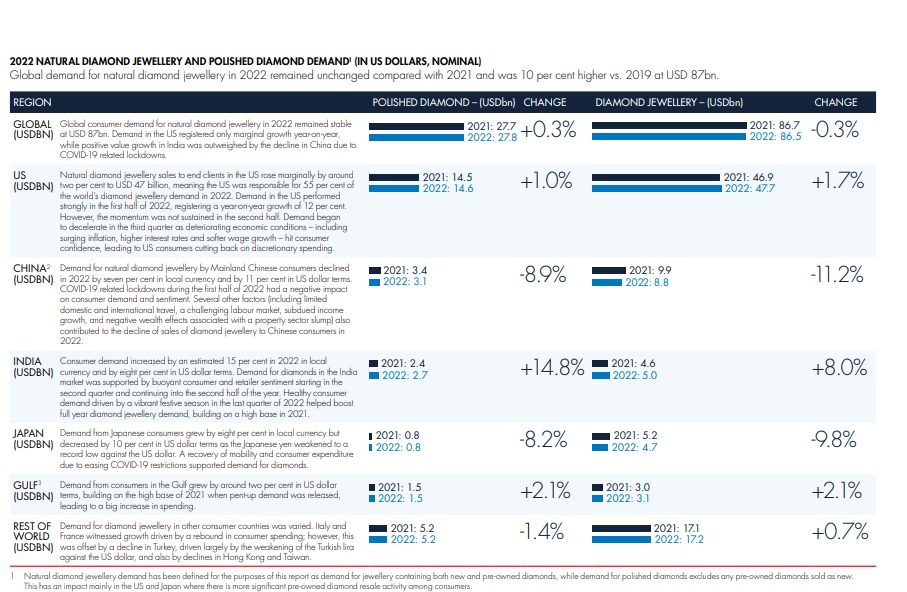
The weaker macroeconomic environment, especially in some of the main diamond-consuming countries, impacted global demand for natural diamond jewellery in the first half of 2023, according to De Beers' tenth annual diamond insight report.
The report noted that while demand in the United States and Japan was lower than in the first half of 2022, growth was expected to be positive in both China and India.
The economic headwinds of soaring inflation, elevated interest rates, and rising cost of living in the first half of 2023 in the US disrupted consumer demand for natural diamonds.
But the US economy held strong.
“The labour market remained tight, as evidenced by the downward trend for the unemployment rate which indicated the economy remained close to full employment,” it said.
“US retailers’ expectations for diamond jewellery demand in the second half of 2023 remain positive.”
Source: De Beers
It was reported that after China reopened in late December 2022 following COVID-19-related lockdowns, the country's declining growth in demand for diamond jewellery was reversed in the first quarter of the following year.
Strong domestic sales from international luxury brands, as well as acquisitions in Hong Kong, as Chinese consumers gradually resumed international travel, drove demand growth in the first quarter, alongside the impact of the low base effect.
“The post-pandemic reopening-related consumption boost started to peter out in the second quarter and a more sustained consumption momentum beyond the second quarter requires higher consumer confidence, stronger wage growth or rising house prices, as consumers saved less and spent more as compared with the first quarter of the year,” said De Beers.
“In the near term, elevated inflation and higher interest rates continue to affect consumer confidence and discretionary spending in some of the major diamond consuming countries, including the US and Europe, while consumer confidence also remains a challenge in China.”
Despite the bleak economic climate, De Beers predicts that global demand will be higher in 2023 than it was before the pandemic.
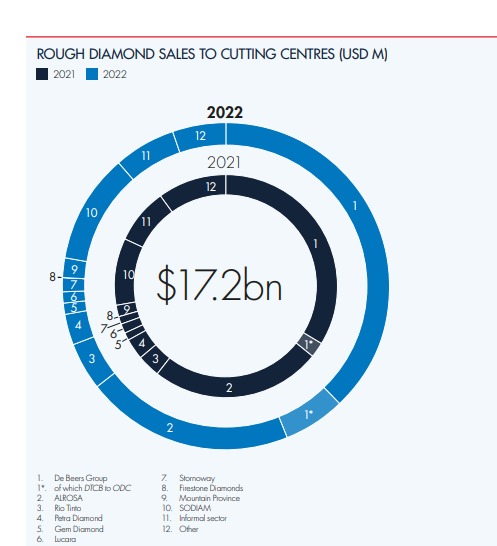
Despite the United States and other countries imposing trade sanctions on Russian diamonds, the group reported an increase in the value of rough diamond sales to cutting centres in 2022.
Source: De Beers
“The reduction in Russian supply, coupled with the fact that diamond producers had depleted their inventories to supply the extraordinary demand in 2021, led to rough diamond supply shortages during 2022,” it said.
“These shortages subsequently pushed diamond prices higher and drove up the value of diamond sales for the year.”
De Beers noted that global rough diamond sales increased by an estimated 8% in 2022 in US dollar terms.
Estimates place the group's valuation at around 38% of the world's total rough diamond sales (34% in 2021). While 2021 was a banner year for ALROSA, the company is expected to have a smaller share of the global supply in 2022, at 20%, than it did in 2019, before the advent of COVID-19.
In 2022, SODIAM of Angola supplied approximately 11% of the world's rough diamond sales to cutting centres.
Rough output
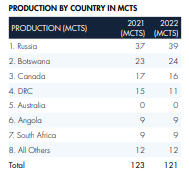
The group also predicted that rough diamond production would drop by about 2% to an estimated 121 million carats in 2022 as levels stabilised following the significant post-pandemic recovery in production capacity throughout 2021.
Rough diamond production is expected to increase by about 5 million carats in 2022, thanks to increases at both De Beers and ALROSA.
In the first half of 2023, De Beers produced 17 million carats, which is consistent with output levels seen in the first half of 2022.
The company expects full-year production in the range of 30 to 33 million carats in 2023.
According to the report, ALROSA's production in the first half of 2023 can be estimated to be between 15 and 17 million carats based on the company's historical seasonality of production.
Russia continued to be the largest producing country in volume terms for 2022, contributing an estimated 32% to global carat output.
Source: De Beers
Botswana was the second largest producing country, responsible for approximately 20% of volumes.
Mathew Nyaungwa, Editor in Chief of the African Bureau, Rough&Polished
