This year marks exactly 80 years of the most famous military order of the USSR - the Order of Victory. The decree of the Presidium of the Supreme Council on instituting the award was issued on November 8, 1943. This is the only Soviet order set with precious gemstones and made not at the Mint, but at the Moscow Jewelry and Watch Factory. A total of 22 Orders of Victory were made (the original plan was to make 30), and 20 orders were awarded. Based on the statute, senior officers of Higher Command Personnel were awarded the Order of Victory for their successful military operations on the front(s) that radically turned the situation to the Red Army’s advantage. In addition to the Soviet commanders and the Supreme Commander-in-Chief J. Stalin, the Order of Victory was awarded to General Dwight Eisenhower (USA), Field-Marshal Bernard Montgomery (Great Britain), Marshal Michal Zimierski (Poland), Marshal Josip Broz Tito (Yugoslavia) and King of Romania Michael I (Romanian: Mihai I). The Order of Victory is one of the rarest awards in the world and enjoys well-deserved recognition of historians and phalerists. While there were many various publications about the order, from thorough scientific studies to outright yellow press, some aspects of the Order of Victory’s creation still raise questions, and the mythical fog around this award since its creation has not yet cleared off.
Let’s start with the level of secrecy that accompanies the process of manufacturing the order. Of course, the Decree on establishing the Order of Victory - as well as the Decrees on awards - was not classified. But many documents about manufacturing the award were classified in the Soviet times. Why make a secret out of the manufacture of a small batch of jewelry, given that this production did not feature any technological innovations, and the design and the materials used were initially in the public domain? This was not a rocket engine, not a laser, not even a carbine - how did the leak of any information about the small-series production of jewelry items - ordinary in terms of technology - threaten the security of the country? Let us not rush to explain this secrecy by the paranoia that supposedly reigned everywhere during the Stalin’s times. There were reasons.
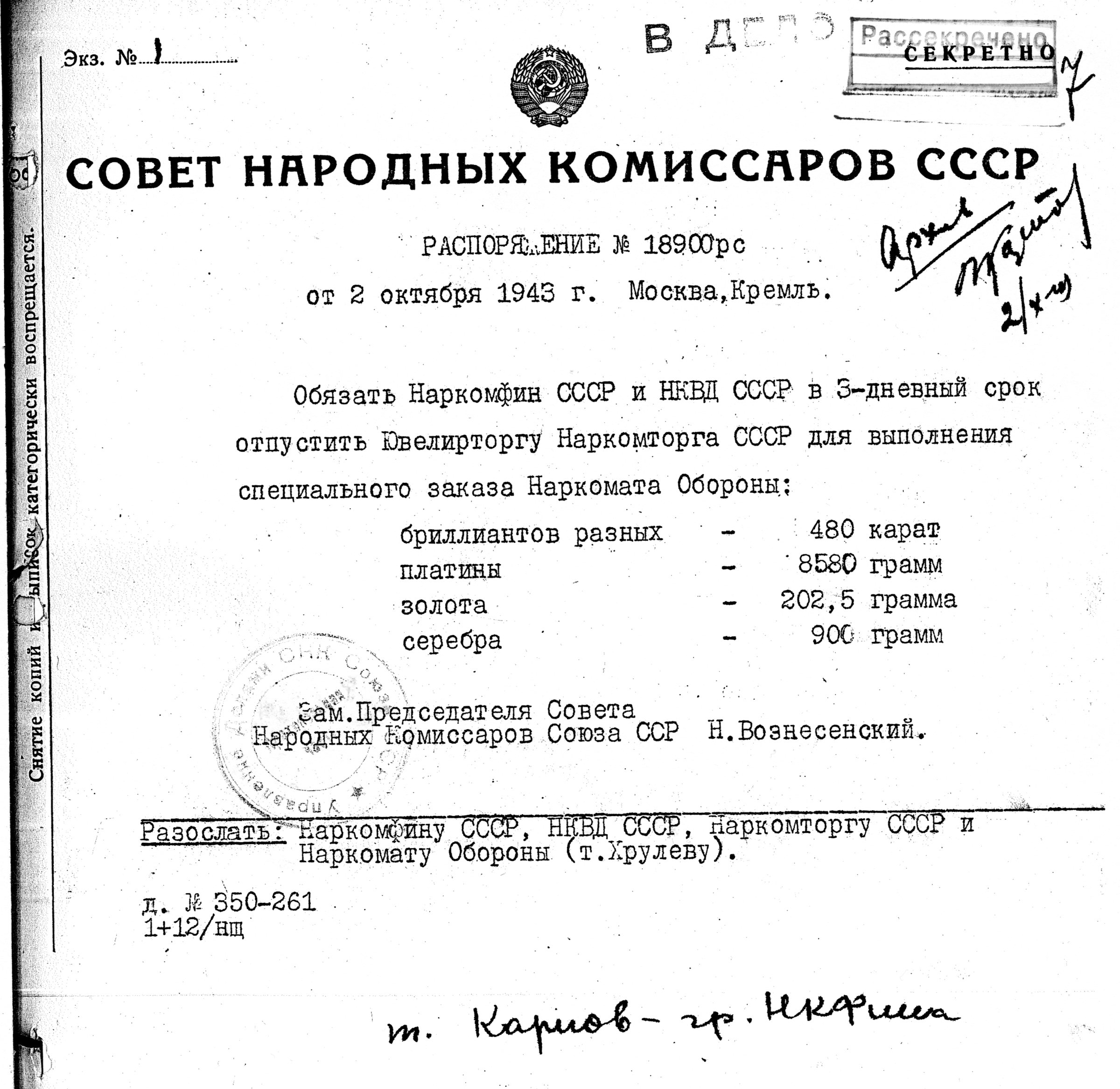
“The country’s State Fund began to steadily receive the first tens and then hundreds of thousands of carats of the Ural diamonds of excellent quality, some of which were used to decorate the insignia of the Marshals of the Soviet Union and the main order of the great power - the Order of Victory.”1 This disclosure was made by V. G. Leshkov, the assistant to the Chairman of the Council of Ministers of the USSR responsible for the diamond sector from 1974 to 1988. Colonel Leshkov was among the limited circle of people for whom there were absolutely no secrets in the Soviet diamond industry, and probably, he knew that the Ural diamonds had nothing to do with the Order of Victory. But in his public speeches, he preferred (like many other competent professionals) to maintain a well-thought-out industry cover-story that concealed, or covered up, the true goal of the development of the Ural deposits from 1941, which was the secret off-budget export of rough diamonds. According to this cover-story launched in the 1940s, the Ural rough diamonds were “supplied to the industry” and were even used in manufacturing the Orders of Victory and Marshal’s stars – rather than exported. And to prove the cover-story, the documents on the transfer of rough diamonds from the Gokhran (State Precious Metals and Gems Repository) for the manufacture of these orders were classified, since there was not a single carat from the Ural diamond output, there were only polished diamonds from the jewelry confiscated or bought through the Torgsin (state-run hard-currency stores that operated in the USSR between 1931 and 1936 - ed.).
Despite the fact that a study carried out by the Moscow Kremlin museums’ experts confirmed that confiscated polished diamonds made prior to the revolution [of 1917] were used in manufacturing the Orders of Victory, there are still publications today about the use of the Ural diamonds in them.2 As a rule, they appear in combination with another aspect of the cover-story stating that Stalin allegedly ordered to use only materials of Soviet origin in the manufacture of the Order of Victory. This thesis is still repeated in dozens of publications, of course, without a single reference to any supporting documents.
While the situation with polished diamonds has become more or less clear, there are still plenty of mysteries about the rubies used for manufacturing the Order of Victory. The Decree of November 8, 1943 states quite clearly that “The Order of Victory is a convex five-pointed ruby star surrounded with polished diamonds”, which, by the way, contradicts Stalin’s legendary order to use exclusively the Soviet-origin materials, since rubies were not mined in the USSR. But what follows is an extravaganza invented by a person far from being involved in creating an industry cover-story, since it contradicts not only the documents but is logically inconsistent.
“The greatest difficulty was caused by shortage of rubies for the red star’s rays. [Jewelry craftsman] Ivan Kazennov collected them all over Moscow but all the stones were different in color and size. The problem was further exacerbated by the fact that he was short on time, and by Stalin’s order, only the materials of Soviet origin should be used in manufacturing the orders. This should also show the resource capabilities of the USSR to the whole world. In such a situation, jewelry craftsman Kazennov decided to use synthetic rubies to manufacture the awards, as he confessed of this much later, after Stalin’s death.”3 This quote is neither from the yellow press nor from some blogger’s random statements but from the collection of the scientific papers dated 2020.
So, for each ray of the Order of Victory’s star, a 3-carat ruby of excellent quality was needed, 15 carats for one order, 450 carats for the entire batch (I would like to remind you that the original plan was to make 30 Orders of Victory). This is already cut and polished rubies, and as for rough rubies needed for production, the volume in carats required is 3 to 4 times higher since the yield of natural rubies suitable for cutting rarely exceeds 30%. So, craftsman Kazennov ran across Moscow in search of such luxury stones... And where did he actually run to, from the Tishinsky market to the Preobrazhensky one? And what did he run with? Where, from whom, and at what price could anyone get rubies worth two to three million dollars in Moscow in 1944 (the cost of those rubies at today’s prices)? Kazennov did not find natural rubies in the capital’s market and decided to push synthetics to the mustached leader. And did this secretly. Did he receive money for natural rubies? And where did the money end up as a result of such a ‘clever’ exchange? Didn’t the image of Lavrenty Beria come to jewelery craftsman Kazennov in his dreams at nights, speaking in a soft voice with his peculiar intonation “Well, master, you failed to make a stone flower, didn’t you?”
The adventures of Kazennov in his search of natural rubies are, of course, an absurd fiction, it’s on the wrong side of common sense. In the “Technical Description of the Order of Victory” dated 21.02.1944, it reads “There are 5 rays of stars going from the round rim, and each is set with 1 ruby (alloy).”4 So, the use of natural rubies was not in the original plans; they were supposed to be replaced by some “alloy”. Well, let it be an alloy, historians decided, it was, probably, a synthetic ruby. After all, everyone knows that in the USSR, there were huge quantities of synthetic rubies and sapphires used for manufacturing the jewelry items and sold to unsuspecting Soviet buyers as natural stones. But some of today’s researchers were not satisfied with such unpretentious conclusions and decided to elaborate on the mysterious term “alloy” from the specification sheet in question.
“The magnificent insignia of the Order of Victory were made of an exaggeratedly large size, on a platinum base, with 162 to 174 small-sized polished diamonds (total weight from 13.23 to 16.54 carats) per one order, with one natural ruby (red corundum) in a star on the Spasskaya Tower weighing 0.02 carats (only in Order of Victory No. 1, according to its description, the mass of a ruby is 0.2 carats) and five large-sized synthetic rubies (a high-quality alloy of colored glass).”5 And this quote is not from the tabloid press, but from a rather respectable journal on history, and the author is a Candidate of Technical Sciences.
But a synthetic ruby, as well as any synthetic corundum (sapphire, leucosapphire) is not an alloy, but a real crystal, unlike glass, which is really an amorphous alloy that does not have a crystal lattice. Only a complete joker can claim that a synthetic ruby is a high-quality alloy of colored glass. But let's not put up a sarcastic smile just yet - surprisingly, there is still some rational kernel in this joke.
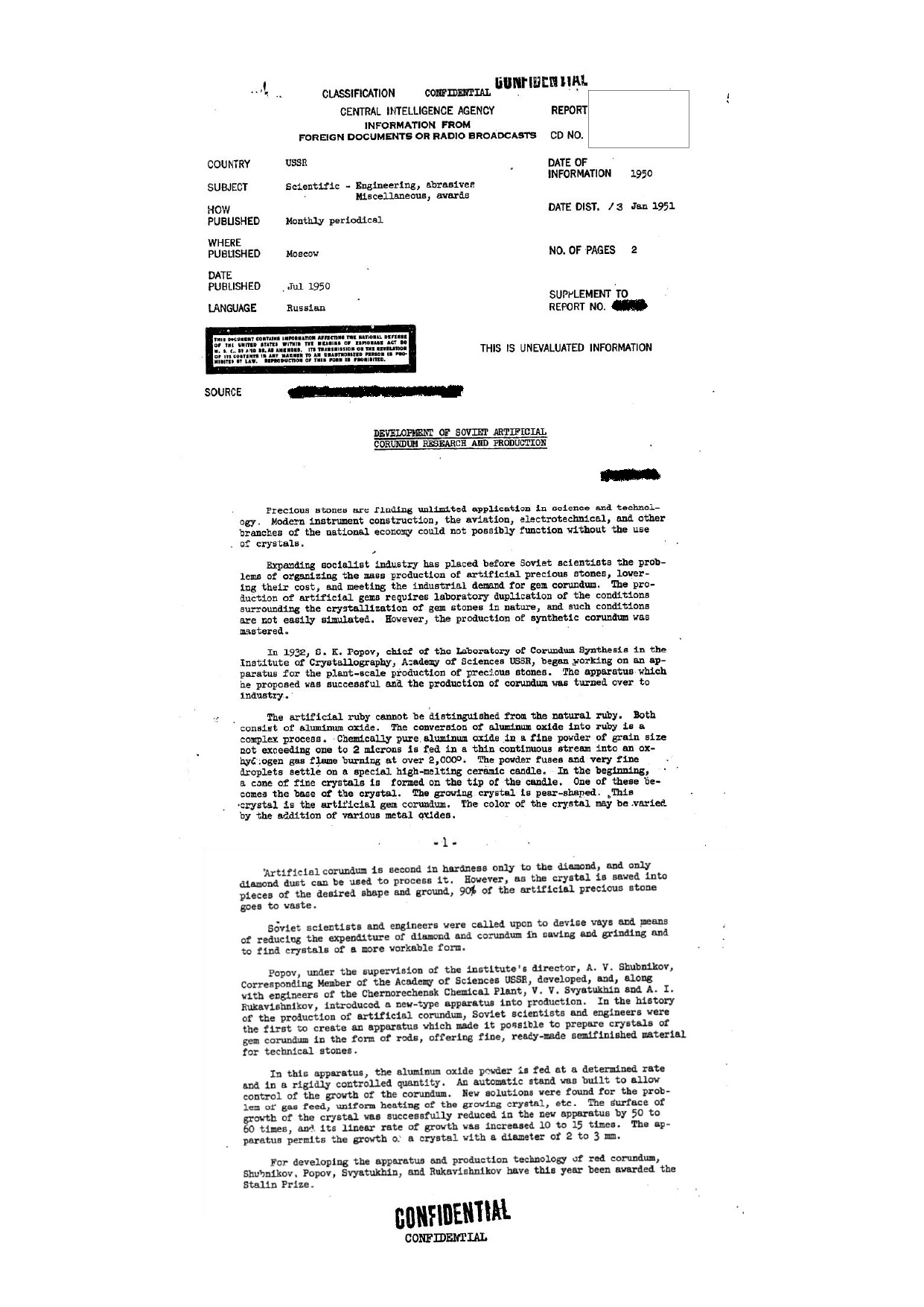
Indeed, there were a lot of synthetic rubies in the USSR, and they were used in jewelry, that’s true. The only question is when they became numerous and acquired the required quality? We have an interesting CIA’s document at our disposal entitled “Development of Soviet Artificial Corundum Research and Production”. This memorandum is marked “Confidential”, which corresponds to the Soviet equivalent of “Secret” and is dedicated to the events of 1950 when a group of scientists led by A. V. Shubnikov, Corresponding Member, the USSR Academy of Sciences, was awarded the Stalin Prize for the development of equipment and technology for the production of synthetic rubies. There were reasons for the CIA’s interest in this work. The new technology made it possible to grow synthetic ruby crystals in the form of rods, and the linear growth rate increased up to 15 times compared to traditional methods. In the same year, Alfred Kastler (France) developed the “optical pumping” method. These were critical steps towards the creation of the ruby laser. With the introduction of Shubnikov’s technology in the USSR, huge “inventories” of synthetic ruby were made, and only from that time (i.e., after 1945), jewelers got an unlimited opportunity to use rubies for jewelry items.
Was there any production of synthetic rubies in the USSR before the war? Yes, there was. In 1938, a pilot production of synthetic corundum was launched at the Chernorechensk Chemical Plant. The synthetic corundum was not produced for a long time. “The workshop worked with interruptions. The plant management was unhappy. This is understandable. A lot of money was spent on constructing the first stage of the workshop; they hoped that the expenditures would be repaid quickly, but so far, there were only losses. The decision was taken to suspend the construction of the second stage. The outbreak of the war interrupted the work on improving the synthetic corundum production process and the equipment for its cultivation. There was not enough hydrogen and oxygen, and the Donetsk alum necessary for the production of the feed material remained in the area captured by the enemy. The workshop had to be temporarily mothballed.”6 So, there was no production of synthetic rubies in the USSR during the war.
And so, where did jewelry craftsman Kazennov get the synthetic rubies from for manufacturing the Orders of Victory in February 1944? The Chernorechensk Chemical Plant switched to the production of explosives and the last ruby boule was grown there almost 3 years ago. This material was not supplied under Lend-Lease. In any case, in the recently declassified reference book “Foreign Trade of the USSR for the period from 22.06.1941 to 31.12.1945 (Statistical Reference Book on Operational Accounting Data)” (RGAE (State Archive of Economy)), F.413, Op.12, D.10949 L.1-542), there is no even a hint at such supplies. And the supplies were not needed because the watch industry of the USSR was suspended during the war, and the factory producing precision technical stones located in Peterhof - the main processor of the Soviet-origin synthetic corundum - was reduced to ruins. Of course, there is some possibility that the Chernorechensk Plant still had some quantities of synthetic rubies in its warehouse. We should take this into account, but it is hardly possible. Three years of war conditions are a long time; in addition, the Chernorechensk synthetic rubies are not mentioned in the documents related to manufacturing of the Order of Victory that are available today. But a certain “alloy” was mentioned, and no one used such a term in the production of synthetic rubies at that time; a “synthetic corundum” was mentioned in the production documents of the Chernorechensk Plant, an “artificial crystal” was also mentioned, but an “alloy” was not.
“Technical description...” dated 21.02.1944 was signed by Alexander Gorkin, the Secretary of the Presidium of the Supreme Council. When an official of this high rank signs documents like that one, he must know for sure that all items are strongly justified as he will have to bear the responsibility for any failures. In simple words, Gorkin could only put his signature if he was sure that all the necessary components for manufacturing the Orders of Victory were available, including the mysterious ruby “alloy”. And really, there was such an “alloy” in Moscow at that time, and in huge quantities, but it had nothing to do with synthetic rubies.
In 1937, 500 sq. m of glass plates, 6 mm to 7 mm thick, were made at the Konstantinovka Avtosteklo Factory using the “selenium ruby” technology. This glass, which can rightfully be called a ruby alloy, was intended for making stars mounted on the Kremlin Towers. The supply included spare plates intended for repairing the stars - they really came in handy in 1946 when it was necessary to replace parts of the stars damaged by antiaircraft shell fragments. The Kremlin had a lot of this material (ruby-colored jewelry glass) in 1944, and Gorsky had nothing to worry about when signing the specification.
As far as we know, a study of rubies used in the Orders of Victory has not been carried out, although it is not difficult to distinguish a synthetic ruby from a jewelry glass. Perhaps, our publication will encourage the current holders of these rarities to solve such an interesting historical problem. And if the confiscated diamonds in the most famous USSR award, the Order of Victory, arouse conflicting emotions, the fragments of the Kremlin stars, on the contrary, could only strengthen the Order of Victory’s symbolism.
Sergey Goryainov for Rough&Polished
1 Diamond Book of Russia. Volume 1. M.: “Mining Book”, 2014. P.69.
2 Krylov V. “We carried out an examination of the Order of Victory awarded to Brezhnev.” Specialist of the Moscow Kremlin Museums Maria Sarycheva speaks about the secrets of the main military award of the USSR. https://iz.ru/805941/vladislav-krylov/my-provodili-ekspertizu-vruchennogo-brezhnevu-ordena-pobeda
3 Gordina L., Sinelnikova E. The award system during the Second World War: the meaning of introducing the Order of Victory. // Materials of the Interregional Scientific and Practical Conference Dedicated to the 75th Anniversary of the Victory of the Soviet People in the Great Patriotic War of 1941-1945. 2020. P.26.
4 GARF (The State Archive of the Russian Federation). F. 7523. Op. 5. D. 41. L. 44–45.
5 Akhmanayev P. The Order of Victory. To the 70th anniversary of its institution. // St. Petersburg collector. No. 2 (76). 2013. P. 20.
6 Pechyonkin I. G., Lugovskaya I. G. The contribution of the VIMS’s (All-Russian Scientific-Research Institute of Mineral Resources named after N. M. Fedorovsky) to the creation of the local synthetic corundum. // Exploration and protection of subsoil. No. 8. 2019. P. 8.
Annexes
GARF (The State Archive of the Russian Federation) F.5446. O.44a. D. 4608. L.5. Letter from A. V. Khrulyov
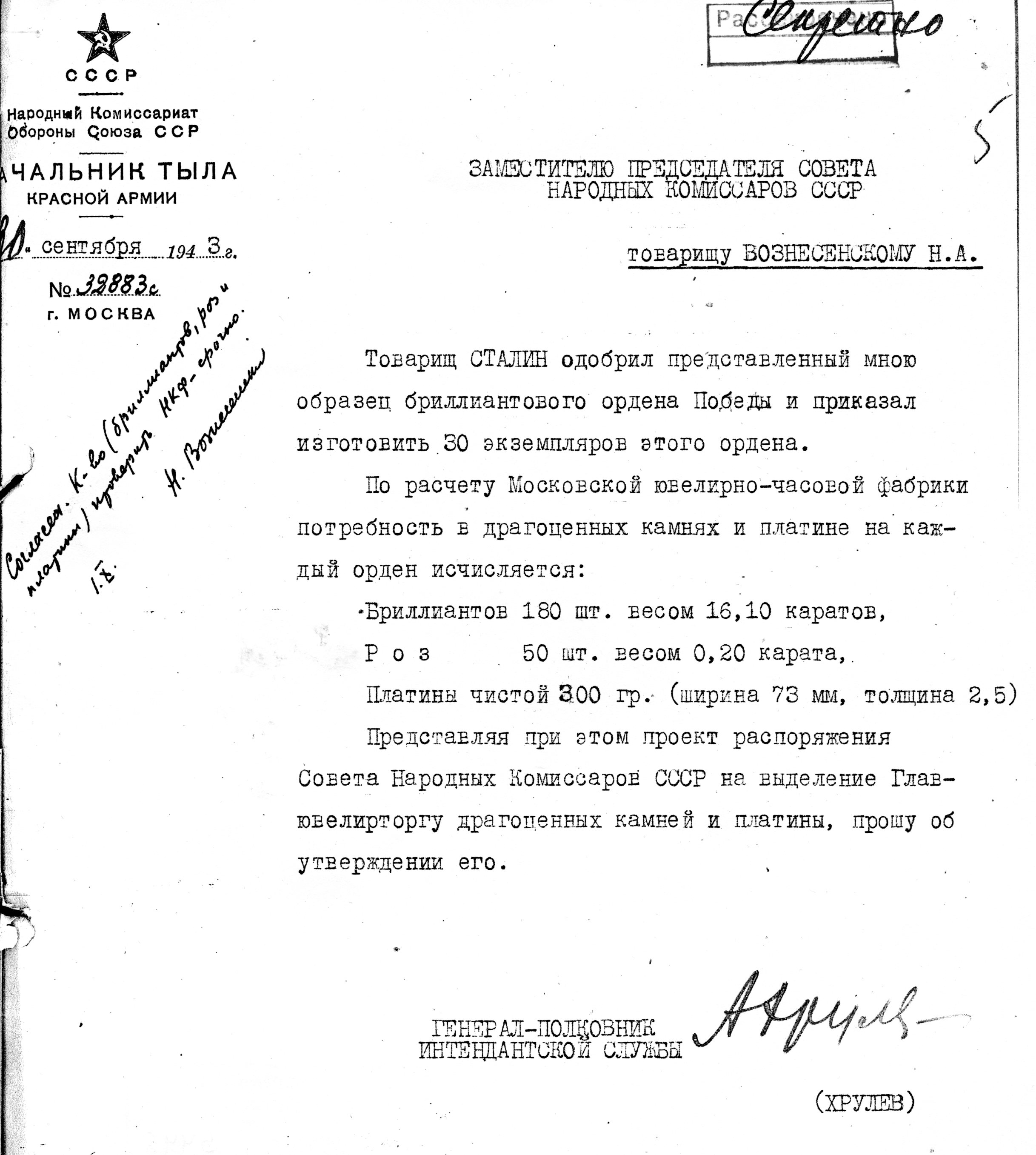
GARF F. 5446. О. 44а. D. 4608. L. 7.
The CIA’s memorandum on the Development of Soviet Artificial Corundum Research and Production.