The first day of December saw gold prices rise to a new record high. Throughout most of 2023, gold market performance has been strong despite some headwinds, and looking into 2024, the rally may continue.
Gold prices gained on the back of geopolitical tensions such as a continued war in Ukraine and a new conflict in the Middle East, as well as economic factors such as signs of U.S. Federal Reserve easing its monetary policy in the coming year. A weaker dollar made gold cheaper for international buyers, supporting demand. One of the more notable factors however was the continued buying of gold by central banks as their confidence in US dollar-denominated assets dwindled, and their urge for diversification increased.
According to a recent survey by the World Gold Council (WGC), 24% of all central banks intend to increase their gold reserves in the next 12 months, as they increasingly grow pessimistic about the U.S. dollar as a reserve asset. By contrast, their views towards gold’s future role grew more optimistic, with 62% saying that gold will have a greater share of total reserves compared to 46% last year.
As stated in the WGC's Q3 Gold Demand Trends report, central banks saw the third strongest quarter of net buying, reaching 337t. Although shy of breaking the Q3 2022 record, year-to-date demand has reached 800t, a new record for WGC's data series.
Louise Street, Senior Markets Analyst at the World Gold Council, commented: “Gold demand has been resilient throughout this year, performing well against the headwinds of high interest rates and a strong US dollar. Our report shows that gold demand is healthy this quarter, compared with its five -year average. Looking forward, with geopolitical tensions on the rise and an expectation for continued robust central bank buying, gold demand may surprise to the upside.”
Meanwhile, the latest US inflation data has reinforced market expectations for a "soft landing" of interest rate cycle in the year ahead, with the Fed able to ease monetary policy despite a relatively strong labor market. When a central bank raises interest rates to curb inflation and slow down the overheated economy, it can result in either "hard landing" meaning recession, or a "soft landing" when an economic downturn is avoided.
However the European Central Bank and the Bank of England both refused to follow the example of the Fed: both Christine Lagarde and Andrew Bailey refrained from discussing interest rate cuts, as it may be too soon for the policy easing in Europe. Bailey even hinted at another rate hike. The Fed's dovish approach contrasts starkly with the European economies’ hawkish one.
Market consensus anticipates a "soft landing" in the US, which should also positively affect the global economy. Historically, "soft landings" have not been particularly beneficial for gold, as in this scenario investors favor stocks and even bonds over zero-yielding gold. In 2024 however a "soft landing" factor for gold prices may be mitigated by continued geopolitical tensions.
Economic and political events worldwide have a sizeable impact on the gold market. Recessions and conflicts have a tendency to support the buying of safe-haven assets, gold being one of them. Such events tend to make gold more attractive to investors as a possible way to preserve value during times of financial and political uncertainty.
Russia continues to wage war against Ukraine, undermining regional security in Europe and disrupting supply chains of critical minerals and energy due to Western sanctions imposed on Russian assets. The outbreak of Hamas-Israel conflict did not add certainty to the world markets, and instead destabilized the situation in Middle East where big gold trading hubs such as Dubai and largest oil producers such as Saudi Arabia are located.
The next year is notably a key election year for many major economies, including the United States, Taiwan, India, Mexico, Russia, South Africa, the European Union and the United Kingdom. Investors may seek to hedge against potential financial risks associated with a change in leadership, supporting gold demand and prices. Combined with continued central bank buying, this factor of uncertainty could prove pivotal for gold. And a global recession is still on the cards.
Another positive factor for gold was the slowing net outflows from gold-backed exchange traded funds (ETFs) in November. American ETFs registered gold inflows rather than outflows for the first time in five months. One of the world's largest gold ETFs, the SPDR Gold Trust, recorded an influx of about $1.5 billion last month. This influx is not only the most substantial since March 2022 but also breaks a chain of five consecutive months of outflows, signifying the resurgence of investor interest in the precious metal.
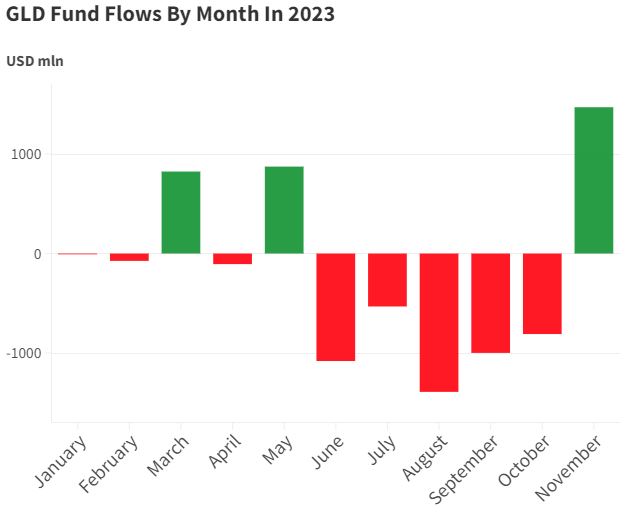
SPDR Gold Trust (GLD) inflows/outflows chart
Chinese buying in particular may prove beneficial to the gold market. Real estate has historically been appealing to local investors but the government's decision to deflate the housing market means the sector is in a structural decline. New sales and housing starts have fallen to decade lows, and house prices have dropped over the past quarters. This means that investors in China may shift their appetite towards other value-retaining assets like gold.
With Chinese equities and renminbi underperforming, gold becomes even more desirable for local investors to hedge against the weakness of the local currency. The spike in demand caused by these factors can be observed in an elevated China gold premium as compared to prices in London. The spread typically hovered around $10 per ounce over the past ten years, but it temporarily rose above $50 per ounce during Q3 2023.
With all the abovementioned positive fundamentals in mind, analysts are typically bullish on gold in 2024.
“Given the premature spike in early December, traders and investors are likely to be more reluctant to jump on another fear of missing out rally,” said Ole Hansen, head of commodity strategy at Saxo Bank. “A fresh record is most certainly achievable in 2024.”
According to Saxo's "outrageous" predictions for 2024 (highly unlikely but not impossible scenarios of world economy and politics), gold prices may even jump to $3000 per ounce given the right circumstances.
The bank's analysts are not alone in their positive assessment of the gold market for 2024. John Hathaway, Senior Portfolio Manager at Sprott Asset Management USA Inc., expressed the view that "we believe gold may be poised for stronger performance in the coming months". He voiced concerns about the Federal Reserve's commitment to a "higher for longer" interest rate stance, suggesting it could precipitate a broader credit deflation and recession. Lingering issues in the banking sector and labor market may further support gold rally.
Commerzbank in a note said the upcoming interest rate cuts speak in favor of gold, adding it expects prices at $2,150 in the second half of next year. Lower US interest rates increase the appeal of non-yielding bullion.
Hedge fund investor Paul Tudor Jones cited by CNBC said that we are currently navigating "the most threatening and challenging geopolitical environment" at a time when the United States is grappling with its "weakest fiscal position since World War 2."
Bart Melek, head of commodity strategies at TD Securities, expects gold prices to average $2,100 an ounce in the second quarter of 2024 due to strong central bank purchases.
All in all, analyst opinions and investor sentiment are favorable for gold into the next year. The price still hovers above $2000 per ounce and the further upside is possible. Main risk factors include the strengthening of the U.S. dollar and the easing or disappearance of geopolitical disturbances, as well as subdued buying by central banks or waning investor sentiment for gold. In the last few days of 2023 however, the next year seems to have a golden sheen to it.
Theodor Lisovoy, Editor in Chief of the European bureau, Rough&Polished
