Artificial Intelligence (AI), advanced robotics, cybernetic systems that blur the lines between the physical, digital, and biological worlds, off-grid renewable energy generation are all parts of the 4th Industrial Revolution (a.k.a. Industry 4.0). All of these components are applicable for the mining industry in order to reduce costs and transform the sector into a more environmentally-friendly one.
Naturally, mining companies are already investing in these new tools to capitalize on possible (and sometimes already tangible) benefits. Although AI and machine learning have been the “buzz words” of the past couple of years or so, the future of this technology may actually be substantial - as opposed to previous trends like cryptocurrencies and blockchain which only saw limited adoption worldwide. Nevertheless, the impact of advanced automation technologies may turn out to be ambiguous.
AI: consumer vs industry perspective
In one form or another, AI has existed since the 1950s when first computers were taught to play checkers with people. Since the 2010s, we have seen relatively advanced AI systems which could make coherent automatic translations and beat world champions in a game of chess.
But what comes to mind when we hear “AI” nowadays is probably some surreal, silly or just fake pictures and videos generated by a machine, circulating all over the internet. This is an example of the so-called “generative AI” models, and they are capable of a very narrow part of what the so-called Artificial General Intelligence, or a sentient machine, would be able to do. So far, the humanity has not created the latter, and some argue that it would take decades if not centuries for a machine to reach human-like cognitive capabilities.
What we use today are narrow, or “weak” AIs which are tailored to specific tasks, and usually trained on massive amounts of data to accomplish them. On a consumer level, there are generative AI models to create illustrations, videos, music and texts, and be able to interact with humans in a user-friendly interface, like a text chat for example. On the other hand, industrial applications of AI in mining include geological exploration tools, predictive equipment maintenance, and mine optimization systems among others.
Both consumer and industrial AIs have some things in common: they are both trained on the previously acquired data and tailored to specific tasks.
Big data, big impact
According to a survey conducted by the Global Data think tank, predictive equipment maintenance takes the lead in the list of new technologies to be adopted by mining companies in the next 2 years. Downtimes of haul trucks, earth-moving equipment, processing plants are notoriously expensive for miners - days or even hours of inoperability can cost tens of thousands of dollars. According to some estimates, 30% - 50% of total mine operating costs can be attributed to maintenance, this is why downtime optimization is crucial.
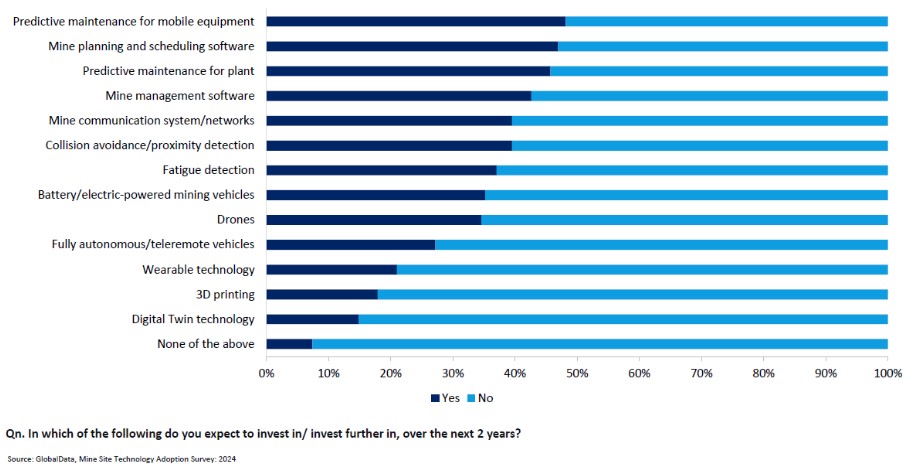
Source: Global Data
Mining companies are already employing certain tools for predictive maintenance using data analysis to identify operational anomalies and potential equipment defects, which enables timely repairs before failures occur. Modern mining equipment features an array of sensors to gauge its performance and signalize when the maintenance is required. However, when you feed this data collected across a mine (or several mines) into an AI system trained to notice the smallest deviations from norm, it can quickly cross-reference these deviations, look at previously collected data and make a prediction on when the maintenance may be required.
With the rise of Industry 4.0 and sensor technology, predictive tools are getting smarter and sleeker, collecting larger amounts of data on mining assets to provide real-time insight into operations. Although predictive maintenance is based on sensor data, an AI can pinpoint a failure by making use of the so-called “digital twin” of the real-world equipment. All this data combined makes it possible to optimize mining operations to a degree never seen before.
Digital twins don’t just offer maintenance benefits: they can optimize processes and increase productivity across the mine, such as in blasting and drilling; improve mine sustainability through the collection of actionable data on operational emissions, energy and water consumption, among others; and above all, improve safety, from training to increased remote operations.
BHP’s Maintenance Centre of Excellence performs machine learning on large amounts of data collected from its operational equipment. This provides actionable insights for predictive maintenance on items such as haul trucks and improving supply chain management.
Russia’s Norilsk Nickel, together with its partners, is developing domestic software for mining automation to begin its implementation in 2026. The MAGMA system helps in processing geological data, simulating mine conditions, developing infrastructure and operating underground works.
Another notable use case of AI in mining industry is the analysis of “big data” in geological exploration. A machine can efficiently analyze terabytes of data sheets in a matter of days or even hours while it would take months for a team of skilled geologists to do the same work. More notably, the technology can enhance resource estimation accuracy by examining geological data patterns and incorporating historical mining data. This helps mining companies make informed decisions regarding investment, production planning and resource allocation, ultimately maximizing the economic potential of mining projects.
For example, Botswana Diamonds recently adopted AI tools for its exploration database to assist in a comprehensive search for new diamond deposits and potentially other minerals. The system acts much like a geologist but can function quicker and more efficiently. Vast data-sets are processed though AI that finds logical gaps in the data and learns to correct them. This exercise is expected to yield fresh insights that will offer drillable targets previously unseen.
AI also offers immense potential in streamlining mining operations and optimizing asset management by evaluating operational metrics and identifying potential bottlenecks. AI-based predictive models enhance decision making and prevent unplanned downtime. Not only that, the AI can help make decisions “on the fly” by connecting drones, satellite imagery and sensors into a smart monitoring system to live-track equipment, assess possible risks and optimize transportation routes.
It has already been 10 years since the British/Australian mining company Rio Tinto began to use fully autonomous haul trucks. According to estimates, the company creates 2.4 terabytes of data every minute from all of its mobile equipment and sensors that collect and transmit data for real-time monitoring.
AI-powered mine automation can significantly improve efficiency and safety in mining operations: robotic vehicles can navigate complex terrains and execute tasks with precision, minimizing human error, reducing the risk of accidents and enhancing health and safety - provided they are not tampered with by malicious actors or run out of computing power.
System error
The current iteration of AI tools and services continuously collect information which is notoriously prone to unauthorized access by third parties. Sensitive data collected may include online activity records, geolocation data, video or audio. Stolen data is of course a corporate nightmare even on itself, but directed cyber-attacks on digital infrastructure can effectively shut down a fully-automated, AI-powered mine, leading to colossal losses. In recent past, we have seen hospitals, power grids, oil pipelines and information systems of entire governments shut down for extensive periods of time due to malicious acts.
AI requires unprecedented amounts of computing power, which translates into more electric power usage. In a 2024 report, Goldman Sachs forecasts that US data centers will consume 8% of all power in the country by 2030 as opposed to 3% in 2022. The cheapest way to quickly provide this amount of additional electricity is fossil fuels, which might delay closings of obsolete, carbon-emitting coal energy plants, making Scope 4 emissions goal for the mining industry less achievable.
Feeding faulty or biased machine learning data into AI can make them inaccurate, and their developers may not even be aware that the bias exists. If a biased algorithm is used, it can harm people and businesses that rely on said algorithm for decision-making. Machine learning models are designed to make predictions based on past, existing data and will operate accordingly. Moreover, a malicious actor, if granted access to an AI system, can inject “bad” faulty data into the machine learning algorithm, making it unstable and inaccurate.
Lastly, the economic consequence of the wider adoption of AI is a loss of jobs due to workflow automation. This is especially concerning in the case of the mining industry that often operates in remote regions where communities have no other job opportunities. The social impact of AI can be devastating for local population’s livelihood in Africa, South America and elsewhere.
Conclusion
The new AI tech already seems to have a transformative effect on the mining industry and as time goes by, its contribution to the sector will grow. It provides companies with substantial benefits while improving health and safety. This process is as unstoppable as the progress itself.
However, mining companies have to decide on how to mitigate risks associated with AI in their operations while following their goals in social responsibility and environmental protection. People still don’t trust mining companies as the world transitions towards green economy. Let us hope that a wider adoption of “emotionless machines” in an industry associated in people’s minds with destruction of nature does not resolve in disillusionment, and instead improve the public opinion of the sector for being more efficient and safe than ever before.
Theodor Lisovoy, Managing Editor, Rough&Polished
Produced and published as part of the project "Best practices have a voice"
