The fourth industrial revolution we are witnessing now is characterized by the development of cyber-physical and adaptive systems, mining and digital technologies, artificial intelligence (AI), green energy generation, as well as the transition from metal industry to production of composite materials. At the core of these areas is the ever-increasing use of rare metals and rare earth elements that are essential for further global progress. Thus, geopolitics will be largely determined in the future by the growing rivalry between the world’s leading countries for access to REMs and technologies for their production.
Rare earth elements (REEs), rare earth metals (REMs), rare earths - all these terms are the names of a group of 17 elements that includes scandium, yttrium and lanthanides (lanthanum, cerium, praseodymium, neodymium, promethium, samarium, europium, gadolinium, terbium, dysprosium, holmium, erbium, thulium, ytterbium, lutecium). While they are called ‘rare’, REMs are found in the earth’s crust quite often, but in small quantities, and the process of their extraction is very time-consuming and labor-intensive, it also requires appropriate technologies and a developed chemical industry.
REMs are also called ‘vitamins for industry’. The share of REMs in end products can be used to determine the level of innovative development and R&D/production intensity and, in general, the technological self-sufficiency of a country. This trend is expected to intensify in the future.
Rare metals (RMs) are a group of over 60 elements, including lithium, beryllium, gallium, titanium, and also REMs. These elements are of critical importance to the development of economies in the world. Many RMs are in the lists of strategic resources compiled by governments to ensure continuous, diversified supplies and build up stocks to meet a country’s needs, as well as to ensure resource and technological security.
Given the importance of REMs with their highly concentrated market, as well as taking into account trade wars and the growing protectionism, many countries plan to create their own complete technological chains, including 1) mining, 2) processing (extraction of REM concentrate), 3) separation of REM concentrate into metals, and 4) end product. Today, only China has a full cycle of the production of REMs. In Russia, for example, the third link is missing. The Solikamsk Magnesium Plant (in the Perm Territory), part of the Rosatom State Corporation, make efforts to solve this problem.
REMs use cases
Today, REMs along with lithium, are ever more often considered as a ‘new oil’. And there is good reason for this. After all, the transition to the latest technologies is actually impossible without using them.
Rare earths are critically important for ‘green’ energy generation. For example, about 300 kg of neodymium is required to manufacture a magnet for one wind turbine. About 3.6 tons of copper and over 350 kg of rare earth metals are used to ensure each megawatt of wind turbine capacity. In general, the energy transition and carbon neutrality transition, which the European Union is striving for in an attempt to get rid of Russia’s oil and gas, are not possible without using rare earths.
REEs are also required in nuclear power generation, the electronics industry, metallurgy, gas and oil refining, as well as in the defense industry, aerospace industry manufacturing spacecraft and aircraft, and many other sectors.
In general, the global distribution of REMs by end use in 2022 was as follows: permanent magnets accounted for 44.3% of demand for REMs, catalysts - 17.1%, polishing powders - 11.1% (Diagram 1). It is important to note that the growth rate of demand for permanent magnets from 2008 to 2022 was +220%, while for catalysts, on the contrary, it slowed down and was +80% only.
Diagram 1
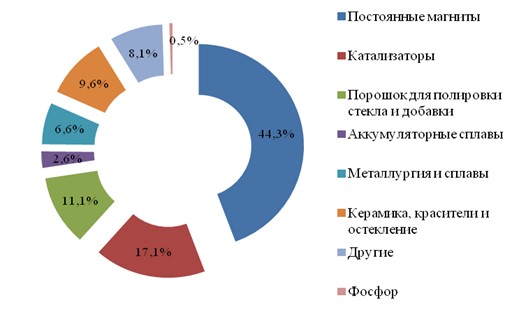
Top-down: Permanent magnet. Catalysts. Glass polish powder and additives. Battery alloys. Metallurgy and alloys. Ceramics, colorants and glassmaking. Others. Phosphorus.
Source: Statista https://www.statista.com/statistics/604190/distribution-of-rare-earth-element-consumption-worldwide-by-end-use/
World reserves of rare earth metals and their main producers
According to the US Geological Survey (USGS) for 2023, explored (proven) reserves of rare earth metals are estimated at 110 mn tons. The largest reserves are in China (40% of the world reserves), Vietnam (20% of the world reserves), Brazil (19%) and Russia (9%) (Table 1).
Table 1
|
No. |
Country |
Reserves |
% |
|
1. |
China |
44,000,000 |
40.00 |
|
2. |
Vietnam |
22,000,000 |
20.00 |
|
3. |
Brazil |
21,000,000 |
19.10 |
|
4. |
Russia |
10,000,000 |
9.10 |
|
5. |
India |
6,900,000 |
6.30 |
|
6. |
Australia |
5,700,000 |
5.20 |
|
7. |
The USA |
1,800,000 |
1.60 |
|
8. |
Greenland |
1,500,000 |
1.40 |
|
9. |
Tanzania |
890,000 |
0.81 |
|
10. |
Canada |
830,000 |
0.75 |
|
11. |
South Africa |
790,000 |
0.72 |
|
Global total |
110,000,000 |
100,0 |
|
Source: U.S. Geological Survey
In 2023, global production amounted to 350 thousand tons (Table 2). China ranks first accounting for 69% of global REM production, the United States ranks second with 12.3%, and Burma ranks third with its 11%. Russia accounts for 0.74% of global REM production, ranking 7th in the world. Today, the main production of REMs in Africa is in Madagascar that accounts for almost 0.3%.
Table 2
|
No. |
Country |
Production |
% |
|
|
2022 |
2023 |
|||
|
|
China |
210,000 |
240,000 |
69.00 |
|
|
The USA |
42,000 |
43,000 |
12.30 |
|
|
Burma |
12,000 |
38,000 |
11.00 |
|
|
Australia |
18,000 |
18,000 |
5.10 |
|
|
Thailand |
7,100 |
7,100 |
2.00 |
|
|
India |
2,900 |
2,900 |
0.83 |
|
|
Russia |
2,600 |
2,600 |
0.74 |
|
|
Madagascar |
960 |
960 |
0.27 |
|
|
Vietnam |
1,200 |
600 |
0.17 |
|
|
Brazil |
80 |
80 |
0.02 |
|
|
Malaysia |
80 |
80 |
0.02 |
|
Global total |
300,000 |
350,000 |
100.00 |
|
Source: U.S. Geological Survey
Until the mid-1990s, the United States was the world’s largest supplier of REEs. Later on, China effectively monopolized the mining and production of rare earths. Until 2012, China was virtually the only supplier of REEs in the world. However, in response to restrictions on Chinese supplies, other countries again saw the need of developing their own REM industry. Commercial production of REMs was launched by the now bankrupt American manufacturer Molycorp Inc. (that owned the Mountain Pass rare earth mine in California) and Australian company Lynas Rare Earths Ltd.
In addition to the restrictions on physical supplies of REMs, China’s ban on the export of REM mining and separation technologies was added on December 21, 2023.1
Today, China supplies 98% of rare earth elements to the EU. In this regard, President of the European Commission Ursula von der Leyen announced the European Critical Raw Materials Act. “Lithium and rare earths are already replacing gas and oil at the heart of our economy.” She added that Europe had to “avoid falling into the same dependency as with oil and gas”. As we can see, the issue of reliable access to raw materials, in particular to rare earths, is at the top of the political agenda in Brussels.
Today, the largest deposits of REMs have been discovered in China, Canada, Japan, Greenland, Tanzania, and Angola. Below is a list of the 20 largest deposits of REMs in the world:
Table 3
|
Mine |
Country |
Development phase |
Reserves (1000 tons) |
Bayan Obo |
China |
operating phase |
56,940 |
|
St-Honore |
Canada |
advanced phase |
18,382 |
|
Minami Toti Shima |
Japan |
early phase |
16,000 |
|
Kvanefjeld |
Greenland |
project definition phase |
11,120 |
|
Ashram |
Canada |
advanced phase |
4,686 |
|
Nqualla |
Tanzania |
Feasibility Study |
4,620 |
|
Ozango |
Angola |
Feasibility Study |
4,470 |
|
Strange Lake |
Canada |
advanced phase |
4,406 |
|
Montviel |
Canada |
advanced phase |
3,877 |
|
Mt Weld |
Australia |
operating phase |
3,368 |
|
Tomtorskoye |
Russia |
Feasibility Study |
1,890 |
|
Nechalacho |
Canada |
Feasibility Study |
1,817 |
|
Nolans Bore |
Australia |
project definition phase |
1,463 |
|
Nechalacho |
Canada |
operating phase |
1,387 |
|
Mountain Pass |
The USA |
operating phase |
1,354 |
|
Serra Verde |
Brazil |
project definition phase |
1,100 |
|
Round Top |
The USA |
advanced phase |
1,099 |
|
Songwe Hill |
Malawi |
Feasibility Study |
664 |
|
Tantalus |
Madagascar |
advanced phase |
562 |
|
Norra Karr |
Sweden |
advanced phase |
550 |
Source: S&P Global Market Intelligence
Rare earths are a ‘bottleneck in digital civilization’
As scientific and technological progress advances, the utilization of rare earth elements (REEs) grows and their scope of application expands. From 1988 to 2023, global REM production increased by more than 5 times - from 63.1 thousand tons to 350.0 thousand tons (Fig. 1).
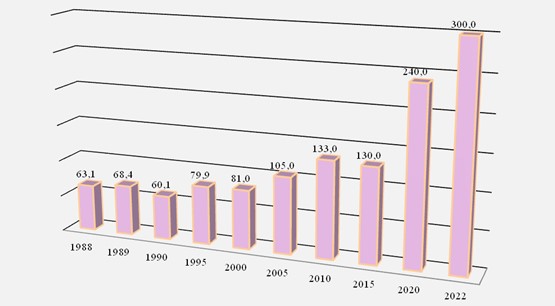
Source: Mine production of rare earth elements worldwide // Statista https://www.statista.com/statistics/1187186/global-rare-earths-mine-production/.
Rare Earths Statistics and Information // U.S. Geological Survey
https://www.usgs.gov/centers/national-minerals-information-center/rare-earths-statistics-and-informa...
Given the European Union’s plans to carry out a green transformation of the economies of EU’s member states by 2050, the demand for REMs may increase by three or four times. This exceeds the current capacity for their production. For this reason, they are called a ‘bottleneck in digital civilization’.
Is there an alternative to China?
Africa’s potential for mining rare earth elements is largely untapped, given the low level of geological exploration. As Figure 2 shows, exploration expenditures in Africa were among the lowest ones in the world in 2023, at $1.27 bn. The largest decrease was in Mali where exploration expenditures fell by $71 mn, or by 46%, compared to last year. Burkina Faso and Tanzania reduced their exploration expenditures. Guinea and Zambia improved their figures, with their exploration expenditures increased by $40 mn and $37 mn, or by 83% and 89%, respectively. It is important to stress that the vast majority of exploration work in these countries remains focused, in particular, on gold mining, rather than on mining the rare earth metals that are critical to the transition to carbon-free energy generation.
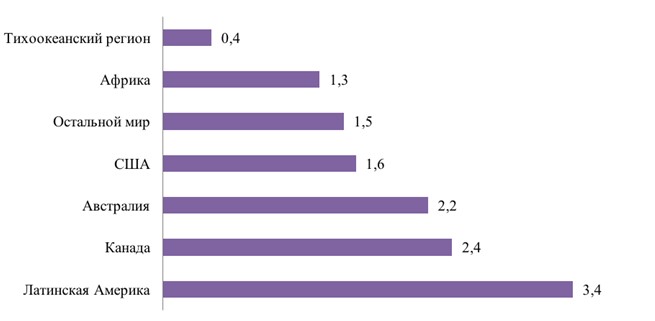
Figure 2. Geological exploration budget, $ bn. Top-down: Pacific Region countries. Africa. Other countries. The USA. Australia. Canada. Latin America.
Source: World Exploration Trends 2024 // https://www.spglobal.com/marketintelligence/en/pages/world-exploration-trends-2024#sec9
Expanding the geological exploration is critical to Africa’s ability to discover and mine rare earth elements. Several high-grade deposits have already been discovered. In 2022, Canadian exploration company Mkango Resources announced that its Songwe Hill REM mine in Malawi would be put into production in 2025. Australia’s Bannerman Energy acquired a 41.8% stake in Namibia Critical Metals that holds a 95% stake in the Lofdal deposit of heavy rare earths. The mine produces 2,000 tons of REM oxides per year and contains rich deposits of two most valuable heavy rare earth metals, dysprosium and terbium, required to make permanent magnets. The Steenkampskraal mine in South Africa is considered the one with the highest-grade ore in the world. It contains 15 elements and 86,900 tons of REE oxides, as well as large deposits of neodymium and praseodymium. In 2020, the Angolan subsidiary of the British company Pensana Rare Earths received exclusive rights to mining rare earth elements at the Longonjo mine for a period of 35 years.
It is important to note that leading countries rely not only on existing reserves in their own subsoil and abroad, but also actively finance projects to produce REMs using coal waste. For example, in 2016, a research group at the University of Kentucky began looking for economically viable methods for extracting REMs from coal and products formed during coal mining. Novosibirsk scientists are currently developing technologies for extracting valuable REMs from coal ash.
Japanese scientists suggest that there are 1,000 times more rare earth elements at the bottom of the Pacific Ocean than in all known deposits on the Earth’s surface. In January 2024, Norway opened up 280,000 sq. km of its territorial waters - an area larger than that of Great Britain - to start seabed mining of REMs.
Therefore, it can be assumed that production of REMs in the future will increasingly depend on a country’s existing competencies and technologies.
Conclusion
Contrary to popular belief, scientific and technological progress leads to an expansion of the types of raw materials used and their scope of application rather than to a decrease in the production of mineral raw materials. That is, the structure of global demand and consumption is changing. For example, an attempt to reduce the consumption of fuel resources (primarily coal and oil) leads to an increase in demand for non-fuel minerals needed to developing new technologies and ensuring the transition to clean energy generation. On the other hand, technologies associated with renewable energy sources are usually more metal-intensive than traditional energy generation methods.
The ongoing transformation of global mineral markets under the influence of scientific and technological progress will likely have profound implications for countries whose economic growth, exports and budget revenues depend on the production of raw materials. In particular, the energy transition will give a significant impetus to the economies of countries that mine raw materials and produce metals needed for ‘green’ energy generation. Therefore, a developed REM industry in countries is a strategic competitive advantage that can increase the geopolitical and economic power of such countries to have influence at the world stage.
Margarita Obraztsova, PhD in Economics, for Rough&Polished
Produced and published as part of the project "Best practices have a voice"
Reference:
[1] https://www.csis.org/analysis/what-chinas-ban-rare-earths-processing-technology-exports-means
