After imposing sanctions on the Russian Federation, including the sanctions against its diamond sector, the impact of these measures and the threats of overcoming the sanctions have become topics of discussion in business and political publications. Making no pretense of being experts, we will nevertheless risk sharing an interesting historical analogy that may serve as useful food for thought on this complex issue.
On September 1, 1939, the Wehrmacht crossed Poland’s borders and World War 2 began. On September 3, 1939, England declared war on Germany. On the same day, a complete embargo was imposed on supplying all types of rough diamonds to Germany. Restrictions were also imposed on supplying rough diamonds to Japan and Italy, and three months later, the export of roughs to these countries was completely banned. The embargo imposed on rough diamonds had every chance of success, since the British-South African corporation De Beers controlled 95 percent of the global diamond market at that time, and thus, cessation of industrial diamond deliveries to Germany’s military-industrial complex did not seem like a very difficult task at first glance.
By the outbreak of World War 2, Germany was a leader in the development and application of diamond technologies in mechanical engineering, especially in engine building and, accordingly, the country was the largest importer of industrial diamonds. In 1938, the last pre-war year, Germany purchased 1,700,000 carats of rough diamonds. For comparison, the USA purchased 1,400,000 carats the same year, and the USSR bought a maximum of 250,000 carats. Such a significant difference between the rough diamonds purchased by Germany and the USSR (with a comparable amount of defense products manufactured) is explained by the fact that Germany was the largest manufacturer of diamond tools, a wide range of precision specialized machines, measuring and optical instruments. In the USSR, there were practically no such industries because the first factory to manufacture diamond tools was put into operation in 1959 only, and the diamond tools were imported before that.
There is no doubt that in case of a successful implementation of the embargo imposed on rough diamonds, Germany’s military-industrial complex would have collapsed in six months, maximum in a year, so, the manufacture of all types of internal combustion engines, gearboxes, reduction units, bearings, sight units, quartz resonators, wires for electrical equipment, etc. would have become impossible. The reality, however, turned out to be completely different.
Arms production in Germany from 1940 to 1944
|
Products / years |
1940 |
1941 |
1942 |
1943 |
1944 |
|
Aircraft (pcs) |
10,247 |
11,776 |
15,409 |
24,807 |
39,807 |
|
Aircraft engines (pcs) |
15,510 |
22,400 |
37,000 |
50,700 |
54,600 |
|
Tanks and self-propelled guns, SPGs (pcs) |
2,200 |
5,200 |
9,200 |
17,300 |
22,100 |
|
Artillery weapons (1,000 pcs) |
6 |
30 |
69 |
157 |
361 |
|
Machine-guns (1,000 pcs) |
59 |
96 |
117 |
263 |
509 |
|
Rifles and carabines (1000 pcs) |
1,352 |
1,359 |
1,370 |
2,275 |
2,856 |
Based on data from The Penguin Historical Atlas of the Third Reich - Penguin Books, 1996, pages 128-129.
Arms production in Japan from 1940 to 1944
|
Products / years |
1940 |
1941 |
1942 |
1943 |
1944 |
|
Aircraft (pcs) |
4,768 |
5,088 |
8,861 |
16,693 |
28,180 |
|
Artillery weapons (1,000 pcs) |
3 |
7 |
13 |
28 |
74 |
|
Ships* (pcs) |
30 |
49 |
68 |
122 |
248 |
⃰ only large ships, except for boats, amphibious ships and small submarines.
Based on data from Overy Richard, The Oxford Illustrated History of World War II - Oxford University Press, 2015, page 243.
It is easy to see that the production of major weapons in Germany and Japan grew from year to year, and by the last full year of the war, it exceeded the production level at the start of the world conflict by many times. Common sense suggests that such an increase in weapons production necessarily required an equivalent increase in the production of machines and diamond tools. Thus, both Germany and Japan had to consume an ever-increasing quantity of industrial diamonds from 1940 to 1944, exceeding their pre-war purchases. It is quite obvious that the embargo imposed on rough diamonds in 1939 completely failed. But it remained a mystery until now who the supplier of rough diamonds to the Axis powers was, what channels were used and what terms for making these deliveries were.
In the historical literature, one way or another touching upon this problem, one can find three versions:
- in 1940, the Germans occupied Belgium and Holland. The diamond inventories of the largest cutting&polishing and dealer centers in Antwerp and Amsterdam fell into the hands of the Nazis and were used for the needs of the arms industry;
- the Nazis created a powerful smuggling network that allowed them to obtain industrial diamonds from African diamond-mining countries, Brazil and Venezuela and deliver them to the Third Reich and Japan;
- polished diamonds confiscated from victims of Nazi pursuits in occupied countries were used in the arms industry of the Third Reich.
But upon closer examination, the three versions and their combinations appear highly unlikely and unsatisfactory. The hypothesis about the use of confiscated polished diamonds in industry should be rejected immediately. There is ample and documented evidence that this channel was used by the Nazis exclusively to obtain convertible currency. In Germany, there were two major cutting&polishing centers in the cities of Hanau and Idar-Oberstein where firms with long-standing and strong business contacts with dealers in the US polished diamond market operated. During the war, these sales channels went underground and were used to transport both polished diamonds looted by the Nazis and polished diamonds made from gem-quality rough diamonds captured in Belgium and Holland. However, there is no reliable data on the use of polished diamonds for industrial purposes.
In Antwerp and Amsterdam, the Nazis got a good rough diamond trophy, including industrial diamonds. In the fog of war, the size of this trophy cannot be determined with precision down to a carat, but its order is clear: it was somewhere around one million carats of industrial diamonds. This is the figure cited by Eric Laureys, the author of the impressive work titled “Meesters van het diamant. De Belgische diamantsector tijdens het nazibewind” (Masters of the Diamond. The Belgian Diamond Sector during the Nazi Regime) based on impeccable archival data. But a million carats account for only 58.8 percent of Germany’s purchase of rough diamonds in 1938. And this one million carats of diamonds was not obtained in one lot, but in batches, the last of which was supplied to the industry only in February 1944. Obviously, the plunder of Antwerp and Amsterdam could not fully satisfy the appetites of the military-industrial complex of Germany and Japan.
The situation is no better with the smuggling. There are a lot of publications mentioning the smuggling of industrial diamonds by German and Japanese agents in Africa and South America. When reading such works, one gets the impression that diamond-mining countries were simply overcrowded with blond Aryans and black-haired samurai, who were constantly travelling across borders with suitcases full of rough diamonds. There are thousands of cross-references. But the problem is that there is not a single documented case of arresting smugglers. There are no situations, for example, that smugglers - a certain Hans Müller or a certain Kichiro Nakamura (with their full face and profile photos) - were arrested while crossing a border with a suitcase of rough diamonds, photos and indicated weight of rough diamonds; or that smugglers were interrogated, confessed, surfaced their agents and contacts, and a protocol was made; or that smugglers stood their trials, received sentences, were imprisoned (or shot), and with capture headlines in media about this. Isn’t it rather strange that there was not a single failure during six years of large-scale smuggling operations in unfriendly or, at best, neutral countries. However, there was one misstep, but it had nothing to do with diamond-mining countries. In December 1943, Leonard Smith, a major New York industrial diamond broker and De Beers’ client, was arrested and sentenced to five years in prison for attempting to organize a smuggling channel to Germany (C. Higham. Trading with the Enemy. Moscow, 1985. Page 51). And this is the only known case of attempted rough diamond smuggling to the Third Reich that resulted in a court verdict.
Of course, there were the investigations made by Edward J. Epstein (The Rise and Fall of Diamonds: The Shattering of a Brilliant Illusion, 1982) and Janine Farrell-Robert (Glitter & Greed: The Secret World of the Diamond Cartel, 2003) about smuggling industrial diamonds from the Belgian Congo and Angola, based on documents from the USA’s Office of Strategic Services (OSS, the precursor to the CIA).
But even in this case, there was not a single case of arresting smugglers or confiscating rough diamond parcels. All the facts were taken from operations reports and intelligence reports. Information of this kind is very useful at the stage of framing hypotheses, but it obviously cannot serve as proof of real operations. And even if OSS was right in its assessment of this traffic, the rough diamond imports could not satisfy the needs of the military-industrial complex of the Third Reich and Japan. The summary OSS report states, “Available information indicated that the major source of leakage to Germany was the Forminière mines in the Congo, and through his various contacts “Teton” discovered evidence that a full year’s supply of diamonds had reached Germany from Forminière through Red Cross” (Top Secret. WAR REPORT OFFICE OF STRATEGIC SERVICES (OSS) Prepared by Office of the Assistant Secretary of War, War Department, Washington, D.C. July 1949. P.42). Let’s believe this report and assume that rough diamonds smuggled from the Belgian Congo provided Germany with a yearly requirement of industrial diamonds. But the war lasted for more than one year.
The story of smuggling the rough diamonds by the Nazis from Africa and South America is very similar to that of smuggling Africa’s rough diamonds by the USSR during the Cold War. Everything is the same, including hundreds of agents, suitcases of rough diamonds, the Congo-Cairo-Lebanon supply channel, the use of diplomatic mail, a lot of evidences, reports and intelligence reports, dozens of books, hundreds of articles with cross-references. Only difference was the depiction of strong Ivans from the KGB (Committee of State Security of the USSR) instead of blond Aryans and dark-haired samurai. And again, not a single smuggler was arrested! Again, six years of smuggling: from the establishment of COCOM (1949) to the discovery of the Mir kimberlite pipe in the USSR (1955) - and not a single trial of Soviet diamond smugglers! One can’t help but get the impression that both cover-stories were concocted by the same people.
‘Rough diamond smuggling’ by the Soviets intrigued readers of monographs, articles and dissertations until 2018, when we published declassified documents about record deliveries of industrial diamonds from England to the USSR in 1951-1953 in quantities that were many times greater than the pre-war supplies and those under Lend-Lease. It became clear that ‘smuggling’ was part of a cover-story aimed at concealing the truth about secret trade with the enemy in circumvention of the sanctions imposed. The secret trade was conducted during the Korean War when British pilots as part of the UN forces and Soviet pilots as part of the 64th Fighter Corps were killing each other in dogfights.
And now, when the fingers of former allies are reaching for the trigger again, it’s high time to tell where Nazi Germany actually got rough diamonds from and which historic role Nazis played in ‘smuggling rough diamonds’.
In July 1940, a new intelligence agency - Special Operations Executive (SOE) was established in England. Officially, the new agency was tasked with forming, financing, training saboteur teams chosen from the Resistance fighters, and conducting sabotage operations in the countries occupied by Germany, Japan, and Italy. SOE was formally part of the Ministry of Economic Warfare, but the very fact of its existence and the entire staff were kept secret. SOE operated independently of military intelligence and MI6. The principles of personnel selection, financing, reporting, and planning of operations established in SOE from the moment of its inception were such that the colleagues immediately gave it the nickname - ‘The Ministry of Ungentlemanly Warfare’. Assessments of SOE’s activities have always been ambiguous - from enthusiastic recognition as an effective mechanism for protecting democracy to accusations as an uncontrolled, subversive and frightening large-scale organization. In 1946, SOE was annihilated and most of its archive was destroyed during a fire at its headquarters at 64, Baker Street. But some documents still survived.
SOE had a department headed by a certain J. F. Venner, who held the rank of Wing Commander (lieutenant colonel). This department had a very bizarre mission: it was necessary to provide funding for SOE residencies and sabotage teams in the occupied countries by selling rough diamonds in the ‘black’ markets of these countries for local currency. At first glance, the idea is strikingly absurd! Of course, there were a lot of rough diamonds in London, in the De Beers’ inventories, and it was not difficult to transport these high-unit-value goods. But selling rough diamonds in the ‘black’ markets of occupied countries inevitably would require contacting the local criminals, most likely crowded with agents of the Nazi secret services, and the probability of failure would be close to 100%. Wouldn’t it have been safer to give the rebels pound or dollar notes, which were very popular in all the occupied countries and were incomparably easier to work with than to sell rough diamonds, especially taking into account that SOE had no problems with financing?
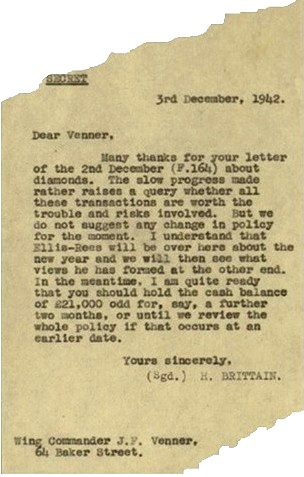
A fragment of the surviving Venner’s correspondence about rough diamond deliveries.
Nevertheless, such a strange decision was taken. SOE was tasked to implement the decision, and planning and methodological guidance were carried out by the Diamond Advisory Committee, it was impossible to export a single carat from England without its permission. 12 persons were in this body, including government officials, De Beers group’s employees, Otto and Louis Oppenheimer who were the representatives of the Oppenheimer clan, as well as Meyer Louis Van Moppes, owner of LM Van Moppes & Sons Ltd. The Van Moppes company was a De Beers’ sightholder and the largest supplier of industrial diamonds to Germany until 1939. The first parcels of rough diamonds intended for sale in the ‘black’ markets in the countries occupied by Germany left England in the summer of 1941.
And in 1940, a representative office of the Four-Year Plan (Vierjahresplan) was established in occupied Amsterdam; the Four-Year Plan was headed by Hermann Goering and it played a key role in the creation and development of Germany’s military-industrial complex. The representative office was headed by Colonel Joseph Veltjens, a personal friend of Goering since the First World War. In early 1941, Goering set a very strange task before Veltjens - to provide the German defense industry with industrial diamonds by purchasing them in the ‘black’ markets in the occupied countries. Common sense suggests that under the diamond embargo imposed by England in September 1939, rough diamonds in the ‘black’ markets in the areas annexed by the Nazis could only appear from stocks hidden by diamond dealers. But why should they buy them? After all, a tip-off given by a police agent and an SS platoon were enough to shake every last carat out of the provident diamond traders. Nevertheless, Colonel Veltjens saluted and registered the N. V. Maatschappij vor Diamanbewerking company in Amsterdam, whose personnel had to take on this unusual task. By chance, the core members of Veltjens’ team were the people who had bought industrial diamonds from LM Van Moppes & Sons Ltd (the De Beers’ sightholder) before the war, the owner of this company became a member of the British Diamond Advisory Committee. Thus, people willing to sell rough diamonds in the ‘black’ markets in the occupied countries and people willing to buy these roughs appeared in England and, accordingly, in Germany at the same time, and they were acquainted with each other for a long time. It would have been surprising if they had not met before.
Today, it is clear that Germany and Japan together received a minimum of half of the annual world production of industrial diamonds throughout the war years. This is the quantity behind the data in the tables above and it was calculated using the process flow charts for the production of the main types of weapons, the corresponding machines and diamond tools. Only people who have no idea about the process of designing and mass production of complex weapons systems can assume that such a result was achieved due to smuggling of the rough diamonds. Smuggling is actually an extremely unreliable source, it’s impossible to plan the results, and the ‘military-industrial complex’ and ‘planned economy’ are synonyms.
Germany and Japan needed not just huge quantities of industrial diamonds, their supplies had to be regular, constantly increasing and excessive to hedge the risks of losses amid military operations. This explains the huge quantity of industrial diamonds found in the zone occupied by the Soviet Union. And it is not surprising that General MacArthur’s reports also repeatedly had the information provided by the USA trophy teams discovering tens of thousands of carats of industrial diamonds stored ‘for future use’ at Japan’s factories. It remains to be added that the SOE unit known as Force 136 with its station in Singapore had the same task as Venner’s department - to provide funding for the Resistance fighters’ groups in the countries occupied by Japan by selling rough diamonds in the ‘black’ markets in these countries.
Thus, only the available supply channel meeting the requirements of regular deliveries, continuous increase in deliveries and excessive supplies of industrial diamonds could explain the continuous growth of arms production by the Axis powers during the war. The supply channel British Diamond Advisory Council - SOE - German Office of the Four-Year Plan meets these requirements, but smuggling the rough diamonds does not.
The motives of Germany and Japan to take part in this supply channel are clear. It remains to be seen why England and De Beers needed this. It is difficult to resist the temptation to ask counter-questions like “Why did De Beers and its sightholders, whose owners were ethnic Jews, sell a record quantity of industrial diamonds to Germany in 1938? Didn’t they know who Hitler was and why he needed these diamonds? Hadn’t they read Mein Kampf by Hitler? Hadn’t they heard anything about the Nuremberg racial laws of 1935? Did the Night of Broken Glass (Kristallnacht) pass them by?” But we are not in Antwerp’s Diamond Quarter (Diamantkwartier) to ask such a question and get a response.
Therefore, we would like to refer to the brilliant work titled Conjuring Hitler: How Britain and America Made the Third Reich by Guido Preparata, in which he convincingly showed that the true meaning of the long-term financial, resource and technological support for the Nazi regime and playing off this regime against the USSR was the ‘final solution of the German question’ - the elimination of any claims by Germany to the status of a world power. The stronger the enemy, the more fatal its defeat will be, “To annihilate the German threat, the British ruling elites had gambled for high stakes; for over 30 years (1914-45) they had woven a web of financial machinations, international complicities, intelligence conspiracies, diplomatic devilry, military savvy, and inhuman mendacity, and they finally succeeded. This game for Anglo-American supremacy has cost an estimated 70 million lives in two world wars: a holocaust whose horror is beyond words. …there was no longer a Germany worth speaking of: all we see is a benumbed population harnessed to a native automaton…”
I hope that the extrapolation of this interesting historical material to today’s events will contribute to understanding the causes and goals of major armed conflicts, as well as the peculiarities of the practice of imposing sanctions that accompanies these conflicts.
Sergey Goryainov for Rough&Polished
