Geopolitical uncertainty, military conflicts, epidemics that have characterized the global economy recently, reaffirm the timeless value of gold due to its reliability, liquidity and profitability. Moreover, gold is the most attractive asset for investing and wealth preservation, especially in long-term planning, precisely, in times when the world is in turmoil.
The price rally is not over
One can safely say that in 2024, gold became one of the most profitable assets in the world. It continues to set new price records due to its attractiveness as a safe-haven asset enabling to avoid the unpredictable geopolitical risks, and thanks to high-volume purchases of gold by central banks.
On October 17, 2024, the spot price of gold was $2,690 per troy ounce. If trading sessions end at this level, there is going to be the new highest one ever recorded. The previous high was reached the day before and was equal to $2,674. In just one day, the growth rate of gold prices was plus 0.82%, and it was plus 12.35% over six months. The gold price rally is supported, among other things, by expectations of further decline in interest rates by global central banks, namely, by the US Federal Reserve System and the European Central Bank.
At the same time, the gold bar price hit the all-time high of $1 mn1. In the first half of this year, net purchases of gold by central banks amounted to 483.3 tons, which is equivalent to almost 40,000 bars. The purchase of gold was among the factors that contributed to the sharp rise in prices for the yellow metal this year.
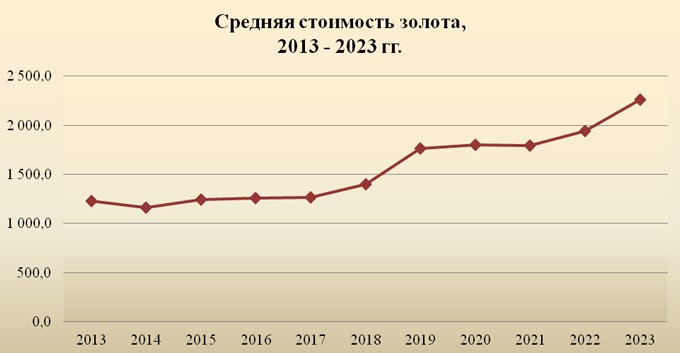
Over a period of seven months of this year, the average price of gold had an upward trend and was $2,287.4.2 In general, the price has risen by about 17% since the beginning of the year. Overall, the price of gold has increased over the last 10 years by almost 85%, from about $1,225.7 in December 2013 to $2,257.4 in December 2023 (Diagram 1).
Diagram 1: Average gold price, 2013 to 2023
Source: https://www.gold.org/goldhub/data/gold-prices
Diagram 2: Average price of gold bars*, 2013 to 2023
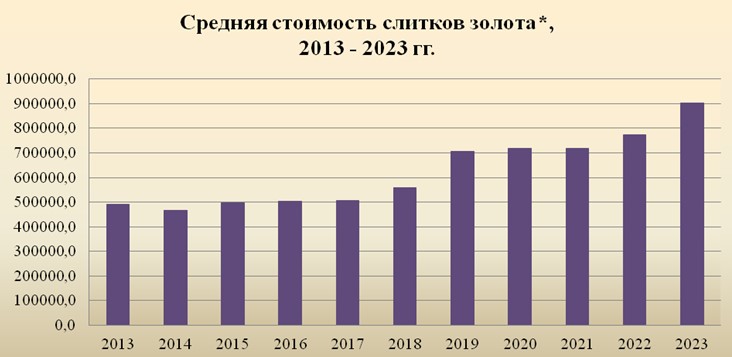
* The price of gold bars is calculated using the average spot price per ounce multiplied by 400.
The gold market is currently showing an upward trend, the longest one since the USA went off the Gold Standard in August 1971. The current trend started in March 2020 (since the WHO declared the COVID-19 pandemic) has resulted in rising the spot price of gold by 56.2%. The duration of the current price rise is exceptional, but not record-breaking in terms of the pace of price increases. For example, during the largest gold price rally ever recorded - from November 1978 to January 1980 - the prices rose by almost 277%.
In general, if one traces the history of gold prices through the last 50 years, this yellow metal was always used when the world was in turmoil and experienced crises: from the exit from the Gold Standard in 1971, to the subsequent stagflation in the late 1970s and early 1980s, during energy crises, the recession of the early 2000s, the global financial crisis of 2008 triggered by the US mortgage crisis and the bankruptcy of the major American banks, the COVID-19 epidemic, as well as during the current geopolitical uncertainty and escalation of armed conflicts. One can expect the price rally to continue because the current alarming situation in the world, including the ‘hot’ conflicts, is far from becoming normalized and ending.
In addition, if one follows the theory put forward by Ray Dalio, the founder of the Bridgewater investment company, of short-term (8 years) and long-term (50-75 years) debt cycles, the world is now at the stage of completing the long-term debt cycle started in 1945 after World War 2 and the establishing of a new world order based on the dollar. The restructuring of the monetary system may be required at the stage of completion of this cycle when debts become too large and the central bank loses its ability to create money and increase lending to the economy to stimulate the real growth. After this, a new long-term cycle normally begins.
It is worth noting that at the first stage of such a cycle (out of six ones), a return to cash based on gold (less often, based on silver or other metals) or pegging to a hard currency is normally observed. At this stage, it is important for the money to be a hard currency, since in these cases, no trust (or credit) is needed for exchange. Gold has a significant difference from debt assets like fiat money: only this yellow metal can be used both as a reliable and safe means of exchange and wealth preservation. Thus, we are apparently witnessing a historically long-lasting rise in gold prices.
Gold reserves
As for physical gold reserves, four top countries are the United States, Germany, Italy, and France. In total, the G7 countries accumulate 17,531.18 tons of gold. At the same time, Canada, a member of the G7, has no gold reserves.
Russia ranks fifth in physical gold reserves. In total, the BRICS countries (excluding those that have joined recently) account for 5,626.77 tons of gold. Although this is only official data.
China is among the largest importers of the yellow metal in the world. In 2023, Switzerland ranked first in gold imports, mainland China ranked second, Hong Kong - third, Great Britain - fourth, and India ranked fifth. These five countries taken together accounted for more than two-thirds (70.3%) of the world’s imports of this precious metal. Meanwhile, it’s interesting that the main country supplying gold to China and Hong Kong is Switzerland, the leading gold importer.
In addition, China is the largest gold producer in the world, the country mined 370 tons of this precious metal in 2023. The People’s Republic of China has been a leader in gold mining for many years. In 2023, its gold mines’ output increased by 5.7%. This was the first increase in gold production in China over the past several years.4 Against this background, there is every reason to believe that the Celestial Country is the largest holder of gold reserves given the policy of China’s leaders to ban gold export.
Share of gold in gold and foreign exchange reserves of countries
As for the share of gold in gold and forex reserves in 2023, Bolivia, Portugal and Uzbekistan rank first, second and third with the indicators of 86.7%, 72.15%, and 71.42%, respectively. However, as for physical gold, they have small volumes of this precious metal equal to 23.51 tons, 382.63 tons, and 371.37 tons, respectively. They are followed by the countries having large volumes of physical gold, in particular the USA, Germany, France, and Italy. Russia ranked 18th only with its gold share of 26.05%. It’s worth noting that the share of gold in total gold reserves in Belarus is 44.32% (Table 1), despite its insignificant volumes of this physical metal, 54.02 tons.
It is important to emphasize that the Central Bank of the Russian Federation seems to have put an end to its practice aimed at its refusal from gold purchases. Unprecedented sanctions imposed on Russia contributed to this as well as the disconnection of Russia from SWIFT, the international money transfer system. Therefore, recently there has been an encouraging, albeit extremely cautious increase in the share of gold in the country’s total reserves. According to the Central Bank, the value of gold in Russia’s international reserves reached a new high of $179.6 bn in late July, 2024. A month earlier, the gold reserves of the Russian Federation were estimated at $174.2 bn, up 2.9%. The share of gold in the country’s international reserves increased from 29.4 to 29.8% over the month. At the same time, the total value of Russia’s international reserves grew by 1.4% over the month, from $593.5 bn to $602 bn.
Table 1
|
|
Country |
Gold reserves, tons |
% of gold in gold and forex reserves |
|
1 |
USA |
8,133.46 |
69.89 |
|
2 |
Germany |
3,352.65 |
69.06 |
|
3 |
Italy |
2,451.84 |
65.89 |
|
4 |
France |
2,436.97 |
67.28 |
|
5 |
Russia |
2,332.74 |
26.05 |
|
6 |
China |
2,235.39 |
4.33 |
|
8. |
Japan |
845.97 |
4.37 |
|
9. |
India |
803.58 |
8.55 |
|
11. |
Taiwan, China |
422.38 |
4.71 |
|
16. |
Great Britain |
310.29 |
11.64 |
|
27. |
Brazil |
129.65 |
2.44 |
|
30. |
South Africa |
125.41 |
13.40 |
https://www.gold.org/goldhub/data/gold-reserves-by-country
As one can see, despite the fact that gold once lost its leading role in the international settlement system and was replaced with the world reserve currency in the form of the US dollar, the world’s largest powers now prefer to keep most of their reserves in gold as the safest financial asset, which is a protective mechanism against various global shocks and collapses.
Asia is not only a driver of the development, but also a leader in gold purchases
As for continents, an interesting situation is developing. Asia became the leader in gold purchases (in dollars) in 2023. The Asian countries accounted for almost 59% of the global imports of the yellow metal, or $287.5 bn.
That said, China accounts for an ever-increasing share of demand for gold. As of the first quarter of 2024, demand for gold coins and bars in Europe decreased by 53% compared to 2023. Meanwhile, China’s demand, on the contrary, soared by 67%.
Europe ranks second in gold purchases with 34.9%. Imports to the 27-member European Union is lower (4.1%), because the leading gold importers - Switzerland and the United Kingdom - are not members of the EU. North America accounted for 5% of world’s gold purchases, the Pacific Islands (primarily Australia) accounted for 1.2%, Africa - 0.2%, and Latin America - 0.1%.3
Conclusions
It can be assumed that gold prices have not yet hit their all-time high, as the US presidential election is coming up (November 5, 2024), major armed conflicts are in full swing (the special military operation in Ukraine, and the Palestinian-Israeli conflict). Instead of a recovery trend, the global economy is showing a slowdown in economic growth rates, an alarming situation is developing in the economies of the world powers, in particular excessive debt burden and inflation (the US debt has reached $35 trillion, or over 145% of the country’s GDP).
Some forecasts show, the price of gold in the next year and a half may well reach $3,000 per ounce. This is a completely realistic outlook because in addition to geopolitical risks, there are problems of the depletion of traditional mines. It is unprofitable to develop new deposits at this stage, because the costs of exploration and the creation of the necessary infrastructure require capital investments, the amount of which is not expected to be offset even by record prices for this precious metal.
In general, the current global changes, including the transformation of the world economy towards a multipolar world, a change in technological and world economic structures4, carry the risks of uncertainty and cataclysms. What makes the situation even more unpredictable is that the dollar is losing its status - albeit slowly - as the world’s reserve currency.
The USA and European countries undermined confidence in the dollar by ‘freezing’ Russia’s assets worth over $300 bn. In international trade, increasingly more countries are switching to payments in their national currencies. And the BRICS+ countries have repeatedly declared their desire to create a common currency for this intergovernmental organization participants.
Thus, the dollar is increasingly becoming a ‘toxic’ currency and the countries are trying to replace it with more reliable instruments. Gold is undoubtedly one of them. Therefore, there is every reason to believe that this yellow metal has not yet ‘had its say’ in the current price rally.
Margarita Obraztsova, PhD in Economics, for Rough&Polished
Produced and published as part of the project "Best practices have a voice"
1 Since gold bars typically weigh around 400 troy ounces, each one would be worth more than $1 mn.
2 with the exception of May when the price fell by 0.8% compared to April
3 excluding Mexico but including the Caribbean countries.
4 S. Glazyev. A breakthrough in the future. Russia in the new technological and world processes. – M.: Knizhny Mir, 2019.
