The availability of copper concentrate (a feedstock for copper smelters) is among the key factors influencing the global copper market, along with expectations related to the U.S. monetary policy and the Gulf War. Available exchange warehouse copper stocks are growing, but a shortage in the copper concentrate market, coupled with tariff uncertainty, has contributed to copper prices reaching record highs by the end of August 2026.
While the impact of the concentrate shortage on refined raw material supplies is currently limited, market players predict increased pressure on copper smelter profitability, which could eventually result in the decline in supply. The first signs of this process have already appeared, with Glencore and Japanese producers mothballing smelters and limiting the copper smelting capacity.
The structural weakness of processing fees that will persist in the medium term will inevitably require either a significant increase in concentrate supply or a significant reduction in copper smelting facilities, according to the International Energy Agency (IEA). Therefore, the reduction in the number of copper smelters or their closure, including those in China, remains the primary mechanism for bringing the market into balance.
Roots of the deficit
The copper concentrate deficit has worsened amid operational disruptions and force majeure events at key mines: the closure of Cobre Panama and accidents at Grasberg, Kamoa-Kakula, and El Teniente. These force majeure events have exacerbated the recurring copper supply problems caused by declining ore grades (the average global grade of copper mines has fallen by 40% since 1991), as well as a significant shortage of new discoveries, and the increasing difficulties in the implementation of projects. Mines in Chile, the world’s largest copper producer, have been facing the copper ore depletion and water resource availability issues for several years, and reduce the production.
According to the International Copper Study Group (ICSG), global copper mine production in the first half of 2026 fell by 1.1% compared to a year ago. A 2.6% decline in copper concentrate production, primarily in Chile, the Democratic Republic of the Congo, and Indonesia, more than offset a 4.3% increase in hydrometallurgical production (SX-EW, liquid extraction and electrowinning). Nornickel estimates a copper concentrate market deficit at 751,000-tonne this year.
Under these conditions, smelting facilities built to cope with aggressive growth in demand for raw materials has proven to be excessive. China is a leader in the growth in copper smelting capacity, having commissioned a record number of new copper smelters in recent years. According to IEA, China currently controls approximately 50% of global smelting facilities. China put copper smelters into operation much faster than global mining companies could supply raw materials. China’s refined copper output in 2025 increased by 8% to 14.72 mn tonnes, while the global production grew by just 1%, according to the International Copper Study Group. India is also expanding its copper smelting capacity, launching some of the largest copper smelters in the country’s history (such as the Adani project).
Copper smelter production by region and China’s growing share:
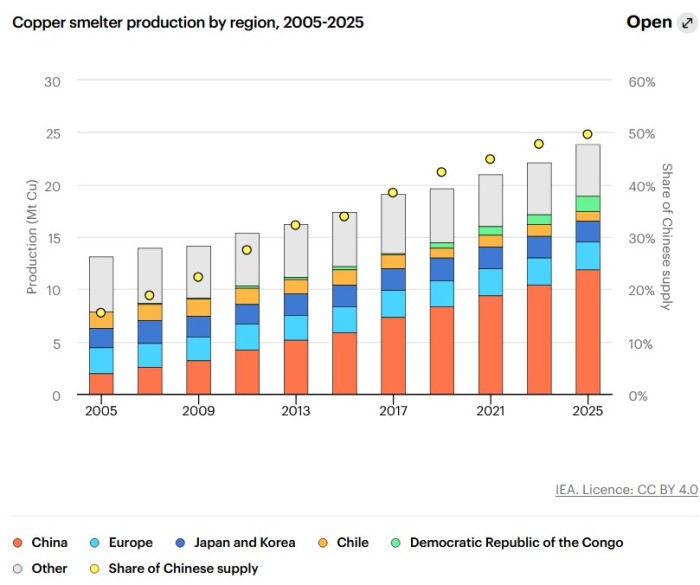
Source: The International Energy Agency (IEA)
Amid the fierce competition for raw materials, copper smelters are reducing their service fees (Treatment Charges/Refining Charges, TC/RC). Historically, these fees/charges are paid by mining companies to smelters for processing the concentrate to produce pure metal. When raw materials are scarce, copper smelters are forced to reduce their fees to zero to fill the smelters’ capacity, and even go into the red, essentially paying the mining companies for the right to process their copper concentrate.
Copper concentrate processing benchmarks (TC/RC), based on the prices in the agreement between Chile’s mining company Antofagasta and major China’s smelters, have fallen from $80 per tonne in 2024 to $21.25 in 2025. This year, the benchmarks are zero, and the figures in spot market are negative: the SMM’s Imported Copper Concentrate Index, calculated by Shanghai Metals Market, fell to a record low of minus $182.14 per tonne at the end of August 2026.
Concentrate processing fees at copper smelters:
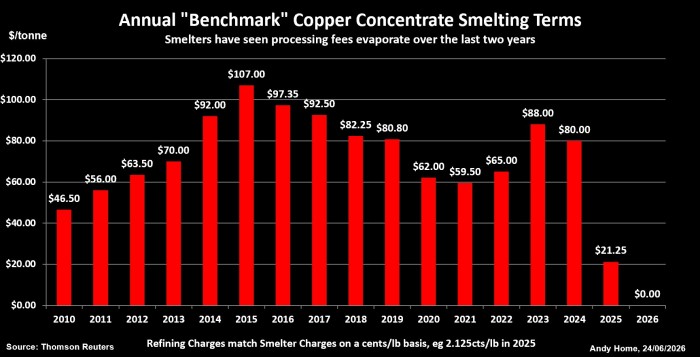
Source: Thomson Reuters
The copper concentrate market is a segment remaining under the most pressure in the copper value chain, Nornickel notes in its Quintessentially Copper review. Baseline copper concentrate processing prices for 2026 were set at $0 per tonne and are likely to remain under pressure as copper smelters continue to compete for scarce concentrate supplies.
By-products are a lifesaver, but for how long?
However, low TC/RC ratios alone are not enough to trigger widespread closures of copper smelters. Copper smelter margins are supported also by by-products contained in copper concentrate: precious metals and sulfur. Higher gold and silver prices have significantly offset the loss of smelters’ primary source of revenue. An additional contribution was due to a sharp surge in sulfuric acid prices thanks to disruptions in supplies from the Gulf countries caused by the closure of the Strait of Hormuz resulted from the war with Iran. According to Reuters, some China’s copper smelters are processing more pyrite (iron pyrite), so-called ‘fool’s gold’, just due to its higher sulfur content.
Thus, byproducts are a kind of protective buffer to maintain the economic viability of the key link in the copper supply chain. However, rising volatility and the recent decline in the prices for precious metals and acid raise questions about how long this protective buffer can last, according to the IEA report.
The smelters’ revenue structure historically relied heavily on the TC/RC ratio has changed and become increasingly dependent on the byproduct and premium product markets that are inherently more volatile. Privately owned copper smelters that are not part of vertically integrated companies - that is, those without access to primary mining and with higher transportation costs - are most vulnerable to copper concentrate shortages and declines in the TC/RC ratio. Some of these copper smelters, like Japan’s Mitsubishi Materials, have already been forced to cut copper production, while others, like Australia-based Glencore’s smelters, received emergency government assistance to prevent their closures, IEA notes. Other copper smelters are reducing primary processing volumes but expanding the recycling. “However, the critical question remains how long these smelters can maintain low TC/RC ratios if by-product prices adjust,” IEA says.
The bulk of China’s copper smelters do not yet cut their production capacity. China’s smelters are generally more competitive, benefiting from lower capital and operating costs, and they are also mainly state-owned ones, which ensures them support during the periods of low revenues from TC/RC. Nevertheless, China’s largest copper smelters have agreed to cut their production by more than 10% in 2026, and the government has suspended construction of planned new smelting facilities for about 2 mn tonnes of capacity. However, these reductions are not yet sufficient to significantly balance the market, IEA notes, and they are unlikely to significantly increase processing fees.
China’s copper smelters have primarily responded to the concentrate shortage and the declining TC/RC ratio with statements of production discipline and delays in individual expansion projects, rather than with large-scale production cuts, according to Quintessentially Copper. Nornickel believes these are the first adjustments due to the copper concentrate shortage, but pressure on costs could become more significant in the second half of 2026.
On the other hand, the surging sulfuric acid prices, while supporting copper smelter profitability, hinder the increase in refined metal production, Nornickel notes. Cost and availability risks grow in copper production by the SX-EW method that uses sulfuric acid as a leaching reagent. This is a serious problem: the SX-EW method accounts for approximately 21% of global copper production. Therefore, higher prices for acid can result in higher costs, lower leaching efficiency, and limit the cathode production, particularly in regions with intensive use of the SX-EW method, such as Chile and the Democratic Republic of the Congo, according to Quintessentially Copper.
Scrap shortage
However, a concentrate deficit does not equate to a refined copper deficit. When a shortage of copper concentrate is approximately 750,000 tonnes, the refined copper market is in surplus - ICGS estimates a visible surplus of 131,000 tonnes for the first six months, with a surplus of 96,000 tonnes expected for the full year.
This happens because copper smelters, amid a shortage of copper concentrate supplies, partially replace it with copper scrap. Recycled copper accounts for approximately 16%-17% of global copper output, or approximately 4.3 to 4.8 mn tonnes of refined metal per year. Recycled copper production is more profitable than smelting the metal from concentrate due to significantly lower energy consumption. According to ICSG, copper production from scrap increased by 4.3% in the first half of the year, with most of this increase occurring in China.
The problem is that copper scrap stocks are not keeping pace with demand, and it’s also difficult to provide recycled copper supplies. According to research by Shanghai Metals Market, traded copper scrap stocks at the companies in China, as well as in Japan and South Korea, are low, while ‘high-grade’ Millberry scrap (at least 99.9% copper) remains relatively scarce.
The copper supply shortage cannot meet the growing demand from new smelters in China, according to S&P Global. In the third quarter, the market expects copper processing fees to remain low due to the ongoing copper concentrate shortage, although this may be partially offset by negative smelter margins and potential production cuts, which, however, does not appear inevitable taking into account the above.
Uncertainty over U.S. tariffs still supports prices
Besides the situation in the copper concentrate market, one of the reasons for the rise in copper prices is the fear of the introduction of import tariffs in the USA, which creates regional imbalances and pressure on the market. Traders rushed to import metal into the USA, tightening the physical market. With prices at record highs, any disappointment with USA’s tariff policy could test this premium, ING notes.
Copper shipments to the USA accelerated in anticipation of a possible tariff decision, leading to a record increase in COMEX stocks. USA’s copper imports exceeded 200,000 tonnes in July alone - the highest monthly level in at least 12 years.
COMEX copper stocks:
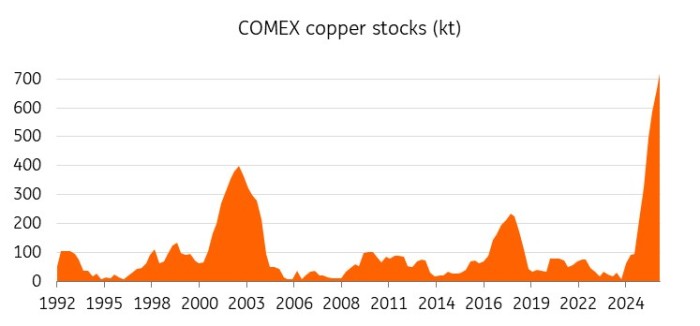
Meanwhile, the London copper market is showing increasingly pronounced signs of a shortage. Copper stocks on the London Metal Exchange (LME) have fallen to a five-month low, and the cash-to-three-month spread has shifted toward backwardation, indicating a lack of short-term supplies.
Of course, the tariff decision is only part of the story. Copper supply growth at mines remains limited, and the low treatment charges we discussed above continue to point to a copper concentrate shortage. Demand driven by electrification, grid investments, and artificial intelligence infrastructure also continues to provide support. ING expects the global refined copper market to post a deficit of approximately 35,000 tonnes in 2026.
However, if final measures are delayed or refined copper is exempted from tariffs, some of the recent price growth could fade. Copper stock accumulation in the USA will slow, copper stock flows will begin to normalize, and some of the current deficit outside the USA will ease. Any correction could intensify if investors close positions built on expectations of the introduction of tariffs, ING warns.
Sergey Bondarenko for Rough&Polished
