This year, the policies of the Indonesian government and major local nickel producers have hovered, more clearly than ever, around the break-even point - the lower threshold of production costs for domestic operations. When prices fell below 2025 lows, near $16,000 per tonne, stakeholders became active, signaling (at least verbally) that they might limit their production capacity. The robust price recovery to $19,500-$20,000 per tonne seen in April-May 2026 has served as a trigger for restarting large-scale projects like Weda Bay as well as loosening the regulations through allocating new quotas and tax cuts. With demand from key nickel consumers growing more slowly than supply, and the surge in exchange warehouse stocks creating a sense of surplus, the Jakarta factor has become exceptionally significant.
However, it hasn’t triggered a price reversal; although officials have stated this as a goal, they have shown little resolve in tightening mining quotas. In this environment, a sustained price recovery could only occur if production facilities are shut down due to costly sulfuric acid or a boosting demand for batteries. Yet, there are no signs of improvement in this respect either, because lithium iron phosphate (LFP) batteries containing no nickel are steadily increasing their market share and have become the dominant energy source in China.
Regulation based on circumstances
Early this year, nickel market players had high expectations that Indonesia - the world’s largest producer accounting for over 60% of global output - would take sufficient action to prevent another year of surplus supply in the global market. And Jakarta has opted for stabilizing the market by reducing nickel ore mining permits (known as RKAB, Rencana Kerja dan Anggaran Biaya) and raising benchmark prices for nickel ore; these measures were aimed at boosting government revenue, which have resulted in squeezed profit margins for processing plants.
Rising the production costs and the prospect of tightening the supply, coupled with smooth demand growth, have fueled the expectations for the first nickel deficit in the market in three years. In its April forecast, the International Nickel Study Group (INSG) that took into account the lower production volumes in Indonesia projected a moderate nickel deficit of 32,000 tonnes, compared to the metal surplus of 283,000 tonnes, while at the previous meeting held in October 2025, the forecast was a surplus of 261,000 tonnes. The INSG’s April outlook was based on the assumption that the global nickel supply would decline by 4.2% amid a 4.2-percent increase in demand for the metal.
Chinese companies that have invested heavily in Indonesia’s nickel industry over the past decade - helping the country become the world’s largest producer of this metal - have expressed their concern over these measures. Their unease has been compounded by rising prices for sulfuric acid used by approximately 30% of Indonesia’s nickel sector in the high-pressure acid leach (HPAL) process that converts low-cost laterite ores into battery-grade nickel. Furthermore, operations were later hampered by water shortages caused by the El Niño weather phenomenon - the Pacific temperature anomaly; the water shortages resulted in disruptions at several processing plants due to a lack of water for cooling their smelting units.
As Reuters columnist Andy Home writes, Indonesia’s authorities have faced a dilemma: how to reduce mining output without doing any harm to local processing plants (built primarily thanks to financing by Chinese corporations), some of which began ramping up production this year. Eventually, in the middle of the year, Jakarta selectively assigned quotas to processing plants facing raw material shortages, though further details are not available.
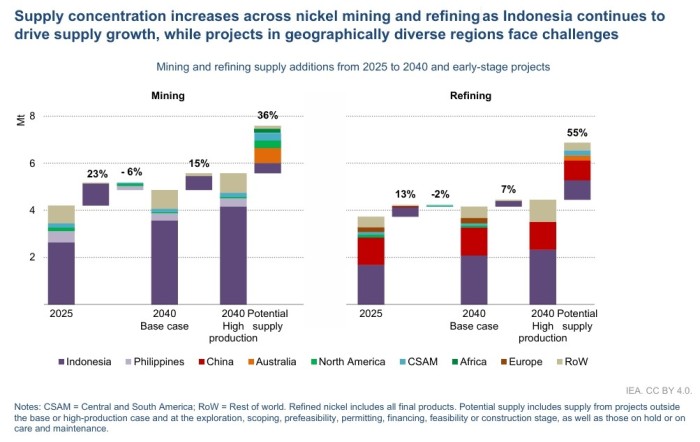
Concentration of nickel extraction in Indonesia, and of nickel processing in Indonesia and China, taking into account both existing and new projects:
Source: IEA
In mid-September, it appeared that the expectations of Chinese investors had been heard, because Indonesia made another major policy shift regarding its nickel mining capacity. The minimum prices for low-grade nickel ore used to calculate royalties were slashed, thereby easing the tax burden on the HPAL facilities.
According to Bloomberg’s calculations, the new mineral benchmark price formula will reduce the price of nickel ore by nearly half.
This reduction in costs was intended to partly offset the producers’ higher expenses for chemicals. The Indonesian Nickel Smelter Association (known as FINI, Forum Industri Nikel Indonesia) stated that the new mineral benchmark price formula ensures operational stability and eliminates the risk of losses, correcting an imbalance faced by enterprises due to rising sulfur prices caused by the conflict in the Middle East.
For the nickel market, the implications extend beyond an increase in production costs for existing projects, as the opportunities are also created to develop low-grade ore reserves previously considered economically unviable. The Indonesian Nickel Producers Association (known as APNI, Asosiasi Penambang Nikel Indonesia) stated that the new formula “better aligned with the economics of limonite could expand the utilisation of low-grade ore reserves, increase limonite uptake by HPAL facilities, and drive the utilisation of resources that were previously economically marginal”.
Initial measures do not appear to have led to a significant drop in the production, as companies that exhausted their quotas increased their ore imports from the Philippines to maintain uninterrupted operations. Between January and July of this year, ore shipments from the Philippines rose by 67% (to 11.4 mn tonnes). Furthermore, a selective review of the quota system resulted in higher permitted mining output for several companies. For instance, the French group Eramet resumed the operations at its Weda Bay mine following a forced suspension in May that occurred after the company had exhausted its annual quota.
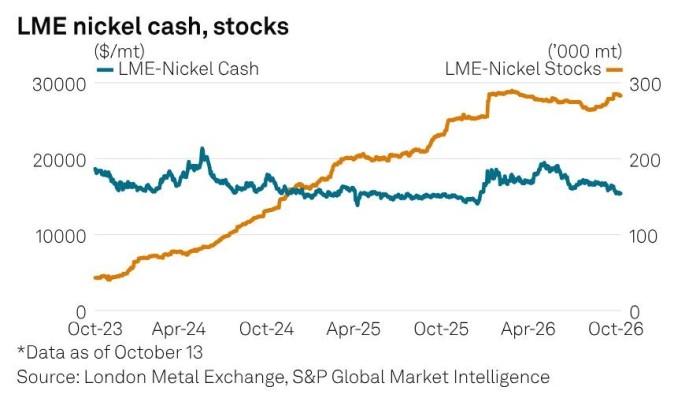
This has dampened the expectations of a deficit and aggravated the market conditions, especially given that nickel stocks on the London Metal Exchange (LME) remained high this year, ranging between 255,000 and 289,000 tonnes, which reflects an overall surplus of the metal. In October, the aggregate nickel stocks on the LME, including both warranted and non-warranted stocks, as well as on the Shanghai Futures Exchange (SHFE) reached 478,000 tonnes, i.e. an amount sufficient to supply to the global market for seven weeks.
LME nickel inventories and price, 2023 - 2026:
According to Home from Reuters, the actual supply surplus may exceed the figures given in visible stocks. All signs point to the fact that China is actively building up its nickel stockpiles, seeking to take advantage of the current low prices. In the first seven months of this year, China imported 170,000 tonnes of refined nickel, up 28% compared to the same period last year and it is the highest level since 2016.
Home writes that given that China’s own production of refined nickel is surging, fueled by raw material supplies from Indonesia, it is reasonable to assume that some of these imports are being made for strategic rather than commercial purposes.
The availability of ore - coupled with waning purchasing interest from smelters - has led to a sharp decline in the cost of nickel ore. In early October, its prices dropped to a five-month low since the pricing mechanism was revised in April of this year. According to SMM, certain grades of nickel ore were traded at a discount to their benchmark price (known as HPM, Harga Patokan Mineral) in early October. This served as a clear signal that the market has shifted from the deficit seen earlier this year to the surplus.
In mid-October, INSG revised its forecast for the nickel market that previously anticipated a deficit for 2026, and it now anticipates a small surplus (19,000 tonnes). INSG now expects the global nickel production to decline just slightly, from 3.875 mn tonnes to 3.868 mn tonnes, while demand is projected to grow by 7.5%, reaching 3.849 mn tonnes.
In 2027, the nickel surplus in the market is expected to soar to 70,000 tonnes, with production expected to increase by more than 5%, to 4.071 mn tonnes. However, INSG notes that these figures carry uncertainty, particularly regarding the production output in Indonesia.
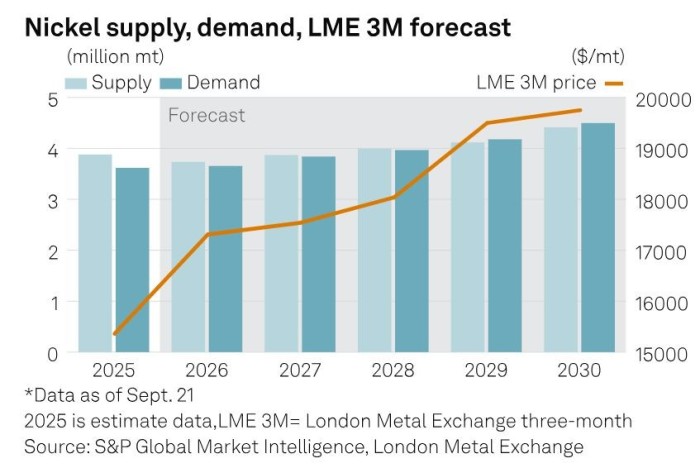
S&P Global Market Intelligence forecast for the nickel market balance: a deficit is not expected before 2029:
Amidst new signs of surplus supply, nickel prices on the LME had fallen by approximately 20% by mid-October compared to their May highs, with a particularly significant decline occurring since August. Cobalt prices have also dropped to a one-year low, placing additional pressure on cobalt producers that recover this metal as a by-product of nickel ore processing.
Another round of production cuts?
The slump in prices met with a response; Indonesia’s authorities responded promptly, signaling that they view current price levels as a bottom that should not be breached. On October 7, Bahlil Lahadalia, Indonesia’s Coordinating minister for downstreaming and energy transition, linked the price decline to domestic surplus supply and stated that the government was considering the regulating of the load - capacity utilization - of nickel smelters.
The minister noted that even if the installed smelting capacity requires large volumes of ore, the government must take into account the global supply and demand for finished nickel products, rather than automatically ensuring that smelters operate at full capacity. Indonesia is also considering a moratorium or tighter control over new smelters that produce nickel semi-finished products, such as nickel pig iron and ferronickel, with a greater focus on shifting toward sectors offering higher value-added products.
In late October, Bloomberg reported that major Chinese nickel producers were making plans to reduce the product output in Indonesia, as falling metal prices and rising operating costs exert significant pressure on the industry. Bloomberg mentioned that top executives from leading companies, including Tsingshan Holding Group, GEM Co. Ltd, Lygend Resources & Technology и Zhejiang Huayou Cobalt, were preparing to have a meeting where a coordinated reduction in production volumes was discussed, it has been the second dialogue on this topic since August.
The discussion concerns cutting the nickel output at the HPAL facilities. Specifically, a proposal is under consideration that each producer would reduce the metal output by approximately 30%; this figure was first mentioned in August. There is no information yet as to whether any agreement has been reached.
Although Jakarta’s measures have kept prices above the $16,000 per tonne for an extended period compared to lower prices for most of 2025, the price remains just slightly above the break-even point, even for some Indonesian nickel producers, according to Home. In fact, both Indonesia and the nickel market require an increase in demand, he concludes.
Awaiting demand
The INSG’s October forecast anticipating a 7.5-percent growth in nickel consumption for 2026 was based on a 5-percent increase in stainless steel production during the first half of 2026 (according to the World Stainless Association) and the expectations for further increase in the second half of 2026 and throughout 2027.
In the conditions of a steady and consistent growth in nickel consumption for the stainless steel production (accounting for about 65% of nickel use; the demand in absolute figures shows a steady rise from 1.92 mn tonnes in 2022 to an anticipated 2.52 mn tonnes by the end of 2026), the only volatile variable is the demand from the battery sector. INSG notes in its press release that the role of nickel in the battery market is growing more slowly than it was previously forecast - due to the competition from lithium iron phosphate technologies. Furthermore, the growth due to increased global electric vehicle (EV) sales has failed to materialize, as the annual growth rate of the EV sales is decreasing.
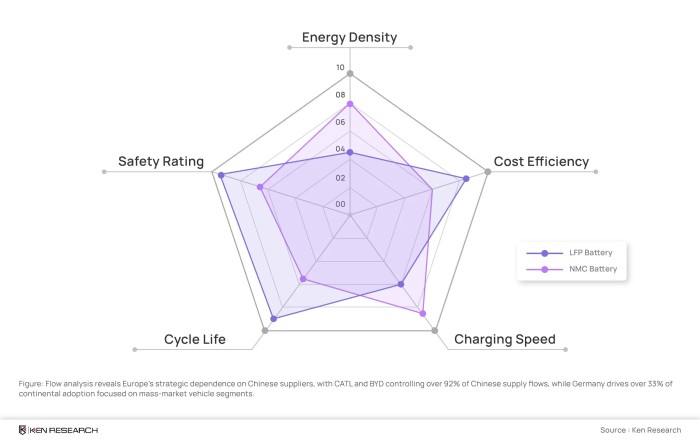
The Chinese EV market and global automakers are increasingly shifting towards using LFP batteries, containing no nickel or cobalt (like nickel-manganese-cobalt (NMC) batteries) and they offer lower costs and greater thermal stability. LFP batteries are beginning to dominate the mass-market EV and energy storage segments, whereas NMC batteries retain their position in the premium segment and in EV models with longer driving ranges.
Comparison of characteristics and performance of LFP and NMC batteries:
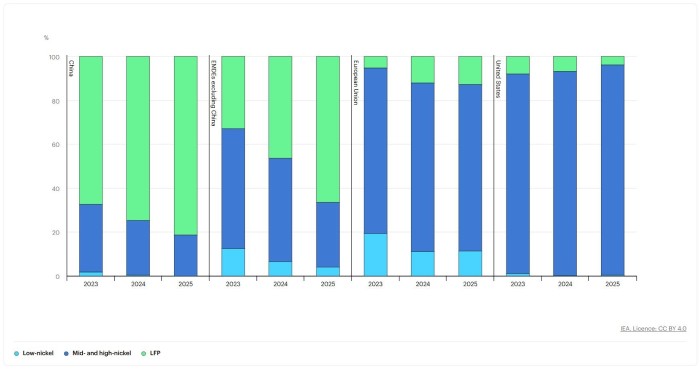
In 2025, LFP batteries accounted for over 55% of all EV batteries used globally, up from nearly 50% in 2024, according to the research by the International Energy Agency (IEA). While adoption remains heavily concentrated in China, growth pace is also increasing rapidly in other developing nations. Nowadays, LFP batteries account for two-thirds of all EV sales in the developing countries - double the EV sales in 2023 - driven by the import of Chinese-made vehicles and batteries. In 2025, LFP batteries were, on average, more than 40% cheaper per kWh than alternative NMC batteries.
Demand for battery types (low-nickel, medium/high-nickel, and LFP) by major consuming regions, 2023 - 2025:
Source: IEA
Weaker-than-expected demand from the battery sector explains the high exchange warehouse stocks, as the LME market specifically keeps records of Class 1 nickel stocks - the type of nickel used in batteries. This accumulation of the metal on the exchange followed the commissioning of HPAL facilities in Indonesia. The commissioning of Class 1 nickel production facilities is set to continue through 2026–2027, and Indonesia currently has no plans to decrease this metal production unlike the production of nickel semi-finished products. Greg Miller, a senior nickel market analyst at Wood Mackenzie, says that most output is likely aimed at Class 1 production and will potentially increase exchange inflows in 2027.
At the same time, tighter regulations in Indonesia and rising production costs could have a negative impact on the demand for nickel in the battery sector. Rising production costs at the HPAL facilities due to an increased price of sulfuric acid and a change in ore pricing mechanisms introduced in April result in soaring prices for a key battery component - mixed hydroxide precipitate (MHP) primarily sourced from Indonesia. Consequently, nickel-based batteries could see their market share shrink even further, according to S&P Global.
Sergey Bondarenko for Rough&Polished
