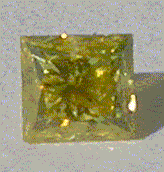
 This polished diamond was manufactured in Belarus by Adamas BSU, a government-owned company, from a synthetic diamond produced by the BARS installation. It complies with the Belarus National Standard TU RB 400078252.010-2004. The following is the diamond’s specification in accordance with the factory documentation:
- Princess cut – 65 facets;
- Color 3 (Canary Yellow);
- Weight 0.45 carats;
- Size 3.95X3.70 mm.
Its retail price is 671 290 Belarusian roubles or $320 by the exchange rate of the Central Bank of Belarus, inclusive of VAT 18% and Sales Tax 5%.
This polished diamond was offered for examination to several gemological laboratories in Moscow. Their experts were not informed of the diamond’s original data. One laboratory defined the diamond as natural and modified by thermal baric annealing. The rest were successful in defining the diamond as synthetic. All the experts were at once attracted by its color (“There is no such color in nature,” “The color is impudent,” or “The color is defiant”) – this was the initial identification hall-mark. The second and the primary identification criterion was related to the cross-like color zoning characteristic of diamonds made of mono crystals grown by the BARS processing technique. This hall-mark is found if the diamond is cut by the center of the original synthetic crystal, but if the diamond were cut by the crystal’s periphery finding this hall-mark would be difficult or impossible.
The diamond did not differ from a natural one by its thermal response, electric conductivity or light deflection. Spectrophotometery did not detect nickel or iron – catalysts used in the processing technique employed by Adamas BSU.
None of the experts could determine the diamond’s manufacturer; some of them were tentatively suggesting Novosibirsk or Israel as places of its origin.
The cutting quality was evaluated as “good” by all experts.
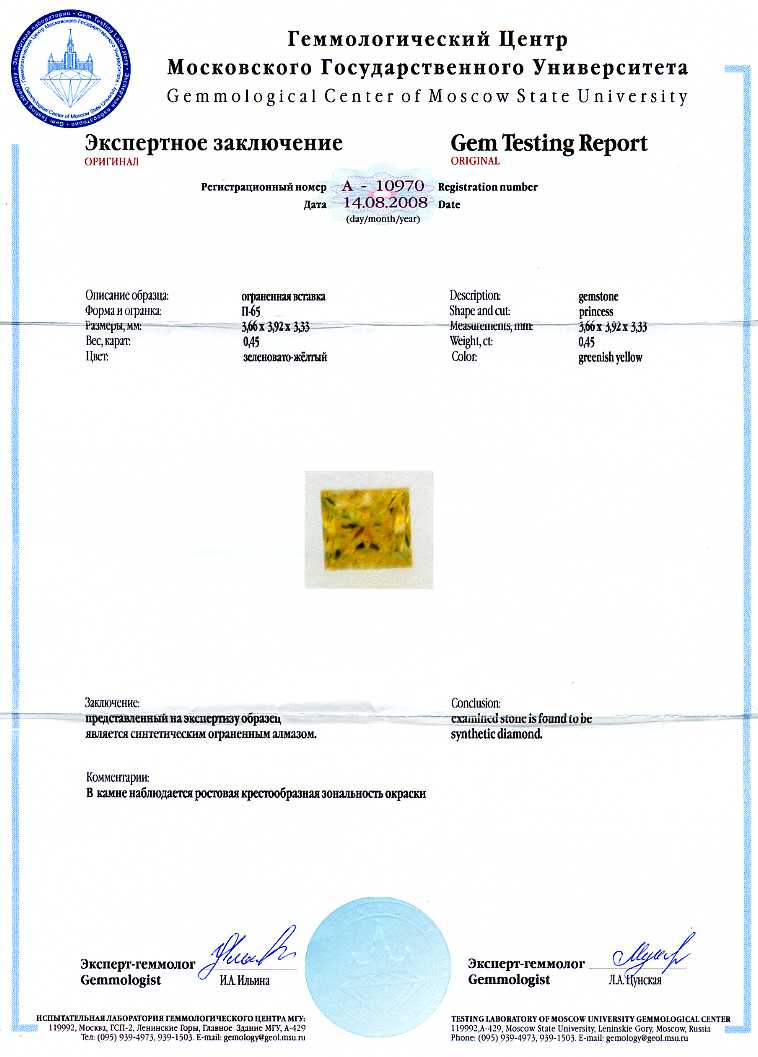
Samples of some of the expert findings of gemological examination.
Picture of MGU1 Certificate
Picture of IGC Certificate
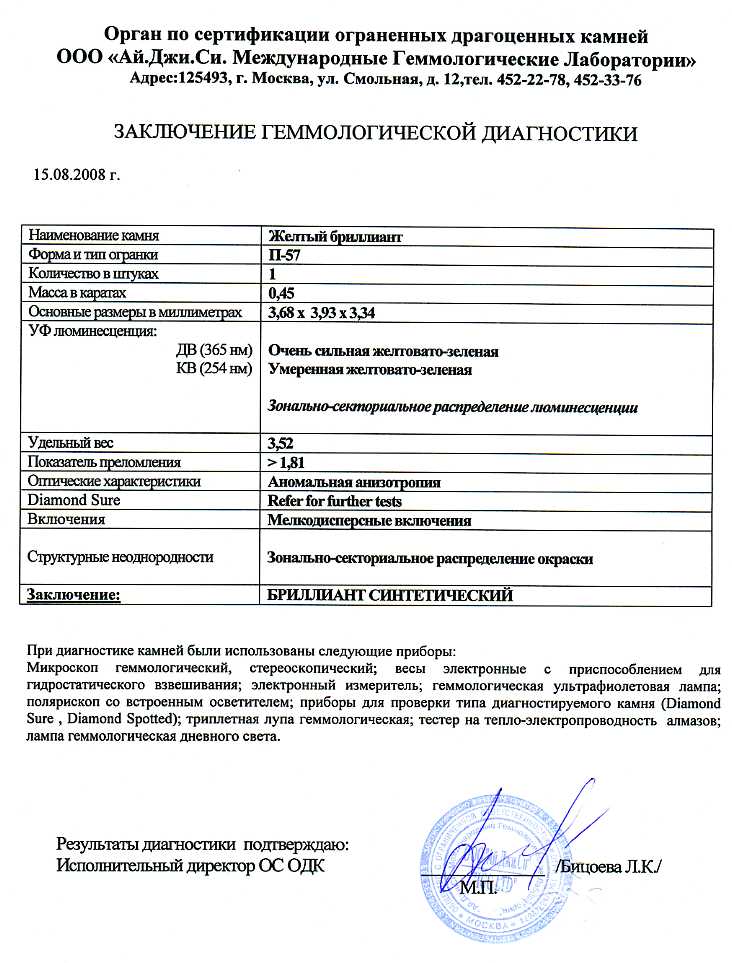
Note: 1. It is noteworthy that there is a discrepancy in evaluating the diamond’s size – such an error (in hundredths) is present in all the expert findings.
2. There is an error in stating the cut shape in the second expert finding, probably due to a misprint.
On the whole, the level of Moscow gemological laboratories allows a high level of probability in relying on the quality of expert examination in cases when identification of synthetic diamonds appears a legal necessity (for instance for customs clearance).
