In March and April 2008, the Web site of the special government commission under the auspices of the Ministry of Natural Resources of the DRC posted a two-volume report containing a detailed analysis of contracts concluded by the DRC state corporations with foreign mining companies in the period from 1998 to 2003. It is noteworthy that this time frame wholly spans the years of Kabila Senior’s rule (1997-2001) as well as the period when Kabila Junior’s position was very shaky. Kabila Junior seized full-fledged control over the political situation in the DRC only in 2006, when using the outcome of the “general democratic elections” (the first from the Lumumba time in 1960) he managed to impart legitimacy to his regime and succeeded in totally mopping up the security agencies responsible for the attempt of a palace coup resulting in his father’s death.
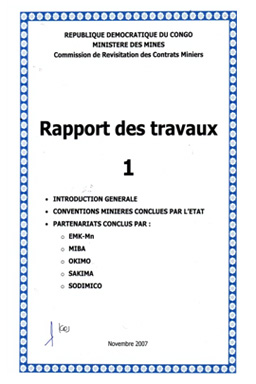
Cover page, the 1st volume of the report.
The commission’s conclusions said that 61 contracts must be overhauled – this is almost a complete list of mineral mining projects in the DRC. The basic essence of modernizing the contracts boils down to a sharply expanded share of DRC government-owned companies in joint mining ventures. Thus, for example the OKIMO state-owned corporation is recommended to draw up a new agreement with AngloGold Ashanti and up its stake in the gold-mining joint venture in Kilo (the Mongbwalu area in the East of the DRC with an initial inferred resource of 2.9 million ounces of gold) to 45% (from the current 13.78%). AngloGold Ashanti, in its turn, is required to increase its payment for using mineral resources of the DRC.
MIBA, a state-owned diamond-mining corporation, is recommended to review its contracts with De Beers and BHP Billiton also to increase its own share in their joint projects.
The report also advised to re-negotiate the contract between state corporation Gecamines and Freeport McMoRan on the Tenke Fungurume project (Katanga province) containing the world’s biggest copper and cobalt deposits. The revised contract will scale up Gecamines’s stake to the detriment of McRoRan Copper & Gold and minority shareholder Lundin Mining (Canada). It should be taken into account that Freeport McRoRan Copper & Gold is the projects’ operator and its controlling stake belongs to Phelps Dodge Mining Company (USA).
The commission recommended the cancellation of some contracts awarded to smaller, especially unlisted mining companies.
In view of the report’s volume and detailed elaboration it may be assumed that this document was the result of a long effort most probably started after the 2006 elections (the first volume is dated 2007 but published in March 2008) and aimed at consistent softening the positions of Anglo-American and European (first of all French and Belgian) mining companies in the DRC. It goes without saying that Kabila Junior’s administration could not be independent in taking the decision to pursue such a tough and consistent policy in the field of mining business, which is the backbone of the DRC economy. Virtually all analysts incline to the opinion that the Congolese government’s moves are a reflection of the powerful expansion of the People’s Republic of China (PRC) quickly broadening in the DRC both in the mining business and in infrastructural projects and political agreements (formal and informal).
Currently, according to the estimates of some European (mainly French-language) publications the Chinese investments in the DRC amount to approximately $15 billion, and this impressive result was achieved just in the course of two or three years. Therefore, the rate of Chinese investments exceeds the rates of American and European investments about ten times. Besides their unprecedented scale, the Chinese investments in the DRC have some key differences compared to all the others:
- They are pragmatic and do not infringe on internal politics. Unlike the Europeans and Americans, the Chinese do not tie their investment programs to “developing democracy”, “fighting corruption” and “improving human rights” in the DRC.
- The ruling coterie of the DRC is permitted to manage these investments in distinction, for instance, from the Belgian programs, which account for about $200 million a year, but are rigidly controlled by the Belgian government reasonably regarding the corruption level in the DRC as extremely high. Simply stated, some part of Chinese investments is initially earmarked for downright bribing the DRC dministration at all the relevant levels – from the political elite to the management of state-owned mining companies, and the funds allocated for such purposes evidently exclude any competition on the part of the Americans and Europeans on this playground. This is why, if the above mentioned Gecamines is demanding to re-negotiate its contracts with the European and American companies and increase its interest to a controlling stake, it does precisely the opposite dealing with Chinese companies – as a rule, the Chinese get at least a 50% share in joint mining ventures and about 70% in infrastructural ventures.
- A significant part of Chinese investments is designated to bolster the security agencies of the DRC and is channeled via secret services, in the first place through the GSSP (the security service of the DRC President). These investments proximately make up the private fortune of Kabila Junior and his clan but first of all they serve the basis for concealed arms traffic and delivery of other special-purpose goods both for the DRC proper and allies of its ruling regime. It should be said that China is the biggest exporter of arms to Africa, and at that, happens to be an absolutely non-transparent exporter, since does not publish official statistics and does not report data to the UN Conventional Arms Register.
- Chinese investments into the DRC and other African countries are accompanied by a smart and competitive personnel policy. Developing the infrastructure of African countries, China is automatically providing thousands of jobs for Chinese specialists, since the personnel strength based on the Africans proper is minimal and the level of wages offered within African-Chinese projects is virtually excluding any participation of the Europeans and Americans. Besides, China is offering extremely attractive, compared to American and European, terms of vocational training for the Africans in Chinese educational institutions (with further inevitable and appropriate conditioning by secret services of the People’s Republic of China).
The Chinese investment activity in Africa is undoubtedly pointing to China’s intentions to win strong positions on many global mineral markets in the nearest future. In this vein, the DRC is an exclusive bridgehead due to its rich mineral reserves and favorable mining, geological and weather environment for extraction of many types of raw materials: oil, zinc, copper, cobalt, gold, nickel, diamonds, tantalite ores, etc. It should also be appreciated that the PRC is a monopolist on the strategically important manganese market (controlling about 80% of the world’s output, while six other producers share the remaining 20% between themselves). In early 2008, MagMinerals of Canada belonging to the MagIndustries Corporation announced it was intent to implement a large-scale manganese project in the DRC tailored to output 60,000 tons of manganese per year, which is about 10% of the amount controlled by the PRC. Certainly, this declaration could not be left unattended by the Chinese and possibly accelerated the release of the above mentioned report by the special commission of the DRC Ministry of Natural Resources.
The Chinese investment expansion in the DRC and its presumable consequences have been adequately evaluated in the United States and the EC countries involved. Of all possible counter moves to this challenge, the use of force looked most efficient since neither the crediting, financial nor personnel policies similar to those employed by China just could not be implemented by its competitors. In February 2007, the U.S. administration announced its plans to set up a new unified regional command of the U.S. armed forces on the African continent (AFRICOM). It is indicative that this new framework was planned to include an unprecedented number of experts (about 25% of the assigned strength), who were not immediately related to the Pentagon but had an extensive experience of operation in “other fields of state service.” After this declaration it turned evident that Africa was going to have a manipulated regional conflict whose main aim was to block the Chinese investment expansion. Some analysts pinned its timing to the date of official initiation of АFRICOM – the 30th of September 2008 (see for instance the Rough&Polished article as of 26.11.2007). In October 2008, an armed conflict broke out in the DRC.
The rebels were led by General Laurent Nkunda, an ethnic Tutsi and psychologist by university education born in 1967, who had a wide experience (from 1993) of taking part in armed conflicts in Central Africa and was suspected by the United Nations in a series of war crimes.

Laurent Nkunda
It was assumed that the current conflict will be traditionally disguised as a clash between the Tutsi and Hutu peoples based on intertribal discord. However, its genuine reason is so evident to all the participants and observers that Laurent Nkunda decided to dot the i’s saying in a live interview to the Associated Press leterally the following: The government in Kinshasa has signed an agreement with China to the detriment of this country. I am against the copper and cobalt concession to be given to the Chinese and I will fight to cancel this document, which is only advantageous for the political elite in the capital.
The statement made by Laurent Nkunda did not mean only to unmask the disguise which served to deceive no one – it gave a carte blanche to the governments of the countries neighboring the DRC, whose dependence on Chinese investments had already become not less impressive than that of Kabila Junior’s administration. On 08.11.2008, the Congolese government forces were joined by Angola, which entered the civil war in the DRC. This move has seriously strengthened the positions of the DRC government army, which was already significantly exceeding the army of Laurent Nkunda (approximately 20,000 troops against 5,000 accordingly), but it is absolutely incapable to eliminate the real reason of this conflict or to influence its promoters.
If the assumption that Laurent Nkunda’s mutiny was caused by the struggle for mineral resources of the DRC waged by American and European corporations against Chinese companies is correct, then the events may be expected to develop along the following scenarios:
- The conflict will become long-lasting and negotiations rounds will be followed by rounds of violent hostilities. All the territory of the DRC will be struck by intensive sabotage operations primarily aimed at projects burdened with significant Chinese participation.
- The conflict will be sharply intensified, Laurent Nkunda will be joined by two or three more rebel generals and the situation will be quickly converged to “Balcanization” of the DRC followed by declaration of independence and its quick recognition by the countries concerned in North Kivu, Lower Congo and Katanga where the influence of Kabila Junior’s administration leaves much to be desired and which account for the major part of mineral resources in the DRC.
Both alternatives suggest intensive brainwashing for key figures in the DRC government and first of all for Joseph Kabila in person on the part of conflict promoters. If this approach will not yield positive results prior to the completion of negotiations on the contracts reviewed in the report of the Ministry of Natural Resources (i.e. during the nearest three-five months), there may be a likely attempt to remove the DRC President from power.
