To devise an efficient strategy of development for the Russian rough and polished diamond industry there is need in new methods and patterns to forecast any further progress of the global diamond business. The world financial crisis affected the diamond pipeline in 2008, but its impact may be even more revealing in 2009. It is probable that correlations between major parts of the diamond pipeline may be radically changed.
To gauge their magnitude we have analyzed three major components of the global diamond pipeline – rough sales, polished sales and diamond jewelry sales in 2001-2008 – with the help of a ternary diagram usually used in physical chemistry and metallurgy to study multiphase systems (Fig. 1). The analysis of the diagram shows that the diamond-mining industry share was growing up to 2005 accompanied by an almost constant share of the diamond-cutting industry (the missing point in 2005 means the coming of crisis into the diamond-cutting segment). Then there is further growth in the diamond jewelry sales segment. Certainly, the economic crisis will result in lower diamond jewelry sales. The diagram gave a possibility to compute three scenarios (positive, medium and negative) in the world diamond business (Table 1).
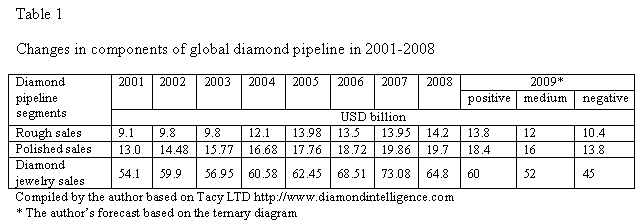
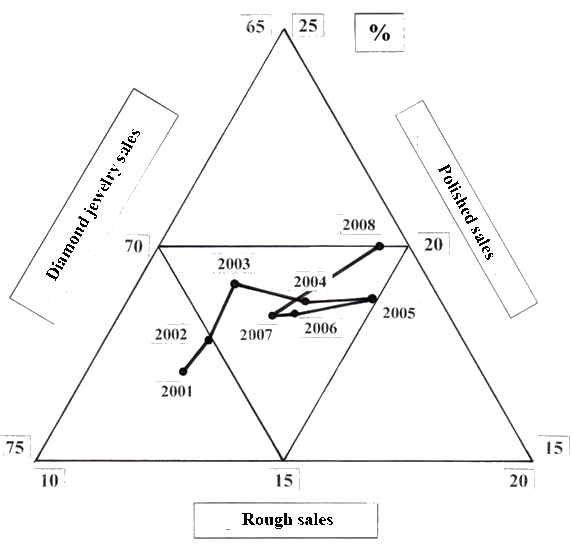
Fig. 1. Global diamond pipeline in 2001-2008
Thus, even taking the positive scenario the diamond business is supposed to recover from the current crisis only by the end of this year, while the negative scenario outlines any recovery of former performance indicators only in 2012. The medium version lies in between these two extreme points. The use of ternary diagrams for the purpose of economic research permits to determine the development vector of various systems with three and more indicators – especially when they are of non-linear character. Any further transformations in the global diamond business and in the Russian diamond industry will allow improving the research methods which appear to be know-how in economic practice.
Yuri Danilov, Senior Research Fellow, Department of Rough and Polished Diamonds Complex Economy, Institute for Regional Economics of the North (Federal State Scientific Entity)
