Competition is the most important economic category, being the driving power of economic development in a society. At the same time during last decades it is undergoing radical changes due to market globalization and new technological ways emerging in advanced countries within the frames of modern economy. In this sense, the works by the well-known American economist Michael Porter on competition and competitiveness appear to meet new requirements. To estimate competitiveness of businesses he has developed a model named "rhombus" [1].
Since he perceived competitiveness between enterprises and industries as their shares in the international trade of the United States, he appears to be mainly merited for introducing the term of “cluster” defining it as “a group of the geographically adjoining and interconnected companies and associated organizations operating in a certain field of business and characterized by common activities and complementing each other.” [1]. However, M. Porter has not defined quantitative characteristics of cluster-forming enterprises, and his model can be used only for quality evaluation of industries and involved enterprises. Table 1 illustrates how to use the given technique to analyze global and Russian diamond markets. Such analysis can be used for strategic planning, but it does not give more precise reference points and is insufficiently effective in crisis conditions.
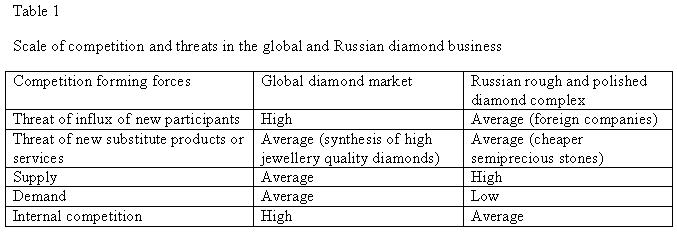
It is obvious, that competition should increase in crisis conditions as lower demand at a reached level of production in the industry results in decreased operating income which should be re-distributed between enterprises trying to keep up their reached levels of production. A sharp change in the situation leads to integration or differentiation of enterprises, which also triggers an increased degree of competition, to the level which existed before crisis.
As competition is the basic motive power of market economy, it is competitiveness of enterprises which governs their further development in crisis environment. However, using M. Porter’s method it is impossible to define unequivocally how the degree of competition in the diamond market changes and how lowered demand affects competitiveness of enterprises engaged in the diamond business.
Thus, development of quantitative methods in estimating competition is now a pressing problem which, if solved, will allow designing a strategy for a way out from the tangled situation and to raise competitiveness of enterprises in the diamond industry.
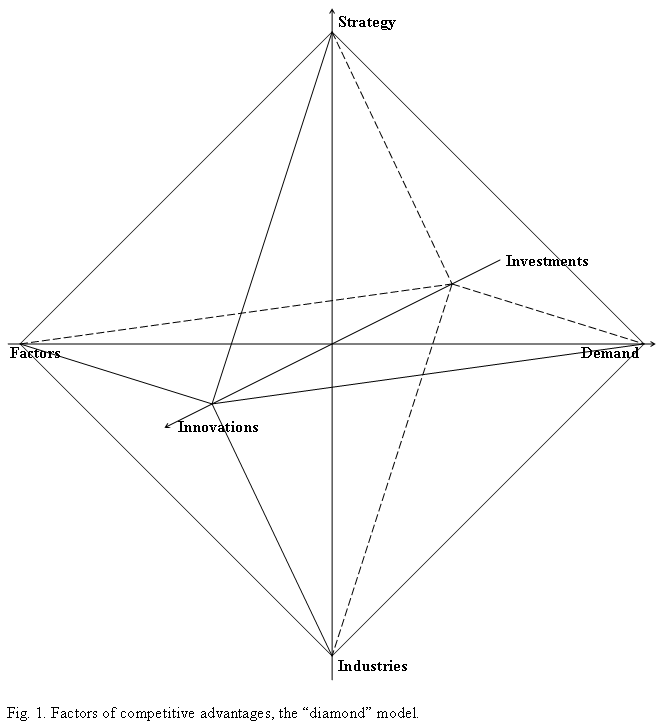
At the same time, the above-mentioned model of M. Porter can be improved adding an additional axis governing influence of investments and innovations on competitive advantages. It is obvious, that both these factors are equally fundamental competitive advantages influencing competitiveness of enterprises, industries and countries. In our opinion, their inclusion appears to be reasonable and makes the method fuller and accomplished. Thus, the “rhombus” actually turns into an “octahedron” or “diamond” (Fig. 1) as sometimes some researchers erroneously call M. Porter’s model in Russian translation.
Thus, the obtained “diamond” model and its application for diamond business analysis is probably a case of logic concurrence between the form of diamond crystal most often occurred in nature and a desirable ideal model for description of competition and competitiveness.
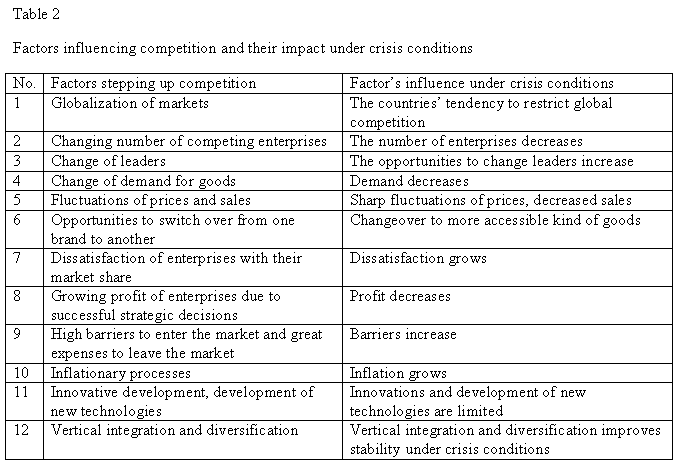
New methodological approaches and techniques are necessary to quantitatively estimate competition and competitiveness of enterprises in scientific research. Formalization of parameters permits to detail values and the degree of influence of various factors.
Let's consider the factors governing competition and competitiveness (Table 2).
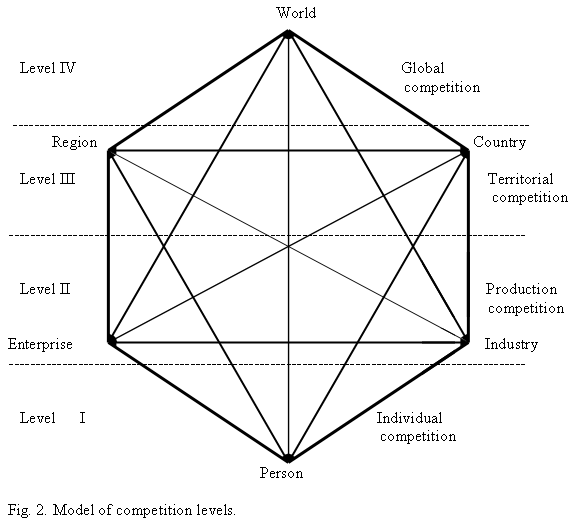
To analyze the economic activity of enterprises and other economic entities the author of this article some time ago offered a methodological approach which taken as a whole combined the advantages of quantitative and qualitative methods of analysis [2]. It was based on the model which showed interrelations between economic entities and their position with regard to competition levels (Fig. 2).
For a formalized analysis of competitiveness attributable to economic entities at various levels of competition it is necessary to choose parameters which can be estimated quantitatively.
With the purpose to give a quantitative estimation to the degree and force of competition going on in the market there is a technique which permits to define its concrete value. Each of the chosen factors describing competition in the market (see Tab. 3) is estimated by way of a 5-grade scale.
Since the above factors render different influence on competition in the market, to register the relative importance of different factors their separate influence is determined via multiplication by an appropriate factor. The obtained value of market competition degree is determined according to the following formula:
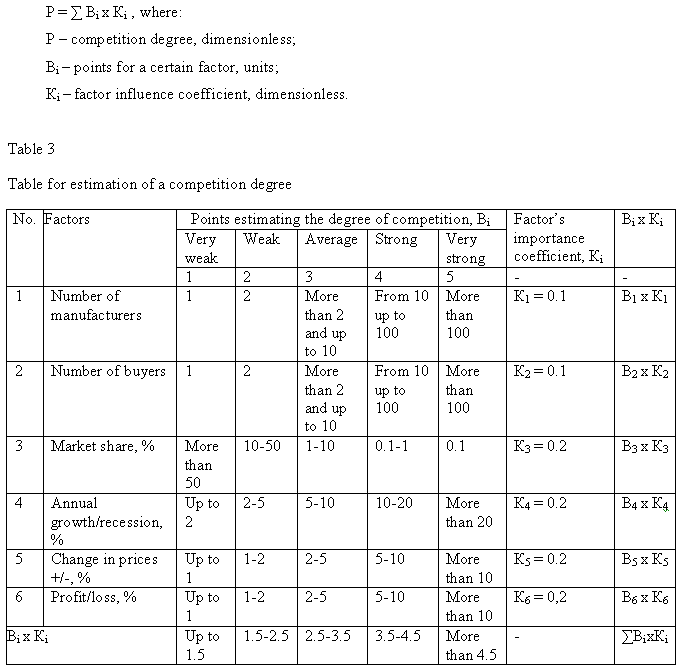
The use of this technique permitted to gauge the scale of global crisis impact on the world diamond business. The pre-crisis value of competition force – P norm. = 3.5, which is within the limits of an average degree of competition. Under crisis conditions it turned out to be – P crisis = 4.3, which corresponds to a high level of competition.
Thus, the quantitative method of estimation shows that the global crisis led to aggravation of competition in the world diamond business.
Yuri Danilov, Senior Research Fellow, Department of Rough and Polished Diamonds Complex Economy, Institute for Regional Economics of the North (Federal State Scientific Entity)
