The historical development of mankind proves that economic crises are a regular phenomenon caused by the development character of any society. Periods of economic revival are always followed by recession, and vice versa. Proponents of the economic theory devised by Marx and Lenin, who tried to deny this axiom using the class approach and politicizing economic laws, were compelled to recognize the obvious - that crises are inherent not only to the market (capitalistic, based on private property) economy, but also to the planned (socialist or state) economy.
Tab. 1 enumerates the largest economic crises, which have left a trace in the world history, and a 10-point scale is used to estimate them.
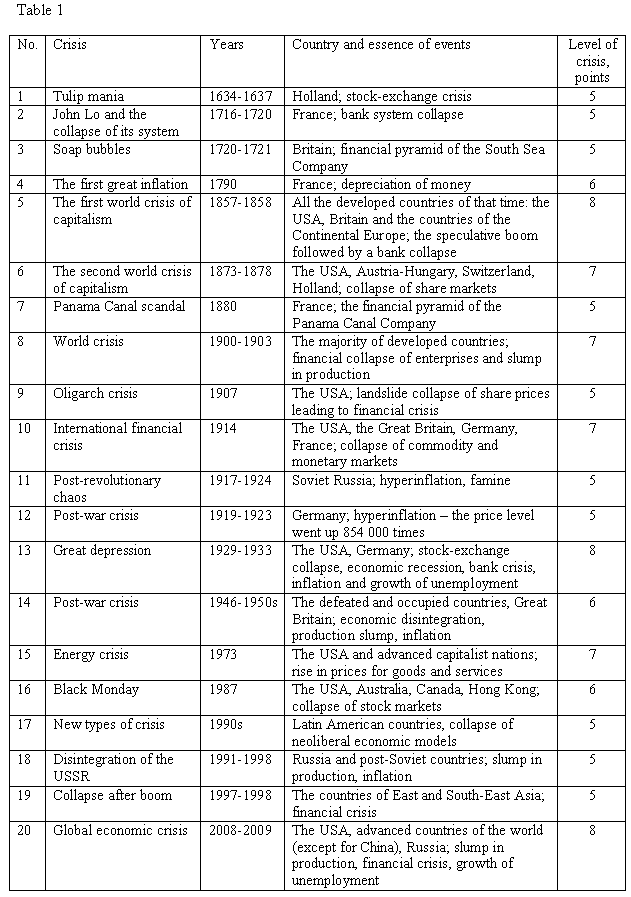
Such approach to economic crises permits to estimate their force, degree and scale of distribution - similarly to natural cataclysms bearing certain resemblance of economic processes. So far, the highest point - 8 - has been given only to three crises which took place in modern time. Other crises have been given from 5 points and above, which suggests that local crises if included will be measured by a lower scale; this also leaves some free space for possible deepening of the current global crisis. Fig. 1 contains a chronologic diagram of the largest economic crises.
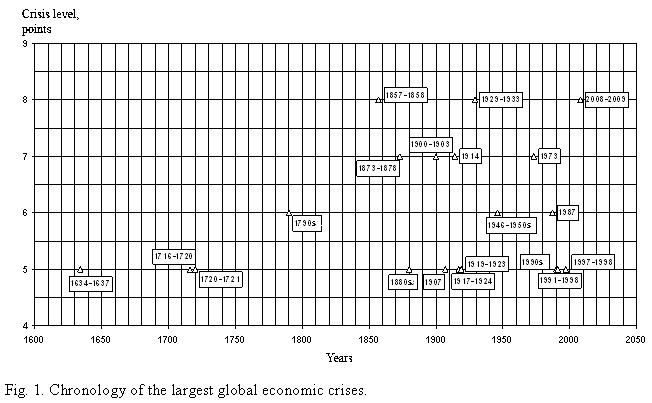
If we take the maximum levels reached by economic crises, the graphic analysis will reflect the existence of a certain repeating pattern with an interval of approximately 75 years, which is somewhat longer than the cycles (from 40 to 60 years) defined by Nikolay Kondratyev, a Russian economist. Though he can be merited for revealing the law of cyclic development in economy the duration of cycles was defined incorrectly since his research covered the historical period of 150 years (up to 1928) and to a great degree was politicized. It is noteworthy that business cycles are not strictly cyclic from the physical and mathematical point of view, since the duration of a period from one peak to another varies considerably.
In the 20th century, the number of crises has sharply increased, and their scope has considerably surpassed all those previous. It is because this century survived two world wars which thoroughly shook the world community. The beginning of the third millennium was marked by a global economic crisis which by its scale – the range of countries, markets and branches of economy affected and also by its speed of development - has surpassed all the previous crises in the world history. In spite of the fact that many nations already argue the world economy is bottoming out, it is necessary to wait some more time to draw final conclusions, especially since there are fears of a coming second wave of crisis.
Yuri Danilov, Senior Research Fellow, Department of Rough and Polished Diamonds Complex Economy, Institute for Regional Economics of the North (Federal State Scientific Entity)
