The global economic crisis produced its greatest impact on those industries and fields of business which do not play a vital role in people’s activities. This is why the diamond business being part of the luxury industry was most affected by the economic downturn. At the time of highest aggravation of crisis phenomena rough and polished diamonds and diamond jewelry slumped in their output and sales as much as ten times which may be viewed as critical for survival of any kind of business. At the same time, recently many market players and analysts give notice of a recovery in the diamond market. Total diamond output figures for 2009 by the world’s major diamond-mining companies and their prospective production for 2010 as compared with 2008 are given in Table 1.
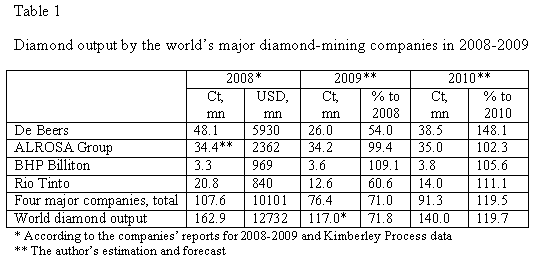
Totally, the four leading producers recovered more than 76 million carats of rough diamonds in 2009 which makes slightly more than 70 percent of their output in 2008. De Beers suffered the greatest slump in diamond output in 2009 which was almost halved. Nevertheless, De Beers managed to keep its leading positions in terms of rough value due to the company’s predominance on the international diamond market during the crisis. Rio Tinto’s diamond output will decrease almost 40% in 2009. And only BHP Billiton, despite the crisis in the global diamond industry, scaled up its rough output boosted by commissioning of an underground mine in Canada. In 2009, backed by the state the ALROSA Group despite a small decrease in output confidently came out on top among the largest diamond-mining companies of the world by physical volumes of recovered diamonds. Maintaining former levels of diamond sales due to rough deliveries to the State Repository, Russia and its leading diamond-mining company ALROSA turned to set pace in global diamond output. 2010 should see further diamond market recovery, but the level of global diamond output reached in 2008 will not be surpassed.
It is expected that the world diamond-mining industry will shrink by about 30 percent, even taking into account renewed operations by all major diamond-mining companies in the fourth quarter of 2009. However, whether or not the global diamond business will manage to bottom out of the crisis depends on other parts of the diamond pipeline and first of all on diamond jewelry sales. Although retailers pinned their greatest hopes to Christmas sales, real restoration of demand will occur only if the world’s economy will start growing which apparently may take from one to two years.
Participants of the diamond market suggest that increased rough supply in the first quarter of 2010 (to approximately $3 billion) may facilitate better conditions for diamond cutters which are now in a tight situation. However, if rough shortfall will persist this part of the diamond pipeline will stay crisis-squeezed. So it is possible to agree with the opinion that many things will get clearer after Christmas sales.
Below there is a brief description of how the world’s major diamond-mining companies performed in 2009 as well as outlooks pertaining to their further operation.
ALROSA Group
In the first half of 2009, ALROSA virtually did not sell any diamonds on the free market and renewed sales from the third quarter of the last year. The second semester turned to be the most successful for the ALROSA Group. The timely rendered state support served to bolster the company’s financial stance. During last September only the company managed to sell $651.5 million worth of diamonds. The major part of rough diamonds was delivered to Gokhran of the Russian Federation. During the first 9 months of 2009, the ALROSA Group’s sales including the rough sold to Russia’s Gokhran reached $1.34 billion.
In the third quarter of 2009, ALROSA clipped its total credit burden by $288 million. In the end of September and beginning of October ALROSA completed the deal of selling its non-core assets which were its stakes in ZAO Geotransgaz and OOO Urengoyskaya Gazovaya Compania for the amount of $620 million. The sale was a part of the program to reduce ALROSA’s credit portfolio which thinned down by 30 billion roubles during the last quarter of 2009.
Besides, in the end of last August the company commissioned its underground mine on the Mir Diamond Pipe which gives additional contribution to its total diamond output.
According to the company, the ALROSA Group’s diamond output in 2009 reached $2244.1 million in money terms. The company’s sales of its basic production amounted to $2187.2 million of which rough sales were $2127.2 million and polished sales were $60 million. In 2009, Russia’s Gokhran bought $923.4 million worth of rough from the company, while the rest was sold on the free market.
In 2010, the ALROSA Group plans to produce $2314.4 million worth of diamonds, of which $872.1 worth of rough is earmarked for shipments to Gokhran, while the remaining part is to be sold on the free market. The company’s sales of its basic production are supposed to reach $3302.3 million of which polished sales are estimated at $124.9 million. At least 70% of the company’s total output will be sold to major diamond market players under long-term contracts. In 2010, ALROSA will re-finance its short-term debt changing the balance to long-term rouble and foreign exchange bonds that will allow the company to reduce it to $3284.5 million by January 1, 2011.
The company’s last December Board meeting decided to submit the issue of transforming ALROSA into an open joint-stock entity for discussion at the Supervisory Board session suggesting that this would permit to raise the company’s investment appeal lowering the total amount of debts and improving its management efficiency.
Summing-up:
1. Despite the company’s recent achievements its system of financial management will have to be considerably improved since its credit debts look too great even after they were slashed, and this is a dingy challenge to its investment appeal in view of its possible transformation into a public company.
2. With aggravated competition between the ALROSA Group and other major diamond miners looming ahead due to the crisis-triggered changes in diamond business environment the company will need to make significant efforts pushing its sales on the international market as the state support in 2010-2011 will be much lower than it was in 2009.
De Beers
Fig. 1 shows De Beers’ quarterly diamond output from Q4 2007 to 2009.
In the third and fourth quarters of 2009 De Beers considerably increased its diamond output. Thus, the company’s third quarter output went up 43% compared with the previous quarter (Fig. 1).
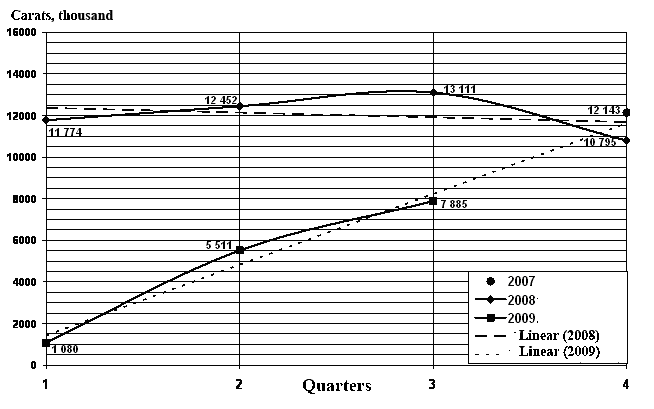
Fig. 1. De Beers’ quarterly diamond output from Q4 2007 to Q3 2009.
2008 – according to the reports issued by Anglo American and De Beers in 2008-2009.
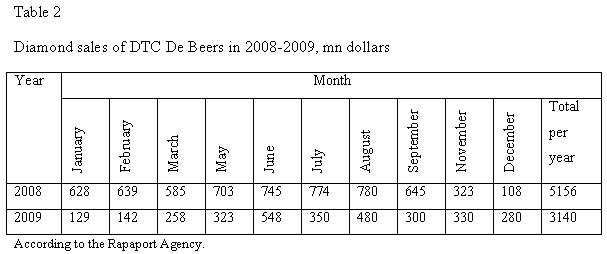
There is an upward trend from the beginning of the year and if it will proceed this way the company’s diamond output in the fourth quarter will possibly make 11.6 million carats, and this will allow De Beers to recover nearby 25 million carats of diamonds in 2009. De Beers’ diamond sales in 2009 reached $3140 million (Tab. 2).
Summing-up:
1. Despite the almost double slump in diamond output by the company’s enterprises and yielding leadership to ALROSA in terms of physical diamond output, De Beers will manage to preserve its global hegemony in diamond sales due to monopolization of the international rough diamond market.
2. The absolutely fine-tuned strategy pursued by De Beers during the crisis was the major reason facilitating diamond market stability, and now it is expected to bring about gradual recovery of demand and prices for rough diamonds.
BHP Billiton and Rio Tinto
During the first 9 months of 2009 BHP Billiton even managed to achieve a slight increase in its diamond output compared with one year ago due to their Koala Mine in Canada reaching its full operational capacity. So far, crumpled demand for rough does not in any way affect BHP Billiton diamond mining operations. At the same time, it is necessary to point to the company’s quarterly decrease in diamond output in 2009. In the third quarter last year the company recovered 780 000 carats of rough on its Ekati Mine (where the company has an 80-percent stake in the total output of 975 000 carats generated by the deposit), which was 13.6% below the previous quarter. However, with these output levels maintained BHP Billiton will produce a total of 3.6 million carats of diamonds in 2009.
In the third quarter of 2009, the Rio Tinto Group’s diamond output reached 2 787 000 carats making the nine-month total score 9 575 000 carats. The diamond-mining branch of the company faced the deepest slump in diamond output due to specific qualities of recovered rough (prevailed by small-size Australian diamonds), which turned out to be the least demanded in the most acute period of crisis. Besides, the slump was caused by lower diamond content and deeper open pits as well as by switching over to underground mining on the Argyle and Diavik deposits in Canada.
At the same time Rio Tinto announced it had launched a sample processing plant at its Bunder Project in India which is said to have a diamond reserve of more than 25 million carats. The total amount of investments at Bunder will exceed $464 million. Besides, in October 2009, on the background of demand recovery the company raised its prices for stones mined at Diavik in Canada by 15%. As a whole Rio Tinto’s diamond output in 2009 will be reduced to 12.6 million carats due to the global crisis.
Summing-up:
1. The diversified operations of BHP Billiton and Rio Tinto will allow them to leave the crisis situation behind rather easily which appears to be true taking into account that these companies continue to invest into developing new diamond deposits as well as into other kinds of raw materials.
2. On the whole, the holding structure of BHP Billiton and Rio Tinto (Anglo American – De Beers) during the world economic crisis has justified itself, and this may be an example for many mining companies in Russia which are engaged in single-type operations, the way it is done by the ALROSA Group.
Yuri Danilov, Senior Research Fellow, Department of Rough and Polished Diamonds Complex Economy, Institute for Regional Economics of the North (Federal State Scientific Entity)
