Today the Republic of South Africa will kick off the 2010 FIFA World Cup. It is the first time the event is fielded on the African Continent rich not only in sports talents, but also in mineral resources, including diamonds. Therefore it makes sense to consider the prospects of the global diamond business through a prism of the forthcoming superb show. By FIFA’s estimates, the World Cup may generate a net profit totaling billions of dollars. The Football Association is expected to gain about $3.3 billion in commercial profit selling the broadcasting rights and receiving contributions from sponsors. Of this sum, $1.2 billion is spent to organize the tournament in South Africa, $1 billion is allocated as financial assistance to national associations taking part in preparing the world championship.
Benefit performance of beneficiation?
Structural transformations during the last decades in the world diamond business triggered the emergence of own diamond-cutting operations in major diamond-mining countries. Although many experts and analysts are ambiguously assessing this process which has received the name of “beneficiation”, it turned into one of the trends in developing diamond industries of Russia, some African nations (Botswana, South Africa, Namibia, Angola) and Canada. Of the basic components making up the world diamond pipe it was diamond cutting which turned unstable and crisis-stricken under slumped demand for rough and polished diamonds, which casts doubts on further development of beneficiation. However, the World Cup in South Africa, one of the participants in the beneficiation process, may give it a good football kick if based on a correctly outlined marketing policy and innovations. If football souvenirs and attributes are properly connected to diamond goods it is obvious that football fans and numerous tourists will sharply push up demand for diamond jewelry made in this country as well as its sales.
Football cut
In our opinion, beneficiation proponents would win a considerable success using innovative approaches and methods in manufacturing and selling diamond jewelry. One of them might involve nonconventional cuts as for instance football-shaped diamonds which may prove to be a sensation if combined with modern scientific and technological achievements. Employing electroluminescent properties of diamonds, nano-diamond coatings and synthetic diamonds with tailor-made properties may also contribute to success.
Post-crisis world
The world economic crisis produced uneven impacts in different countries, regions and industries. Today, when the crisis seems to be surpassed, it is necessary to consider its consequences and prospects of post-crisis development. The U.S. economy which was the first to bear the crisis brunt was also the first to overcome it. Thus, the FRS management this year expects a 3.2-3.7-percent growth. The U.S. unemployment rate is to be down to 9.1%-9.5% by the end of the year, from 9.9%. The level of consumer inflation will predictably increase only by 0.9% to 1.2% this year. The new forecast for economic development was prepared at the April meeting of the FRS. The forecast for 2011 suggests moderate rates of economic growth.
Leaving the recession behind the economies of the United States, major European countries and Japan are expected to be instrumental to a higher demand for goods offered by diamond business. Besides, if we take into account the ever growing Chinese market which may become the world’s largest diamond market in the nearest years, then prospects for diamond business seem positive. This is also proved by higher sales of the world diamond-mining companies in 1Q 2010 (Table 1).
Table 1
Major diamond miners’ output and sales in 1Q 2010
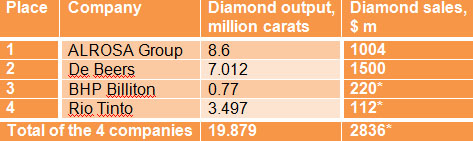
The table is based on the companies’ press releases and reports.
*Author’s estimate.
Any further growth of world diamond output in many respects depends on this summer’s sales, that is sales made in the period of the World Cup, and indirectly on its financial and sports results.
The second wave of crisis?
However, the latest slump in global stock market indicators give rise to doubts. A particular concern is caused by a sharp drop in the Shanghai Stock Exchange Composite Index which deflated almost by 20% from mid-April. According to the author’s forecast, the second wave of crisis may be provoked preeminently by problems in the Chinese economy. And recently there is a growing number of conducive factors, including the crisis in some European economies, the Iceland volcano and the PB’s oil rig disaster. And though all this to some extent even brings grist to the Russian economic mill pushing up the dollar rate and maintaining oil prices at a high level, the global diamond business as well as the countries taking part in the beneficiation program have to go a long way to see its benefit performance – as however it goes true for football as well.
Yuri Danilov, Senior Research Fellow, Department of Rough and Polished Diamonds Complex Economy, Institute for Regional Economics of the North (Federal State Scientific Entity)
