As a result of the global economic crisis which brought about a sharp contraction of demand in 2009, De Beers, the all-time leader in diamond business, conceded its place to Russia’s ALROSA which was able to outstrip its competitor by major performance indicators due to the support rendered by the Russian state. Thus, the balance in this market segment which seemed unshakable before the crisis was broke leading to aggravated competition in the global diamond mining. The groups of companies, De Beers and ALROSA, which have in many ways identical structures and are the largest diamond-mining enterprises in the world, have posted their preliminary results in the first half of 2010. Table 1 compares their basic indicators.
Table 1
Diamond mining output and sales of De Beers and ALROSA in 2008-2010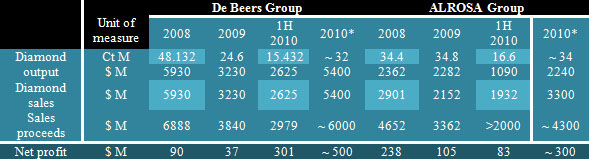
The table is compiled by the author and based on the annual and quarterly reports of De Beers Group and ALROSA for 2008-2010.
* Author’s forecast.
The 1H 2010 results prove that increased demand and upward prices for diamonds were instrumental to De Beers’ higher output, while ALROSA Group posted higher sales. At the same time the pre-crisis status quo is hardly to be restored completely, so the Russian company this year may preserve its superiority in physical diamond output. De Beers Group intends to establish an output limit of 40 million carats. Due to its blanket transition to less productive underground operations on its largest diamond fields ALROSA Group will possibly also limit its output to 30-32 million carats which will be 80% of De Beers’ output, whereas ALROSA’s diamond sales will reach 2/3 of those reached by De Beers (before the crisis ALROSA’s sales were approximately 50% of what was sold by De Beers).
Comparing the activities of De Beers and ALROSA during the recent years, the following conclusions may be made.
In the first place, it is necessary to point out certain similarity in the strategies and tactical decisions pursued by both companies as they overcome the consequences of the world economic crisis, as well as when they try to re-structure their debts and move to IPO. However, despite this similarity, there is a considerable difference in the organizational level of their diamond business, marketing policy and production technology which allows De Beers to have advantage in the competition going on in the global diamond market.
Secondly, the crisis has changed the parity between the two leading transnational diamond-mining groups in favor of the Russian company. Still the latter will have yet to take pains to preserve its position in the conditions of aggravated competition and possible crisis phenomena in the future. To keep its current position and move forward ALROSA Group should not only rely on state support, but also pursue its own competitive strategy based on its own experience and a complex analysis of the situation in the world diamond market taking into account the development of the world economy.
Yuri Danilov, Senior Research Fellow, Department of Rough and Polished Diamonds Complex Economy, Institute for Regional Economics of the North (Federal State Scientific Entity)
